

TUCSON, Ariz.–Co-op Solutions THINK 23 event here was themed “The Invisible Revolution.” But what does that mean?
According to Jean Chatzky, the financial journalist who annually emcees the meeting, it “essentially refers to the dramatic digital transformation of how consumers and investors move money on a daily basis. It’s automatic deposits. It’s automatic payments. It’s subscriptions. People get the benefits of embedded financial applications when they buy online or in a store. It’s invisible finance.”
What really matters in all of that, according to Chatzky, is that money movement is taking place “invisibly.”
“Daily transactions are increasingly out of sight, and that’s good and bad,” according to Chatzky.
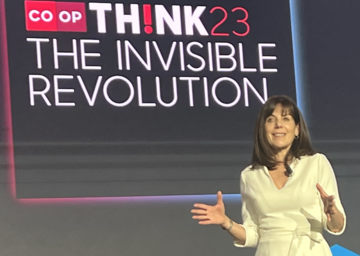
Jean Chatzky speaking to THINK.
What’s Going On?
But why is it happening and what makes it revolutionary? Chatzky said the answer is “consumer demand.”
“We know the pandemic accelerated digital transformation of payments,” said Chatzky. “Estimates are that today about 90% of Americans use some form of digital payments and they are engaging with rapidly evolving solutions in an increasing variety of ways.”
And that includes buy now, pay later solutions, added Chatzky.
She cited data from PayPal, which said its BNPL program during 2022 saw approximately $20 billion in payments volume, a 160% year-over-year increase.
“Those numbers represent a whole lot of digital interactions,” said Chatzky. “Seventy-five percent of digital payments worldwide will be through nonbanks by 2030. You say you want a revolution? Maybe you don’t.”
A Big Hill of Beans
Chatzky noted the $1 billion in value stored (and largely unused) on Starbucks cards represents an amount larger than the assets of 75% of individual banks and credit unions in the country.
“It’s an unregulated neo-bank with deposits redeemable for coffee rather than cash,” she observed.
In this new world, Chatzky said it’s increasingly important that credit union leaders have a member point of view rather than their own point of view and to see the opportunity available to them.
“As a journalist I much prefer transparency over invisibility. I want to know where I stand. As a financial coach I encourage people to start with the things they control, their finances.
People need help. And this is why they need your credit unions. There is a growth opportunity more open to you now than there has been in years if you help people to manage these micro-moments.”