

TUCSON, Ariz.–An ambitious initiative around health care launched by Amazon and then abandoned offers some lessons for credit unions, according to one person who helped lead the effort.
Speaking to Co-op Solutions’ THINK 23 event here, Jennifer Becker, a long-time health care executive who joined Amazon in 2020 to lead its Amazon Care offering during its brief life, shared her experiences with credit union leaders. Despite a huge investment, the company pulled the plug on the program in August of 2022.
Becker themed her remarks, “The Power of Care: Building a Customer-First Ecosystem.”
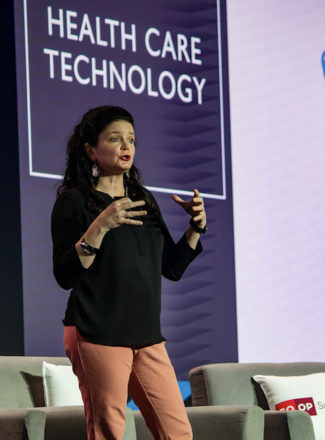
Jennifer Becker speaking to THINK conference in Tucson.
“I’m going to tell you a story about birth. I had the opportunity to be one of the mothers of a new product that was all about ecosystem integration. The thing that kept coming up was to make the seemingly impossible possible.”
The Lessons Learned
While in the end, the impossible won out, Becker said there were numerous lessons learned along the way.
Founded as part of an internal incubator, the idea was to create a customer-centric health care experience that would bring together some of the siloed health care legacy systems and new technologies, said Becker, who added Amazon deliberately called patients “customers” in order to drive that perspective.
Much like credit unions and the competition they face—Becker said she must have at least 10 finance-related apps on her phone, although she is a member of BCU—she noted health care is no different.
The program was initially tested internally with Amazon employees only in the state of Washington and focused on an in-home care model, “because there were just certain things that we couldn't do yet virtually.”
Great Initial Feedback
Amazon Care focused very specific points of care that required hands-on, with Becker saying it initially “went really well. We had best in class customer service and hours and great feedback.”
Amazon’s former CEO and co-founder, Jeff Bezos, signed off on full funding to expand to all 50 states, with Becker hired to build out the infrastructure of what would ideally be a new national healthcare system.
Initially, said Becker, there was a “very tech mindset” at the time at the company that did not have a lot of experience in running a healthcare system. That tech focus included the development of “magic gloves” that were enabled with technology and sent to patients.
“My experience as a customer of healthcare for most of my life, and I’m sure it’s yours, is I would get in the car, I would drive to a clinic or a diagnostic center, I would check in and then I would wait in the waiting room until I was called. It was the old adage of ‘The doctor is ready to see you now.’ That's the phrase that really encapsulated what it felt like for me to be a customer in legacy healthcare systems. 2020 hits and tele-health becomes an add-on in legacy healthcare. There was a lot of presumption that we couldn't use virtual care to deliver what most clinicians were used to practicing; there was this hands-on mentality.”
The ‘Magic Gloves’
That’s where the “magic gloves” came in, which were envisioned as a way to interact with patients using virtual reality.
“It was an interesting idea. It was creative. But it was totally clinically irrelevant,” said Becker. “In this model, from the perspective of health tech, this was cool technology. But what was learned was it wasn’t technology that was important. Instead, it was changing workflows and the approach and becoming coaches to show the patient how to position their hand, for example. We found it was very, very effective and replaced the need for physical exams.”
Becker said what Amazon needed from its tech partners was help to change the clinical workflows.
“It was very different than what we were thinking. In this example, the customer is now at the center of the model. This doesn’t mean we didn’t use new technology, such as smartwatches.”
Relationships & Trust
Having been through the process, Becker said she sees parallels between health care and credit unions, health care and finance.
“When I talked to my friends who are credit union (leaders), we talked about a number of things. A few stood out. The role of relationship and trust between primary (physician) and the customer, between credit union and member, are very similar,” said Becker. “They approach each of us at critical moments in their lives. If we don’t preserve trust, our members don’t engage us and then their health outcomes are at risk. We share life events. Births and deaths, expense increases, rising insurance premiums. And we share an immense challenge to integrate legacy systems with rapidly developing technology.”
Working Backwards From the Customer
What it is that healthcare customers have been saying they need is similar to what credit unions have been doing with members, according to Becker.
“Amazon does this really well. They call it working backwards from the customer. If you ask a clinician, ‘What do you think is most important to your patients?,’ what do you think they say? They often say ‘quality,’ that we’re giving good care. But guess what? That is not what customers say. It’s not that quality isn’t important, but customers say they presume quality, those are table stakes. Customers told us healthcare is too difficult to use and access. Overall, they want convenience and ease.”
What People Want
What did consumers/health customers say they want?
According to Becker:
- The first thing they said they want is a convenient location, everything from being seen while at home to Starbucks to parks to private locations. “They only wanted to go into a facility if it was really needed,” Becker said. “It was starting to change from ‘The doctor will see you now to the patient will see you now.
- They want connected care. They wanted information. They wanted connections with new apps.
Broken Healthcare
“Who here has not experienced a difficult healthcare journey?” Becker asked her audience. No hands were raised.
“What I experienced was most of our focus was not about ecosystem, it was about making access for patients of specialty care better. Then we moved to a specific kind of customer,” said Becker. “But the orthopedic customer may also have diabetes or depression. Simply looking at one customer strand and not considering the whole ecosystem was not working for our customers.”
Healthcare Inequity
Health care inequity is the other big challenge in health care.
“We heard consistently from customers and saw in the data we are not solving for healthcare inequity,” said Becker. “Did you know that in the U.S. a Black baby is two times more likely to die than a white baby? This is very complex and many things contribute, but one of the contributions is access.”
Creating an Ecosystem
Amazon Care’s intention was to create the first virtual health care ecosystem that would integrate legacy health care and health care. But in the end, said Becker, the complexities involved in attempting to resolve a myriad number of issues led one of the biggest and most innovative companies in the country to give up the effort. In a statement, Amazon said Amazon Care wasn't a sustainable, long-term solution for its enterprise customers.