

TUCSON, Ariz.–It isn’t just the payments space that has evolved over the past half-decade, Co-op Solutions has also undergone a number of significant changes, and one executive with the company shared some additional details around what is going on with credit unions gathered here.
During a Q&A at Co-op’s THINK 23 event here, Kasey Stinson, VP-sales enablement and product marketing with Co-op, discussed with Dean Michaels, chief strategy officer with the company, issues ranging from becoming a platform-based business, internal changes aimed at helping credit unions, and more.
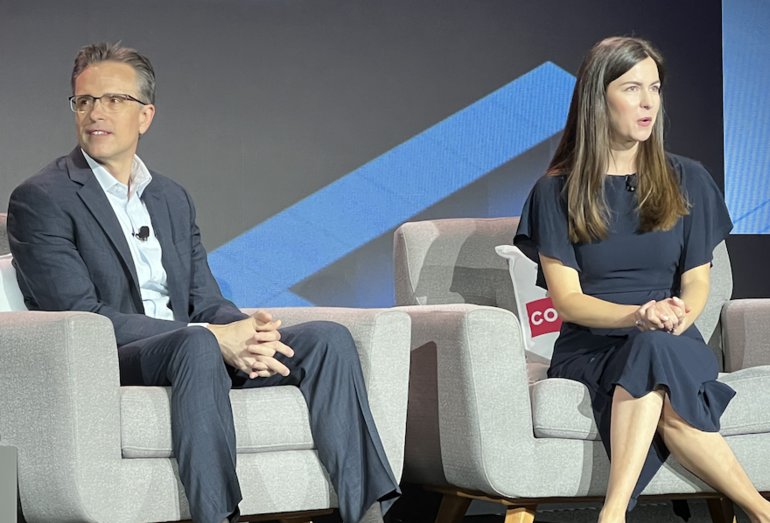
Dean Michaels with Kasey Stinson at THINK conference.
Here is some of what was discussed:
Question: Why did Co-op make a decision to be a platform business instead of a reseller?
Michaels: It was a big decision for us. You have to be able to evolve in order to survive. For us, the need to evolve was really even more evident because it wasn’t just about us as a company, it was necessary for credit unions.
At that time, we saw a way to do it differently and fill a need, and that was to be a platform provider of solutions to credit unions and to do that in an open and agnostic manner. And by that I mean we want to provide solutions without a preference. We want you, the credit unions, to pick the digital providers you want to partner with, and we will partner with them.
At that time what we didn’t see, and we still don’t today, was another company that is really focused on building out their own digital platform and doing it in a member-centric way and doing it in an agnostic way.
Stinson: How have our clients benefitted?
Michaels: It’s human nature to get caught up in the day-to-day: what's on the road map at this moment or what's on the road map next quarter? Of course, that's really important But I also want to give everybody an idea of the strategy: where were we, where are we, and where are we going?
There are three stages of the strategy to create the foundation solutions. The first stage of the strategy is probably the one that clients have the least amount of exposure to, and that was what we were doing to be able to make a difference for (credit unions). This was our investments in our organization. This is where we invested in our people, our processes, our technology, to get us to a place where we could manage our own data, where we could develop our own solutions…We’ve delivered a lot, like our Cooper fraud solution, and our call center focused on helping credit unions either improve back office operations or improve the member experience.
The second stage is the platform solution. This includes things like insights for reporting and it includes the Springboard member servicing user interface. (We’ve) developed a report where clients and partners can go to get the tools they need to be able to integrate. This is really our platform and we cannot lose sight of the magnitude and the scope of the change associated with redesigning and redeploying the platform
The third stage is expand and enhance. This is where we are able to more easily add functionality.
Stinson: Strategy and services at Co-op have come together. How does that enable success?
Michaels: We made some changes organizationally to seize strategic opportunity. That was the ‘what.’ But there is also the ‘how’: how do we work with credit unions to really help them use data to develop strategy?
Our consulting team sits down with the credit union and strategizes. We’ve never lost a company and the reason is that you consistently see (resources a credit union) can use for growth. From a portfolio growth perspective, (SmartGrowth CUs) outperform credit unions. This is an area where we can do a lot more, we can use data to help credit unions drive number experience. We think that's really a significant opportunity, so we wanted to organize in a way to really take advantage of SmartGrowth from a services perspective and also hit on the contact center. We really focus on all things digital in terms of that that member experience from a digital banking perspective.
But at the end of the day members still need help, they still need a live agent to help navigate those digital tools. The contact center sees five-million contacts every year, so these are five-million opportunities to impact the member experience, five million opportunities to really change how a member thinks about their credit union. It’s a solution where we've had an enormous amount of success impacting member experience. But we also really think it’s an area where we can improve. It’s an opportunity.
Stinson: We have highlighted the Strategic Provider program, which supplies pre-vetted companies. This means Co-op has done all the legwork and sourced the partners. How is this program received?
Michaels. We’re off to a great start. We’ve been in market a few months and only have three provider partners today: Origence, SavvyMoney and NYDIG. We plan to grow that out to about a dozen over the next year. The response has been incredible and we have had more than 500 credit union users access our website at coop.org to see our diligence on these providers. We score each one and we are hard graders across major themes, such as feature functionality and risk and compliance, and are they stable. We do a lot of the homework for the credit union to give them a head start. You also get a (financial) benefit when you go through Co-op. This is going to go as far as credit unions want it to go.
Stinson: Can you tell us about how the new Co-op Pay Network works and what it is?
Michaels: It’s a debit network Co-op manages and modifies specifically for credit unions. Debit networks are owned by large public companies and their clients are major banks, whose interests they have at the forefront. The shareholders here are credit unions. The clients are credit unions. So, we have credit union interests at the forefront. You can see merchant-level interchange data.
I think a really big benefit is the ability for us to insulate credit unions when it comes to new fees. Credit unions think they have a fixed price through the network, but the network can get really creative and come up with new fees. Credit unions and Co-op often don’t see value in these fees. And you don’t have to use a different processor with Co-op Pay.
The last thing I would hit on and it’s interesting, is that over the course of last five to 10 years, banks, particularly big banks, have negotiated with networks to not include their logos on a card. They want their brand front and center. With Co-op Pay, branding from a logo perspective is not required and not even recommended. There is still a Visa or Mastercard logo on the card, but we don’t think we need to clutter the card; your brand should be front and center.