PLANO, Texas–It’s “not a fine time” to be running a financial institution, given the economy and where rates are, but there remain ways to make money, according to one analyst.
Speaking to Catalyst Corporate’s Payments Forum, Aaron Martini, director of ALM Services with Catalyst Strategic Solutions, reviewed a number of trends related to credit union portfolios, including identifying the CU he said is the best performing.
Martini noted significant deleveraging is taking place. For example, first mortgage volume is up across the board at credit unions, but refinancings have also been “pretty huge” at $846 billion. Moreover, the average credit score on loans made by CUs has risen “significantly.”
“What does that tell you? It’s mostly super-prime borrowers who are refinancing their homes,” he said.
Meanwhile, home equity lines of credit have been down.
“What some might not realize is that Q2 was the 14th quarter in a row where HELOC value has been down,” said Martini. “The real story that I think everyone understands is credit cards. Card activity off by $76 billion. When we take all of the pieces that are non-housing, (loans are) down $86 billion. That is also a record since the New York Fed has kept these statistics.”
Martini said he has heard from many in credit unions who have remarked that the current environment is giving those who were around for the Great Recession a feeling of de ja vu.
“We’re cutting dividends but the funds keep coming in. That something to think about, especially if we get a continuation of stimulus,” he said.
The Great Divide
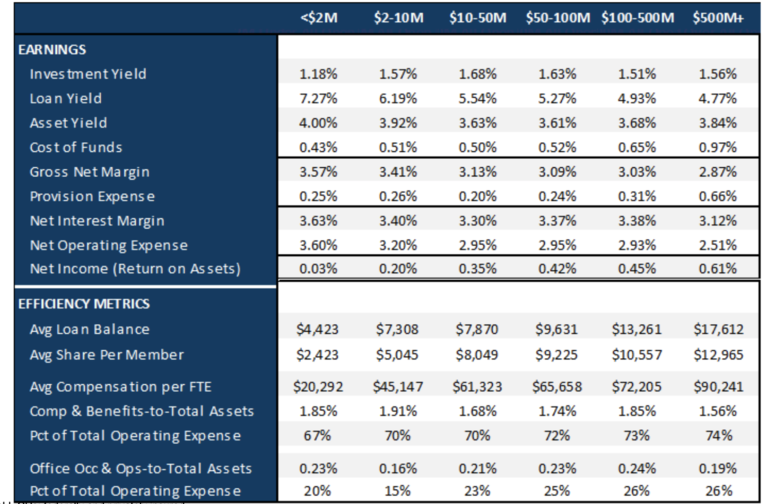
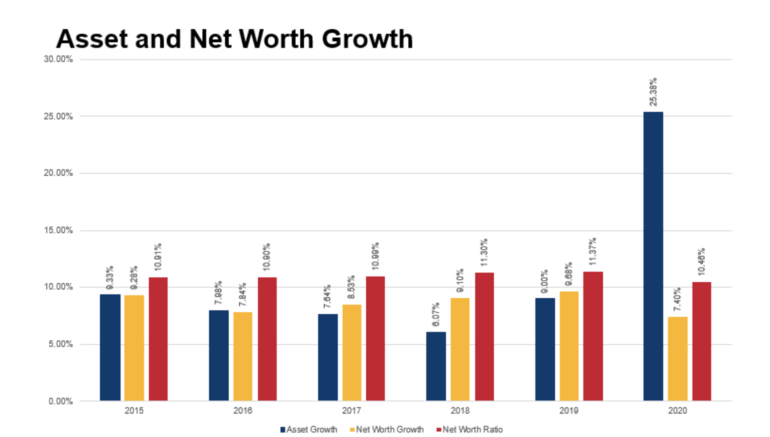
Like other analysts, Martini pointed out there are considerable performance differences to be found between large and small credit unions. Asset growth, for instance, has been 9.78% at CUs of $2 million or less, 21% at credit unions between $50-$100 million in assets, and 26.14% at credit unions larger than $500 million. But positive loan growth is not seen in any asset category below the $100-million in assets category.
“The larger you are the greater the proportion of loans on the balance sheet,” he said. “What is also interesting is what those loans are comprised of. At smaller CUs it’s mostly autos, a figure that shrinks as assets grow, to be replaced by real estate loans. Small credit unions do have a lot of cash and that is a little concerning. It is very hard to make yield in cash today.”
Martini said the loan provision trendline has been flat, with the exception of larger credit unions, which have provisioned more.
“It’s probably going to get worse before it gets better. Everyone loves that saying, but unfortunately, it’s probably true. Everyone needs to be provisioning,” he said.
Martini pointed to FFIEC data indicating there was a 34% decline in net income at credit unions during Q2 2020 compared with same figure one year earlier. At banks, the decline jumps to 70%, he said.
“Why,” he asked. “Provisioning. Banks set aside $62 billion in Q2.”
Getting Focused
Martini told the virtual Forum the pandemic and economic slowdown have forced credit unions to “really refocus, to think about their vision, to jump into action and to ask how to serve members.”
Seeking to identify those CUs that have done the best job of consistently jumping into action, Martini said he looked at various metrics and would have loved to have settled on ROA as a guidepost, but it can’t be used, especially during the COVID crisis.
Instead, he said the “real measure of consistent performance” is pre-provision net revenue.
Using that metric, Martini said the top-performing CU in the U.S. is CommunityWide FCU in South Bend Indiana, with its 82.8% loan-to-assets ratio. Eighty-five percent of its loan portfolio is auto.
Martini said there are numerous ways for a credit union to make money, including in investments, and he cited an observation once made by his brother, who said, “You can make money at anything if you like it and you’re good at it.”
The chart below shows how portfolios perform on average according to asset group.