

FRISCO, Texas–The Treasury Curve is a leading indicator and a great tool for fixed-income investing, according to one expert. And this is a good time to be rethinking the investment portfolio, the same expert added.

Mark Wert
The Treasury Curve is a graphical representation of Treasury yields for all maturities that allows investors to visualize the relationship between short-term, intermediate and long-term treasury yields, explained Mark Wert, senior advisor with Catalyst Strategic Solutions during Catalyst’s Economic Forum here. Much of the recent attention to the curve has been to the fact it’s become inverted, and whether it’s an indicator of a recession.
Wert noted the two biggest factors affecting the curve are inflation and growth.
“The Fed controls the front end of the curve, but investors control the long end of the curve,” explained Wert.
With the Treasury curve, it’s forward-looking, as opposed to so many other metrics, which are backward-looking, he stated. As such, it’s a good guide for credit unions, especially at a time they when they need to be giving new thought to investment portfolios.
Understanding the Economic Cycle
It’s most likely the economy is still in the expansion phase, according to Wert, where there is low inflation, the Fed reduces accommodation, there is a strong stock market, credit is available, unemployment is declining and consumer/business spending increases on increased confidence. The next step is the “peak,” he said where the economy peaks and is at full employment, policy is restrictive, the stock market tops out, the country is at close to or at full employment, property prices are higher, and there is easy credit.
“When consumer confidence starts to decline, that’s when things start to go south,” said Wert, reminding consumer confidence remains high.
Wert noted that prior to the inverted yield curve, the curve environment had been relatively flat. In both scenarios, the Fed and the markets are making clear there is little fear of inflation, he said.
Wert said that many people, himself included, are tired of all the talk of the inverted yield curve. But it can’t be ignored, given its track record. Since the late 1960’s, there have been seven recessions. In each occurrence, the Treasury yield curve inverted ahead of time. Therefore, in this timeframe, the treasury curve is a perfect 7-0 trumping those who like to say “this time is different,” he said. “Who knows, maybe this time is different.”
It’s less discussed, but Wert also offered some insights into what the yield curve can indicate about expansions.
A Fed Admission
The Fed “admitted” in January of this year that it was wrong to raise rates, said Wert. The result has been a pivot to cutting rates. “The question now is, did they cut fast enough?” asked Wert.
Wert posited that since there is a strong correlation between the Treasury and economic cycle curves, some conclusions can be drawn, including:
- Current treasury yield curve usually forecasts = a future economic phase
- Future economic phase usually = a future treasury curve shape
- “If we have a solid idea of the future curve shape, don’t we have a strong guide/tool for making sound investment decisions? Yes, we do.”
The Key
Investment horizon, said Wert, is key. “The curve is a guide but not the answer,” he cautioned. In an inverted environment, Wert said credit unions should be buying longer duration/maturity securities to hedge against reinvestment risk as inflation worries are subdued due to a slowing economy.
“You want to stay shorter, but you have that sticker shock,” he acknowledged, calling it the “curve dilemma.” It’s not an easy conversation, he said, to explain to the board why the CU is buying three-year agencies at a lower yield than one-year agencies.
Wert said he back-tested that methodology through three prior recessions, and it demonstrated how the approach of going longer ultimately pays off. By not going out to longer durations and staying short, the credit union ultimately saw a lesser return in those environments.
Where Now?
In terms of what the Fed will do, it’s related to where the economy is now. And where is that? According to Wert:
- The economy is still in good shape – the U.S. continues to grow 2-3%
- Consumption remains solid, with consumers making up 70% of the economy
- Inflation remains low and below the Fed’s target rate of 2%
-
Crosscurrents remain, such as trade uncertainty
Geopolitical risks
“The Fed will do whatever is necessary to keep growth on track. If more cuts are needed, they will cut,” said Wert. “The economy is still expanding but we may be close to the peak. We may have already reached the peak or could we revisit it? As we saw, the curve has a pretty stellar record.”
Growing Shares
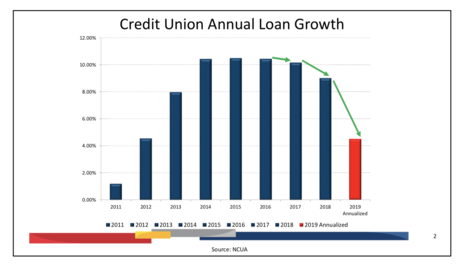
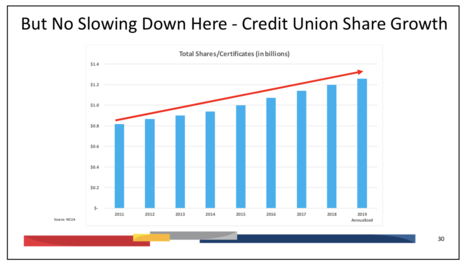
What credit unions need to be thinking about is that as loan growth slows, share growth only has only continued to grow. That leads to excess funds.
“Credit unions are almost always forced to invest at the worst times,” said Wert.
In looking to invest, Wert recommended these portfolio considerations:
- Revisit loan and share growth projections
- Revisit other restraints like your liquidity and interest rate risk parameters
- Is the CU looking for monthly cash flows?
- Is the CU looking to roll investments down the curve – fill a ladder?