

FRISCO, Texas–One economist says there is a question he gets more often than any other: “How many more blows can this aging business cycle take?”
His answer: plenty more, but that depends greatly on who is landing the blows.

Bernard Baumohl speaking at Catalyst Corporate meeting
“Buckle up--the next 12 to 15 months is going to be a crazy ride,” said Bernard Baumohl, chief global economist at Economic Outlook Group, which has been recognized for its highly accurate forecasts. “We are at a pivotal moment in U.S. economic history. But let me tell you right up front the fundamentals of the U.S economy still look pretty good. Expect to see unemployment under 4% well into next year.”
Economic forecasts have been thrown a monkey wrench—or perhaps more appropriately, an e-monkey wrench, however, he said: the explosion of e-commerce and all its consequences have made it difficult for economists to gauge its effects. He called technological innovations a “tectonic change” for the “very fabric of consumer society.”
In remarks to Catalyst Corporate FCU’s Economics & Payments Forum, Baumohl acknowledged despite his own optimism around the economy, there remains an undercurrent of concern that a “recession isn’t just a possibility, it’s probable. So, let me set the record straight: It is extremely difficult for a $22 trillion, free market, highly liquid economy to actually have a recession. That’s why they are fairly rare.”
Three Reasons for Recessions
Historically, recessions have been caused by three factors: high “real” interest rates, a major geopolitical eruption, and by acts of human folly, according to Baumohl.
The one scenario of the three that concerns Baumohl most is the last one; acts of human folly or self-inflicted wounds.
“The question we are now asking is, ‘Are we about to have another downturn next year that is the result of another act of folly?’” he asked. “The trade war is a massive foot on the neck of the economy.”
Baumohl said lowering rates further isn’t going to goose economic growth.
“It isn’t high interest rates hurting this economy, it’s uncertainty over this trade war,” Baumohl said, saying additional tax cuts are also not the answer given the $22 trillion national debt.
That national debt has him concerned.
“At some point, and we’re getting there, investors will no longer have that same appetite to buy U.S. Treasuries,” Baumohl said. “Investors see these deficits. It basically means the U.S. government is going around with hat in hand and they are saying if you want us to take on more risk you are going to have to reward us. The U.S. government can afford it, but the real pain is going to be felt by the private sector.”
The other risk is geopolitical, said Baumohl, citing North Korea, Venezuela, India/Pakistan, Brexit and other global issues. There are also worries around the tensions in the U.S.,. he said.
“I suspect this presidential election will be so divisive, so acerbic, so mean, that it could very well effect consumer and business confidence next year,” said Baumohl.
Other Issues
Baumohl touched on a number of other issues, as well, including:
The Inverted Yield Curve
“There is one other concern: the much-discussed yield curve inversion. While it has been a great predictor of past recessions, it’s different this time,” said Baumohl. “This is not your father’s or your grandfather’s yield curve inversion. This time, the yield curve has occurred because of some artificial factors. I do not see the yield curve inversion this time being an effective predictor of recession.”
The Forecast
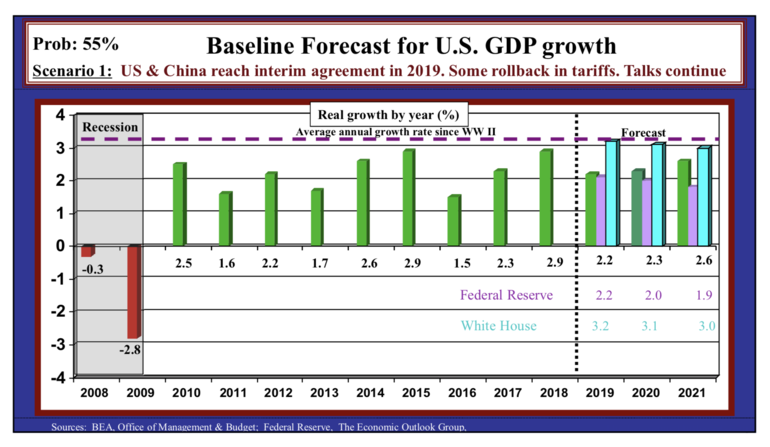
Baumohl said that if anyone provides just a single forecast for the economy, it is insufficient. Instead, at least three are needed. So, he offered a trio of forecasts:
Scenario I: The baseline forecast with a 55% probability foresees an interim agreement between the U.S. and China, meaning no recession in 2020 or 2021, and instead growth of more than 2% and faster growth in the years that follow.
Scenario II: With a 30% probability, the second scenario envisions a future where the trade war isn’t settled and the economy slows significantly in 2020, dropping below 2%, before a rebound to 2.4% in 2021.
Scenario III: With a 15% probability, the third scenario—which Baumohl called most optimistic–sees the U.S. and China reaching a comprehensive trade agreement, which would be a “propellent” to the economies of both countries.
Consumers
The consumer is the “bedrock” of the economy and has kept the economy afloat, said Baumohl, and the Internet and online shopping have spurred a lot of “impulse buying. “But that is “beginning to taper off.”
“The good news is we don’t see any household financial stress,” said Baumohl.
However, one group of consumers, Millennials, has been “somewhat traumatized” by the 2008-09 family crash. “They saw friends, family, neighbors lose their homes. They saw how horrific it was,” he said. Now they think maybe owning a house isn’t the greatest vehicle for building wealth. It’s why homebuilders are focusing more on building multi-unit dwellings.”
Business Spending & The White House
While consumers continue to spend, businesses have pulled back on their capital investments. “It’s a multi-year commitment, and it’s hard to deploy capital when there are so many economic and geopolitical uncertainties. Evidence is mounting there is a recession in manufacturing.”
Baumohl related that one CEO said to him, “I can’t plan for crazy.”
“It was an expression of exasperation; people just can’t quite figure out the erratic, often impulsive strategies coming out of the White House. It makes it difficult for business leaders to commit,” said Baumohl.
Baumohl added that ISM data show contraction has taken place in the sector.
Housing & Immigration
“You cannot have a vibrant economy unless you have a really healthy housing market,” according to Baumohl, who said the total value of the U.S. housing market is $26 trillion (mortgage debt plus home equity). Home equity he said, stands at $16 trillion today, versus $6 trillion a decade ago.
But with household formation slowing, housing demand is lackluster.
But another factor Baumohl said is being overlooked in the housing market is current federal policies putting sharp limits on immigration. Immigration, he said, represents 60% of population growth.
“Imagine everybody in this room is the population of the United States. We close the room to anyone new,” suggested Baumohl. “The only way the economy can grow is if you spend more. But some of you may retire, some of you may not be with us. So, if the doors remain closed, it’s very hard to grow. The policy to slash legal immigration, I think, is going to have a detrimental effect on housing and on the economy as a whole.”
Baumohl is forecasting 5.33 million home sales in 2019, 5.31 million 2020 and 5.45 million in 2021. He said the market is being held back by both the trade war affecting costs and availability of building materials and by fewer available workers who are no longer available due to immigration limits.