

WASHINGTON– Credit card issuers charged $12 billion in late fees during 2020, according to a new report from the Consumer Financial Protection Bureau (CFPB), which is predicting the fees will only increase.
“Many credit card issuers have made late fee penalties a core part of their profit model. Markets work best when companies compete on price and service, rather than relying on back-end fees that obscure the true cost,” said CFPB Director Rohit Chopra in a statement announcing release of the report. “Given their current practices, we expect that credit card issuers will hike fees, based on inflation, as limits continue to rise.”
The Bureau noted the Credit Card Accountability Responsibility and Disclosure Act of 2009 (CARD Act) created a range of protections for cardholders, including limiting how much credit card companies could charge for penalties such as over-the-limit fees and late fees, as well as limits on interest rate increases.
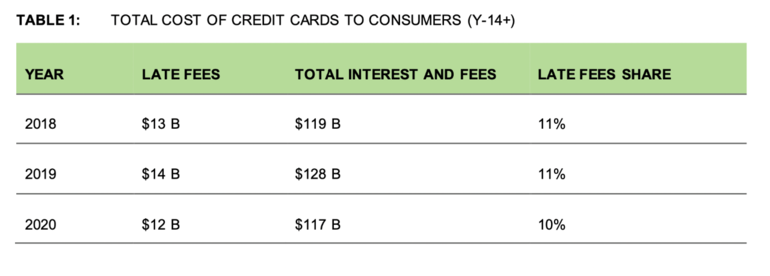
“Many of these protections have been effective in reducing the total cost of credit for consumers, improving competition, and creating transparency on pricing,” the CFPB said. “Nevertheless, today’s report highlights that late fees continue to negatively affect millions of families.”
‘Reasonable and Proportional’
The CFPB further noted that in 2010 the Federal Reserve Board of Governors voted to implement provisions of the CARD Act that required penalties to be “reasonable and proportional.” In its rule the Federal Reserve Board included an immunity provision that allowed credit card issuers to set fees at a particular level, subject to an annual inflation adjustment. Today, these limits have climbed to $30 for the first late payment and $41 for a subsequent late payment within six billing cycles, the Bureau added.
Congress later removed the authority of the Federal Reserve Board of Governors to adjust these provisions and transferred them to the CFPB. The CFPB said it expects many major card issuers to hike fees further, based on inflation, given the existing reliance on the immunity provisions in the marketplace.
Significant Findings
Among the other “significant findings” the Bureau said it found in its report:
- Many major issuers charge the maximum late fee allowed under the immunity provisions set by the Federal Reserve Board of Governors in 2010. Eighteen of the top 20 issuers set late fees at or near the established maximum level, the CFPB said.
- Subprime cards and private label cards are particularly susceptible to late fee charges. “For example, the average deep subprime account gets charged $138 in late fees per year, and deep subprime accounts are more likely than super-prime accounts to carry smaller balances,” the CFPB stated. “As a result, deep subprime cardholders pay late fees that represent a higher percentage of their balances (11% compared to 0.8% for super-prime accounts). These late fees are in addition to accrued interest charges. For private label cards, late fees comprised the overwhelming majority—91%—of all consumer fees and 25% of total interest and fees (compared to 45% and 7%, respectively, for general purpose credit cards).”
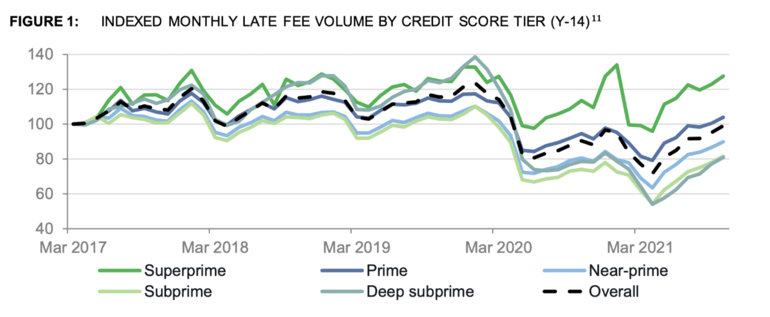
- Late fee volume fell when stimulus checks arrived in 2020 and 2021, particularly for households with lower credit scores. Other evidence has documented that stimulus checks improved household balances and liquidity, the CFPB said. “The fact that late fee charges for credit card issuers fell during the same period suggests that late fees are a penalty on households living paycheck-to-paycheck rather than a meaningful incentive to make on-time payments.”
- Low-income areas, areas with high shares of Black Americans, and areas with lower economic mobility all bear more of the late fee burden. “In 2019, credit card accounts held by cardholders living in the United States’ poorest neighborhoods paid twice as much on average in total late fees than those in the richest areas,” the Bureau reported. “Cardholders in majority-Black areas paid more in late fees for each card they held with major credit card issuers in 2019 than majority white areas. And people in areas with the lowest rates of economic mobility paid nearly $10 more in late fee charges per account compared to people in areas with the highest rates of economic mobility.”
The full report can be found here.
Don’t Forget to Check the Spam Folder!
Don’t forget to check your Spam/Junk email folder if you didn’t receive your free, popular and daily CUToday.info news headlines on Monday.
And if you haven’t yet signed up for the new email solution on which CUToday.info has partnered with ResponseGenius, you can do so here. Signing up requires less than one minute of your time.
CUToday.info has received very positive response from readers following the move to an improved provider of the daily headlines, but many also noted they did need to go to their Spam/Junk folder and mark it as safe.
The new email solution has not only improved every reader’s delivery experience, but it also features a fresh, new format that is easy to read, especially on mobile devices.
Please note and/or make your IT department or email administrator aware the emails will be coming from the domains CUTodayinfo.com and CUTodayinfoReply.com.