

CHICAGO–Americans’ credit card balances have decreased significantly on both a quarterly and annual basis, a “trend that places even more emphasis on this year’s 2020 holiday shopping season,” according to TransUnion.
TransUnion released the analysis in conjunction with its Q3 2020 Industry Insights Report, which found that while there are nearly 450 million credit card accounts in the U.S. as of Q3 2020, average consumer-level credit card balances have declined across all credit risk tiers over the course of the COVID-19 pandemic and now stand at $5,075, down from $5,668 in Q3 2019.
In addition, total bankcard balances fell to $723 billion, a decline of more than 10% year over year and the lowest level since Q2 2017, TransUnion reported.
“Credit card balances have been severely impacted by the COVID-19 pandemic as consumers have slowed purchases, especially on travel and entertainment. With fewer people using their credit cards to buy airline tickets or spend money on vacations, it’s understandable to see such a precipitous drop in balances,” said Paul Siegfried, senior vice president and credit card business leader at TransUnion. “At the same time, we’ve observed consumers using their credit cards to spend more on home-related purchases. There is also a belief that with the immense slowdown in balance growth during the last few quarters, we may see increased credit usage this fourth quarter as some consumers may be positioned to make more purchases this holiday season.”
End of Three-Year Trend
According to TransUnion, the recent declines in total credit card balances reverse a three-year trend between the third quarters of 2017-2019. During those years, consumers consistently increased the balances of their private label and general purpose credit cards in the quarters preceding the holiday shopping season; balance increases continued during the fourth quarter holiday shopping season.
In the 2019 holiday shopping season, consumers added $40.4 billion in bankcard balances – an increase of nearly 27% from the 2018 season, the company noted.
“Consumer sentiment, though, puts pressure on the continuation of this trend,” TransUnion said, citing a financial hardship survey conducted in late October that found more than half of Americans (54%) said they have been financially impacted by the COVID-19 pandemic. Of those persons, half said they expect to decrease retail spending in the next three months, 59% said they will do less discretionary spending.
Other findings included in the most recent TransUnion research:
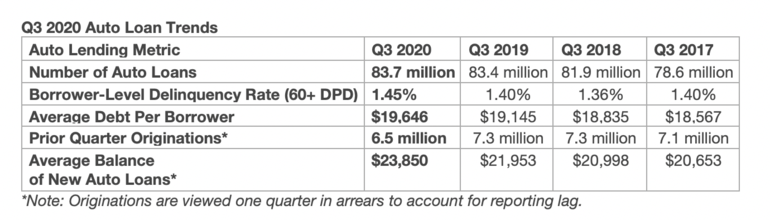
Q3 2020 IIR Auto Loan Summary
TransUnion reported loan originations in the auto market experienced an 11.9% year-over-year decline with 6.5 million new loans opened in Q2 2020, compared to 7.3 million in Q2 2019.
“While originations decreased across all tiers, this was particularly noticeable among subprime consumers as this risk tier declined 28.1% over the same period last year,” TransUnion said. “Despite a recent decline, originations are expected to improve quarter over quarter in Q3 as the auto market moves past the large-scale shutdowns from earlier this year that contributed to dealership closures. Subprime origination growth will likely continue to lag other risk tiers as lenders skew their portfolios toward lower-risk consumers.”
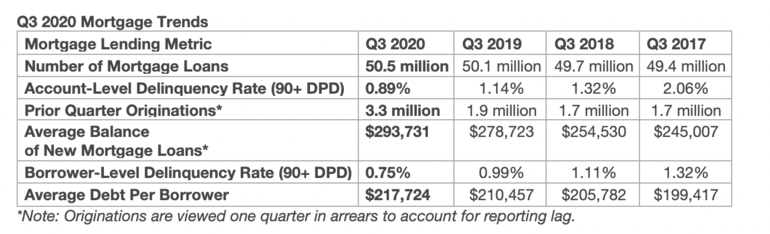
Q3 2020 IIR Mortgage Loan Summary
Mortgage originations increased to 3.3 million in Q2 2020, a 76% increase over the 1.9 million in Q2 2019, according to TransUnion.
Refinance originations continue to drive a substantial percentage of origination activity with a 256% increase over last year. Rate and term refinance originations grew at a rate of 444%, while cash out refinance originations grew 113% year over year, the company said.
“Meanwhile, purchase originations grew at a slower rate of 5% year over year. For home purchases, 15- and 20-year loans grew 62% and 57%, respectively, outpacing the growth of 30-year loans, which experienced no growth this quarter,” TransUnion reported. “Shorter loan terms have outpaced the growth of 30-year loans since Q3 2019. Market share for 15-year purchase loans increased from 6% to 9% year over year and 20-year purchase loans rose from 2% to 3%. Market share for traditional 30-year loans declined from 87% to 83% over that same period of time.”
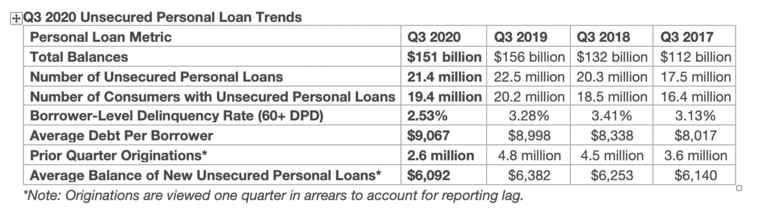
Q3 2020 IIR Personal Loan Summary
Total balances in the consumer lending industry declined to $151 billion in Q3 2020, down from $156 billion in Q3 2019, following a dramatic drop off in originations due to the COVID-19 crisis, TransUnion reported.
“The first full quarter (Q2 2020) of COVID-19 impacted originations, which declined 46.2% year over year as lenders temporarily exited the market, tightened underwriting and/or shifted their portfolio mix toward lower risk consumers,” the company said. “Decreased consumer demand for credit also contributed to the drop-off, as stay-at-home orders drove decreased spending, and stimulus funds provided additional liquidity. Performance has remained stable as serious delinquencies improved to a 10-year low of 2.53% in Q3 2020. Delinquencies were down across all risk tiers, with the exception of super prime, which remained low, but ticked up to 0.03% from 0.02% in Q2.”
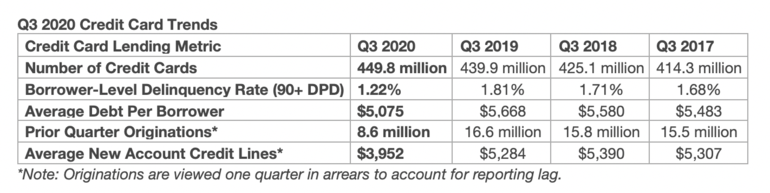
Credit Card Market Reverses Growth Trajectory
Following a peak in Q4 2019, consumer level serious delinquencies (90+ DPD) has fallen for three straight quarters to 1.22% in Q3 2020, a result of payment accommodation programs, lower spending and the increase in payments during the pandemic, TransUnion stated.
“While consumer performance has remained strong in the face of uncertainty, lenders have tightened underwriting criteria across the board with originations declining 48.3% year over year in Q2 2020 to 8.6 million – a trend that was observed across all risk tiers,” the analysis found. “As a result, total credit limits for new accounts hit their lowest level in 10 years at $32 billion and the average new account credit line decreased 25.2% to $3,952, down from $5,284 a year prior in Q3 2019.”