

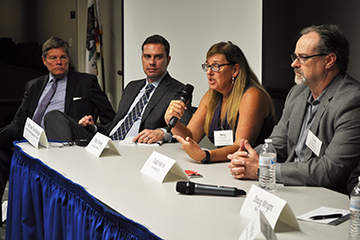
ANAHEIM HILLS, Calif.–Approximately 40 credit union executives gathered here to discuss a number of “what if” scenarios related to the economy, politics and more.
Hosted by the California and Nevada CU Leagues, the “Your Economy–Your Credit Union” event was held at Wescom Credit Union’s offices here.
Leaders engaged in a full day of discussion and awareness on the changing world around them, with an eye toward what they would take back to their boards of directors for yearly strategic planning purposes later this summer, the California and Nevada leagues said in a statement.
“We have no reason to celebrate but no reason to panic,” said Rob Eyler, a Redwood CU board member who is an economist, as well as director of Sonoma State University’s Center for Regional Economic Analysis and dean of the university’s School of Extended and International Education. “We don’t have many signs of slipping into a recession, but we also don’t have reason to believe the economy is going to skyrocket.”
Some areas credit unions should be giving consideration, according to Eyler:
- The right factors are in place for the California, Nevada, and U.S. economies to continue growing at a slow-to-moderate pace well into 2019, barring any unforeseen circumstances.
- Recent job growth is great news, but is the economy gaining the right types of jobs?
- The economy increasingly has fewer people available in the workforce who are prepared, ready, and willing to work.
- During the past two recoveries the economy hasn't experienced compounded change above trend.
- The business investment side of the economy isn’t keeping pace with consumer spending, which has resulted in a lack of consistent corroborated growth that recoveries usually show.
- The economy is in a very experimental but non-fundamental period, where 2.5% gross domestic product (GDP) growth per year isn’t looking too shabby these days.
- Putting the Federal Reserve’s interest-rate decision aside and its impact on the economy, California is already entering new territory when it comes to changes in workers, business, real estate, and technology.
Meanwhile, Dwight Johnston, chief economist for the leagues, asked attendees how likely they feel a recession will ensue later this year or sometime in 2017. Only a couple hands were raised, the league reported. For the rest of 2016 Johnston is expecting the nation to add 150,000- 175,000 jobs per month. He said the reason U.S. unemployment is at 4.7% is because of workers leaving the labor force, whether they are discouraged, retiring, or experiencing lifestyle changes. A surge in retirees means an increasingly “tighter” labor market will form over the next 10 years, according to Johnston.
Johnston said inflation expectations will rise as wage growth continues over the next 12-18 months. He discussed different scenarios—the “hope trade” versus the “fear trade”—depending on the economy’s performance and the Federal Reserve’s decision on its benchmark interest rate versus what those in the global financial markets anticipate, the league reported.
“What does worry me is a bond market implosion—the leveraged funds, the corporate debt, and consumer panic,” he said. “But fortunately the odds of that happening are low.”
Computerization Having An Impact
Michael Steinberger—dean of academics for Western CUNA Management School and associate professor of economics at Pomona College—told the meeting the past few economic recoveries have leaned more toward “jobless recoveries” than not compared to history. That’s because computerization is making its imprint on workers’ lives and changing four types of jobs: manual-routine, cognitive-routine, manual non-routine, and cognitive non-routine, he said.
“What usually happens in a recession and recovery is: routine jobs don’t come back,” Steinberger said, according to the league. “But in 2009, it was the manual non-routine jobs that didn’t make a comeback. Instead we’re seeing an increase in cognitive non-routine jobs in this recovery—jobs requiring higher levels of education and skills.”
He said the largest changes to business during the next 10 years will come from a combination of computerization and demographics (age and ethnicity).
Steinberger noted the top 1% of income-earning U.S. households are taking in $1 out of every $4 nationwide, or 25% of all gross income—a trend not seen since 1928 (and which averaged 12% from 1943-1993). Also, average and median wages have stagnated over the past three decades. The bottom 20% of households has a 43% chance of rising upward today, while the top 20% has a 40% chance of staying there.
It’s expected that mandated government spending on entitlements and other costs will outpace government revenue sometime between 2030 and 2040 if policymakers don’t make changes. Steinberger predicted taxes will probably rise in the long run while public spending declines.
The implications for credit unions remain to be seen, but an afternoon panel of credit union CEOs and CFOs gave their thoughts on opportunities, challenges, and what keeps them up at night, including Mary Torsney, CFO of Financial Partners CU (Downey, Calif.); Todd Harris, CEO of Technology CU (San Jose); and Doug Wright, CFO of Mission FCU (San Diego).
Some of their answers included:
- Margin compression
- A flattened yield curve in the bond market
- Pressure within interest rate competition
- Possible delinquency upswing
- Managing within a low-rate interest rate environment
- How fast (or not) deposit rates should move up going forward
- The ability to generate capital, yet treat members fairly relative to the financial services marketplace
- Cyber-fraud and security
"The fact is, we are managing financial institutions during an unprecedented economic time," Harris said, according to the league. "The combination of a long period of low interest rates, the size of the Federal Reserve’s balance sheet, the size of the national debt, excess liquidity in the banking system, lethargic GDP growth, the slow-paced job recovery, and stubbornly low inflation has not existed before. There is no 'playbook' for this environment."