

MADISON, Wis.–New data show CUs closed out 2020 with fixed-rate mortgages setting a record for their proportion of all loans while CU membership grew at its slowest pace in six years. The forecast for 2021? Fast savings growth (unwelcome news to many), potential inflation, and even more mortgage loans.
All of that and more is from CUNA Mutual’s December 2020 Trends Report. Here’s a look at what else CUNA Mutual’s economists had to say in reviewing the data and looking ahead.
The Mortgage Market
Is a housing boom in the offing?
Real home prices (inflation adjusted) increased 11.6% in 2020, the fastest pace in modern history, raising concerns regarding affordability and home price bubbles, according to CUNA Mutual, which added nominal home prices rose 12.9% in 2020, significantly faster than the cost of living as measured by the Consumer Price Index which rose 1.3%.
“If we subtract this 1.3% inflation rate from the 12.9% nominal home price growth rate, we can calculate the real home price growth rate of 11.6%,” CUNA Mutual said in its analysis. “This is the ninth consecutive year of nominal home price growth exceeding the rate of inflation of the goods and services we purchase to live.”
CUNA Mutua’s economists further noted the chart also shows the housing market moves in cycles of booms and busts.
“Sometime in the next few years we can expect real home price growth rates to turn negative as nominal home price growth rates fall below the rate of inflation of the goods and services we purchase every day,” CUNA Mutual said. “One possible economic scenario for this to happen would be a rise in the inflation rate which will push up long term interest rates and the 30-year mortgage interest rate. This will in turn reduce the demand for housing and bring down nominal home price growth rates. And with the massive monetary and fiscal stimulus currently being applied to the U.S. economy, higher inflation rates may not be that far off.”
Here’s a look at how credit unions performed by category, according to the latest Trends Report.
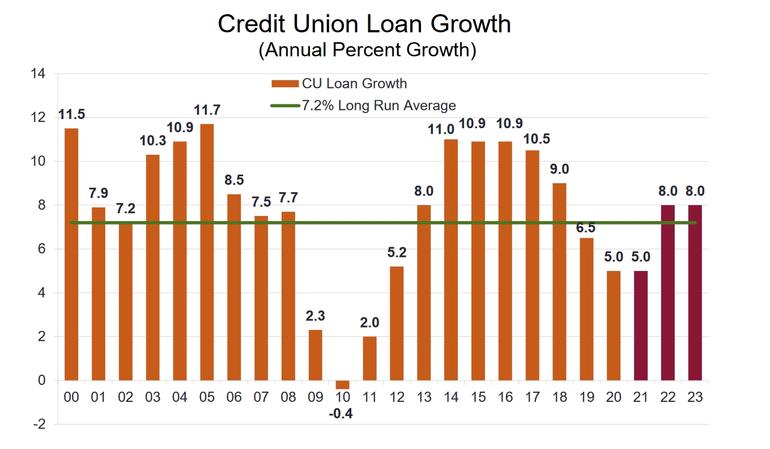
Total Credit Union Lending
Credit union loan balances rose 0.2% in December, below the 0.8% pace reported in December 2019. Driving overall loan growth was strong growth in credit card loans (1.1%), fixed-rate mortgages (1%) and new auto loans (0.2%).
CUNA Mutual noted December credit card seasonal factors – such as holiday shopping– typically add 3.1 percentage points to the underlying credit card trend loan growth. The muted December credit card growth was caused by the continuing effects of cautious consumers deleveraging their balance sheets, the analysis states.
Credit union loan balances rose 5% in 2020, down from the 6.5% reported in 2019 due to two headwinds. “Some members used funds from a cash-out mortgage refinance to pay down high-rate consumer loan debt while other members used stimulus check funds to also pay down debt,” the Trends Report states. “Expect loan growth to remain subdued in 2021 at 5%, slightly below the 7.2% long run average.”
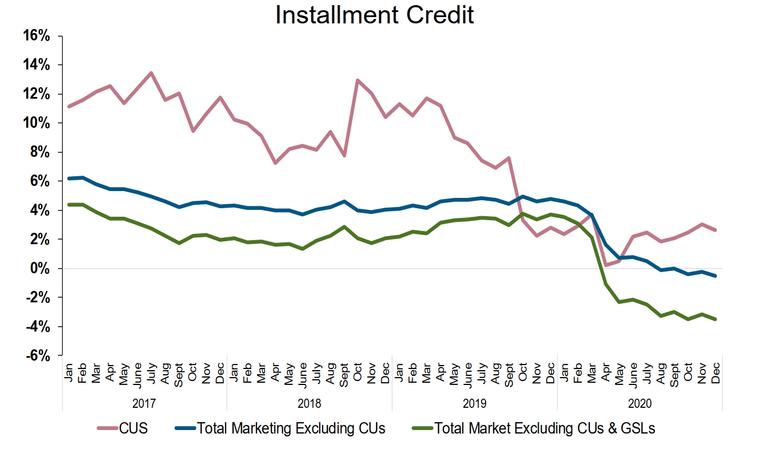
Consumer Installment Credit (CIC)
Credit union consumer installment credit balances (auto, credit card and other unsecured loans) fell 0.3% in December, which was below the 0.1% gain set in December 2019, the Trends Report stated.
“During 2020 credit union consumer installment credit grew only 2.6%, but better than the total market excluding credit unions, which fell 0.5%,” the report notes. “If guaranteed student loans are removed, then consumer credit decreased 3.5% for non- credit-union lenders, the slowest pace since December 2010.”
The analysis added, “Banks have turned more restrictive in their lending during this current environment as it has become harder to determine who is credit worthy. This is an increase in the adverse selection problem that comes with all lending. The adverse selection problem is where potential borrowers who are most likely to default are the ones who most actively seek out a loan and are thus most likely to be selected. Consumers denied loans at banks may therefore be turning to credit unions for their credit needs.”
Meanwhile, CUNA Mutual also noted the “great deleveraging of the U.S. consumer balance sheet took a big step forward in 2020.” Household debt burdens, as measured by residential mortgages and consumer credit as a percentage of disposable personal income, rose to 84.1% in the third quarter of 2020, from a recent low of 80.2% in the second quarter, according to the Federal Reserve’s Flow of Funds report.
The big drop in the second quarter was due to the $1,200 stimulus check sent out in March 2020 which boosted disposable personal income, the denominator of the ratio.
Expect the ratio to decline to the low 72-75% range in 2021 due to the $600 stimulus checks mailed out in January and the possible additional $1,400 checks later this spring. This will be the lowest debt-to-income ratio since 1989, the report states.
“Unfortunately, the debt-to-income ratio will bounce back to the mid 80% range in the second half of 2021 as the stimulus checks mailings come to an end,” CUNA Mutual’s economists said.
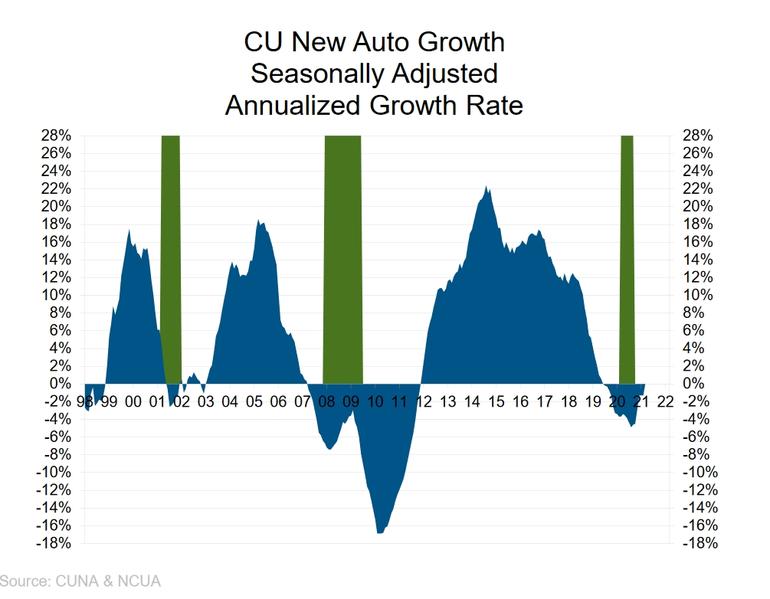
Vehicle Loans
Credit union new auto loan balances rose 0.2% in December, significantly below the 0.4% pace set in December 2019, and fell 3.9% for the full year, according to the Trends Report.
On a seasonally-adjusted annualized basis, new auto loan balances fell 1.3% in December, which is above the 3.3% decline reported in December 2019.
“Five factors drove this decline: the pandemic raised job and income insecurity among potential new auto buyers; rapid loan originations two to three years ago precipitate larger loan balance amortization today; new auto sales declined 14% over the last year, members used ‘cash out’ funds from mortgage refinances to pay off auto loans, and rapid growth of indirect auto lending has leveled off.”
CUNA Mutual said it expects new auto loan growth to return to positive territory in the second quarter of 2021.
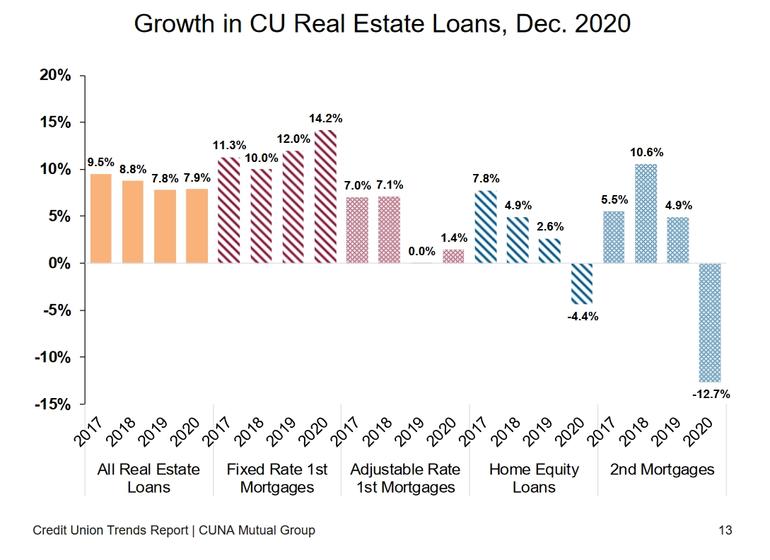
Real Estate Lending
Credit union real estate loan balances grew 7.9% in 2020, slightly above the 7.8% reported in 2019 but below the 9.5% pace set back in 2017. Fixed-rate first mortgage loan balances rose 14.2% in 2020, the fastest annual pace since the 17.6% reported during the housing bubble of 2008, according to the Trends Report.
Second mortgage loan balances and home equity loans reported weak growth in 2020, -12.7% and - 4.4% respectively, due to members rolling existing loan balances into refinanced first mortgages. By year-end, fixed-rate first mortgages made up 33.7% of all loans, the highest in credit union history.
This is also up from 31% at the end of 2019 and 22.6% reported at the beginning of the Great Recession in 2007, the company said.
“Credit unions are making headway in serving their members’ mortgage needs. Currently 2.5% of members have a first mortgage loan at their credit union, up from 1.9% in 2009,” according to the Trends Report. “First mortgage credit quality improved in 2020 with delinquency rates falling to 0.5%, down from 0.55% in 2019.”
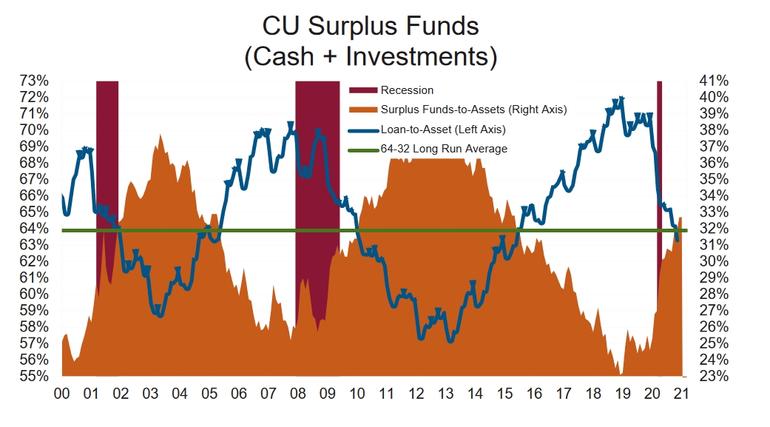
Surplus Funds (Cash + Investments)
According to the Trends Report, in December, “credit union balance sheets crossed the long run Rubicon, to borrow a phrase from the time of Julius Cesar. Credit union surplus funds as a percent of assets rose to 32.7% in December, above its long run average of 32%, due to savings growth outpacing loan growth during the last year.”
Meanwhile, the data show loans fell to 63.3% of assets in December, below its 64% long run average and down from the recent cyclical high of 72% set in October 2018, which was also the highest level since July 1980.
“With loan and asset balances expected to increase 5% and 13.5, respectively, in 2021, the credit union aggregate loan-to-asset ratio will fall to 58.6% by the end of this year,” CUNA Mutual forecast. “This less rich mix of assets along with lower market interest rates should weigh on credit union yield-on-asset ratios this year.”
The Trends Report shows credit unions are increasing the liquidity of their surplus funds. In December, 56.8% of surplus funds had a maturity of less than one year, up from 52.3% one year earlier. Holding more shorter-term investments will also depress credit union yield-on-assets ratios which are expected to fall to 3.2% in 2021, from 3.5% in 2020.
“This will be the lowest in credit union history,” CUNA Mutual stated.
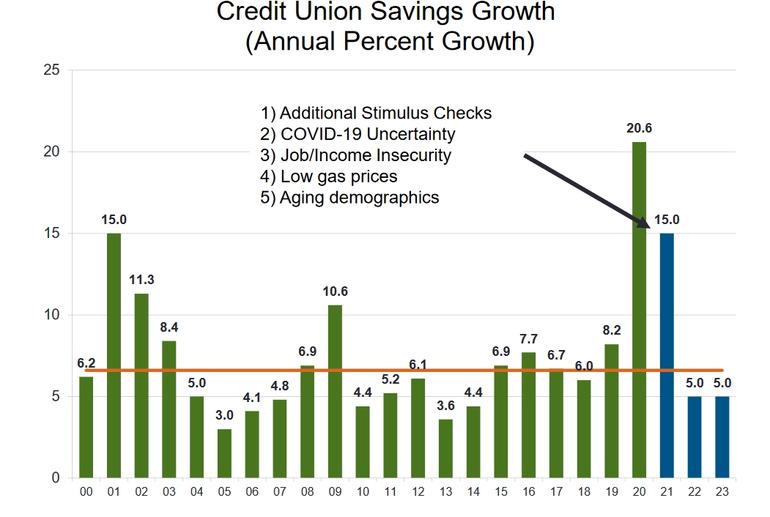
Savings & Assets
Credit union savings balances rose 2% in December, better than the 0.2% decline reported in December 2019. Savings balances typically decline 0.14% in December due to recurring seasonal factors such as holiday spending, the Trends Report observed.
“Expect fast savings growth of around 15% in 2021 due to additional stimulus checks, COVID-19 pandemic uncertainty, low gas spending and aging demographics,” the Trends Report is forecasting. “Around 50% of the new savings dollars will be placed in regular share accounts and 30% in share draft accounts. With deposit interest rates on these accounts already close to zero, credit union cost of funds will approach record lows this year.”
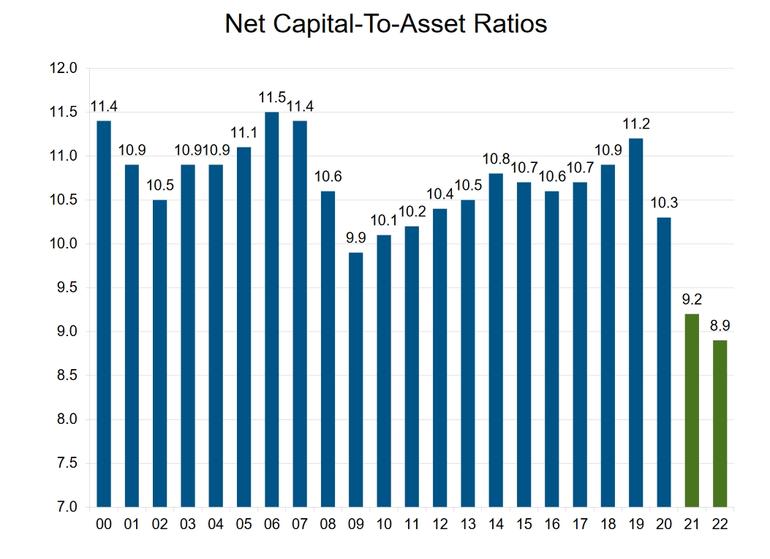
Capital & Other Key Measures
The Trends Report stated the credit union industry’s net capital-to-asset ratio ended 2020 at 10.3%, down from the 11.2% reported at year-end 2019, as asset growth outpaced capital growth.
Credit union earnings as measured by return-on-asset ratios came in at 0.65% in 2020, resulting in credit union capital growing only 8.4%, below the 18.1% growth in assets, CUNA Mutual said.
“The credit union capital ratio is expected to fall to 9.2% in 2021, which would be the lowest since 1994, as the expected pace of capital growth (5%) is expected to fall below the expected pace of asset growth (13.5%),” the Trends Report states. “Capital growth will be subdued in 2021 due to return-on-asset ratios falling to 0.5% this year as net interest margins fall to the lowest in history. The growth rate of capital is also known as the return on equity ratio and is an important measure of credit union financial performance.”
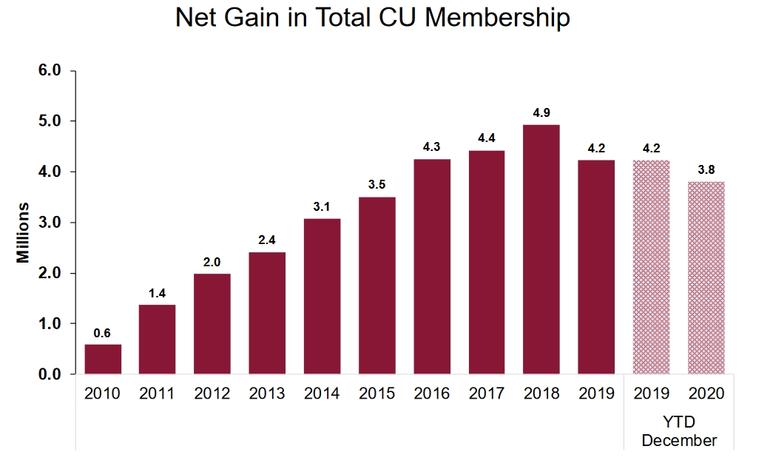
Credit Union Members
Credit unions added 149,000 memberships in December, roughly half the 294,000 reported during December 2019. Credit unions added 3.8 million memberships for all of 2020, the slowest pace in six years. This membership slowdown is due in large part to the recent drop in credit demand caused by the pandemic, CUNA Mutual noted.
“Membership growth is also driven by job growth. In 2020, the economy lost 9.3 million jobs, according to the Bureau of Labor Statistics. For 2021, expect an economic turnaround with an expected 4.5 million additional jobs being added to the workplace,” CUNA Mutual said. “Credit union membership growth is expected to be 3% in 2021, below the recent five-year average of 3.7% due to the mortgage refinance boom coming to an end and weak consumer loan growth.”