ALEXANDRIA, Va.–The second quarter of 2022 marked the largest year-over-year growth in loans outstanding in at least two decades, according to new data released by NCUA, with loan balances rising in all major categories, compared with the second quarter of 2021.
But once again credit unions in the smallest asset categories actually reported declines in lending, as well as membership, the NCUA data show.
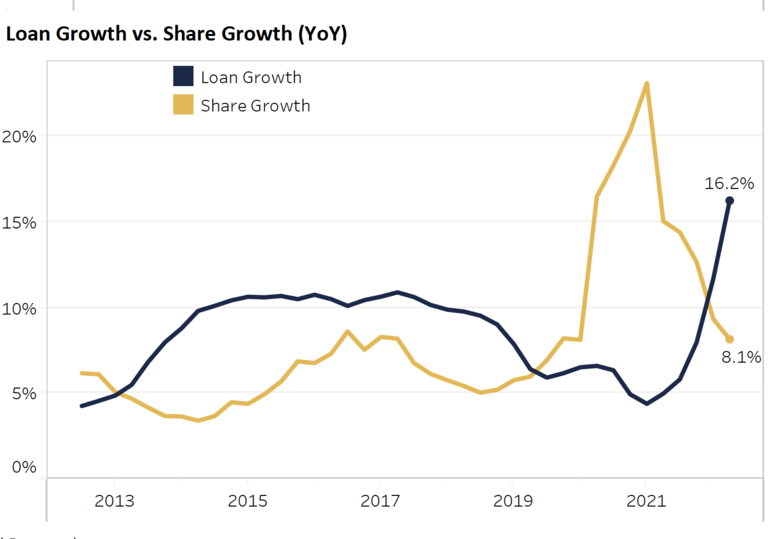
Overall, total loans outstanding in federally insured credit unions increased $194 billion, or 16.2%, over the year ending in the second quarter of 2022, to $1.39 trillion.
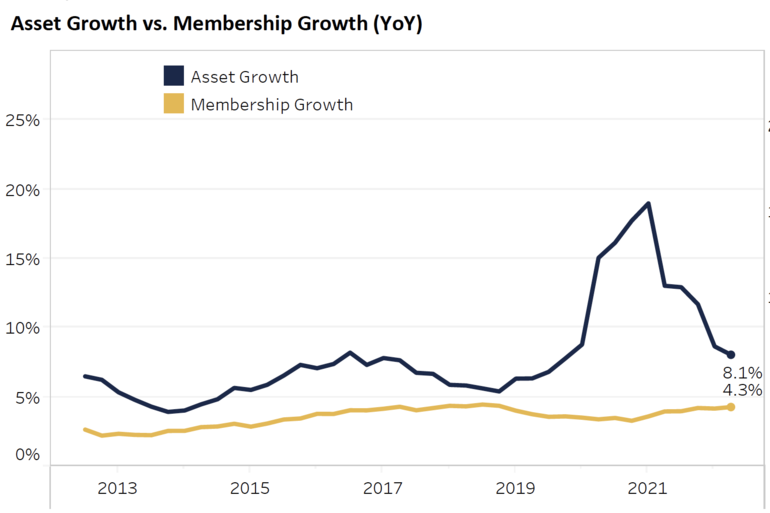
During the same period, total assets climbed by $159 billion, or 8.1%, to $2.14 trillion. Insured shares and deposits also grew $110 billion, or 7.0%, to $1.69 trillion, from one year earlier, NCUA said, according to its new Credit Union Data Summary.
“These latest quarterly industry performance results point to a growing and overall healthy credit union system that’s facilitating the ability of families to achieve their financial goals,” said NCUA Chairman Todd M. Harper. “But, at the same time, we have also seen declines in the system’s net income and returns on average assets, rapidly rising interest rates and continued inflationary pressures. And, we have identified growing liquidity concerns within the system. Therefore, credit unions of all types and sizes must remain diligent in managing safety and soundness as we continue to navigate the challenging economic environment ahead of us.”
NCUA reported that as of June 30, 2022, there were 4,853 federally insured credit unions with 132.6 million members.
Overall Performance
Here’s a look at how credit unions performed through June 30, according to NCUA:
- Total assets in federally insured credit unions rose by $159 billion, or 8.1%, over the year ending in the second quarter of 2022, to $2.14 trillion.
- Total loans outstanding increased $194 billion, or 16.2%, over the year to $1.39 trillion. The average outstanding loan balance in the second quarter of 2022 was $16,647, up $491, or 3.0%, from one year earlier.
- The delinquency rate at federally insured credit unions was 48 basis points in the second quarter of 2022, up two basis points from one year earlier. The net charge-off ratio was 28 basis points, little changed compared with the second quarter of 2021.
- Insured shares and deposits rose $110 billion, or 7.0%, over the year ending in the second quarter of 2022, to $1.69 trillion.
- The loan to share ratio stood at 74.8% in the second quarter of 2022, up from 69.6% in the second quarter of 2021.
- The credit union system’s net worth ratio was 10.42% in the second quarter of 2022, compared with 10.16% one year earlier.
- Net income totaled $18.0 billion at an annual rate in the first half of 2022, down $3.3 billion, or 15.4%, from the same period a year ago.
- The net interest margin for federally insured credit unions was $55.9 billion at an annual rate in the first half of 2022, or 2.67% of average assets. That compares with $49.2 billion, or 2.57% of average assets, in the first half of 2021, NCUA said.
- The return on average assets for federally insured credit unions was 86 basis points in the second quarter of 2022, down from 112 basis points in the second quarter of 2021. The median return on average assets across all federally insured credit unions was 42 basis points, down four basis points from the second quarter of 2021.
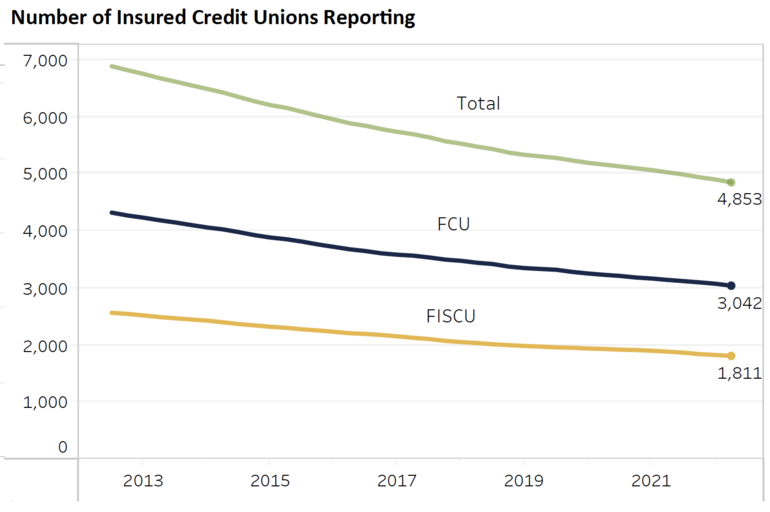
- The number of federally insured credit unions declined to 4,853 in the second quarter of 2022, from 5,029 in the second quarter of 2021. In the second quarter of 2022, there were 3,042 federal credit unions and 1,811 federally insured, state-chartered credit unions. “The year-over-year decline is consistent with long-running industry consolidation trends,” NCUA said.
- The number of credit unions with a low-income designation declined to 2,620 in the second quarter of 2022 from 2,649 one year earlier.
- The number of complex federally insured credit unions (those with total assets greater than $500 million) rose to 703 from 701 a quarter earlier.
Additional Data Points
NCUA further reported:
- 399 CUs opted into the Complex Credit Union Leverage Ratio (CCULR) framework with an average CCULR of 11.35%.
- 304 CUs reported under the Risk-Based Capital (RBC) framework with an average RBC ratio of 15.39%.
- Federally insured credit unions added 5.4 million members over the year
Balance Sheet Details
Balance sheet performance included:
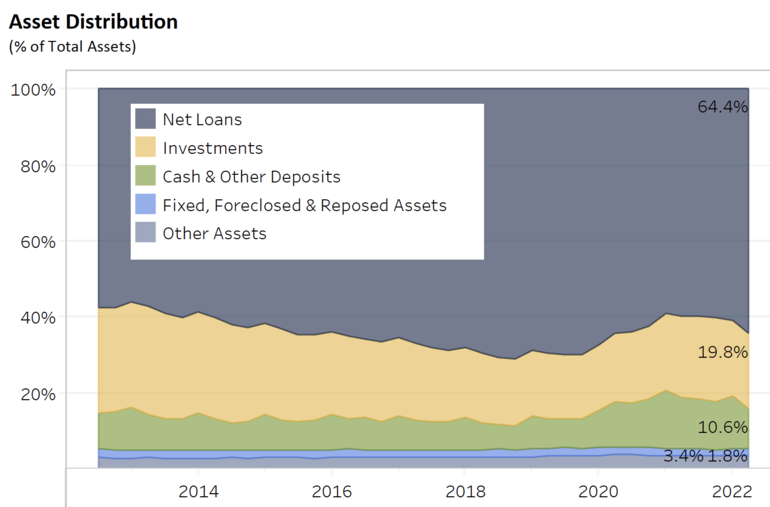
- Cash declined $74.0 NCUA noted that that the 2022Q1 Call Report redefined cash to exclude cash equivalents (investments with original maturities of three months or less). Cash now represents cash on hand and cash on deposit.
- Total investments rose $30.4 billion, or 7.0%, to $464.6 billion. NCUA noted that the 2022Q1 Call Report introduced a new definition for total investments on the investment maturity schedule.
- Investments with maturities less than or equal to one year declined $15.5 billion, or 14.4%, to $92.3 billion.
- Investments with maturities of one to three years rose $14.8 billion, or 14.2%, to $119.2 billion.
- Investments with maturities of three to five years increased $7.6 billion, or 7.1%, to $113.9 billion.
- Investments with maturities of five to 10 years rose $22.3 billion, or 23.1%, to $118.9 billion.
- Investments with maturities greater than 10 years increased $1.2 billion, or 6.5%, to $20.4 billion.
The Loan Portfolio
When it comes to lending as of June 30, NCUA said:
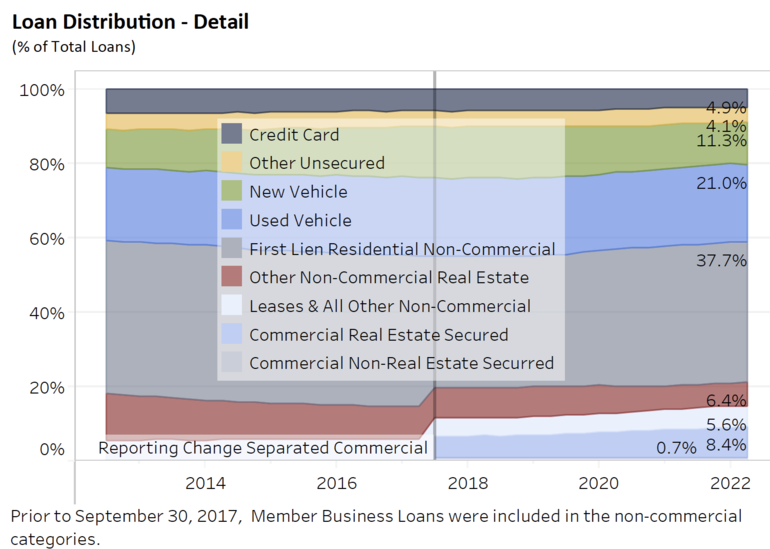
- Total loans outstanding increased $193.8 billion, or 16.2%, over the year, to $1.39 trillion. NCUA noted that the loans variable was redefined to include loans to natural person credit unions, which were previously reported as investments. Credit union loan balances rose in all major categories, compared with the second quarter of 2021.
- Loans secured by 1- to 4-family residential properties increased $87.1 billion, or 16.7%, to $609.9 billion in the second quarter of 2022.
- Auto loans increased $58.7 billion, or 15.1%, to $447.6 billion. Used auto loans rose $43.2 billion, or 17.4%, to $291.0 billion, and new auto loans rose $15.5 billion, or 11.0%, to $156.5 billion.
- Credit card balances rose $7.4 billion, or 12.4%, to $67.3 billion.
- Non-federally guaranteed student loans increased $0.8 billion, or 12.9%, to $7.2 billion.
- Commercial loans, excluding unfunded commitments, increased $24.2 billion, or 23.8%, over the year to $125.6 billion in the second quarter of 2022. Commercial loans are not directly comparable to member business loans.
- The delinquency rate at federally insured credit unions was 48 basis points in the second quarter of 2022, up two basis points compared with the second quarter of 2021.
- The delinquency rate on non-commercial real estate loans was 39 basis points in the second quarter of 2022. NCUA noted this is a new variable added in 2022Q1; data for previous quarters are not available.
- The credit card delinquency rate rose to 107 basis points from 77 basis points one year earlier.
- The auto loan delinquency rate increased 14 basis points over the year to 45 basis points in the second quarter of 2022.
- The delinquency rate for commercial loans, excluding unfunded commitments, was 41 basis points in the second quarter of 2022, compared with 67 basis points in the second quarter of 2021.
- The net charge-off ratio for all federally insured credit unions was 28 basis points in the second quarter of 2022, little changed compared with the second quarter of 2021.
Liabilities and Net Worth
According to the new NCUA data:
- Credit union shares and deposits rose by $139.7 billion, or 8.1%, over the year to $1.85 trillion in the second quarter of 2022.
- Regular shares increased $62.3 billion, or 9.9%, to $689.0 billion. Other deposits increased $37.1 billion, or 5.0%, to $782.5 billion, led by money market accounts, which grew $52.2 billion, or 13.9%, over the year.
- The credit union system’s net worth increased by $21.6 billion, or 10.8%, over the year to $222.7 billion. The aggregate net worth ratio — net worth as a percentage of assets — stood at 10.42% in the second quarter of 2022, up from 10.16% one year earlier.
Income Statement Details
When it comes to the income statement, NCUA said:
-
Net income for federally insured credit unions in the first half of 2022 totaled $18.0 billion at an annual rate, down $3.3 billion, or 15.4%, from the first half of 2021. Interest income rose $5.7 billion,
or 9.8%, over the year to $63.6 billion. - Non-interest income fell $3.1 billion, or 11.7%, to $23.6 billion, largely due to a drop in other income.
- Interest expense totaled $7.6 billion annualized in the first half of 2022, down $1.1 billion, or 12.5%, from one year earlier.
- Non-interest expenses grew $4.8 billion, or 9.1%, over the year to $58.0 billion in the first half of the year. Rising employee compensation and benefits, which were up $2.3 billion, or 8.3%, accounted for nearly half of the increase in non-interest expenses.
- The aggregate net interest margin widened by $6.8 billion, or 13.8%, over the year to $55.9 billion at an annual rate in the first half of 2022.
- The credit union system’s provision for loan and lease losses or credit loss expense increased $2.1 billion, or 154.8%, to $3.4 billion at an annual rate in the first half of 2022.
Performance by Asset Category
“Consistent with long-running trends, credit unions with assets of at least $1 billion reported the strongest growth in loans, membership, and net worth over the year ending in the second quarter of 2022,” NCUA stated again.
According to the agency:
- The number of federally insured credit unions with assets of at least $1 billion increased to 412 in the second quarter of 2022 from 392 in the second quarter of 2021. These 412 credit unions held $1.6 trillion in assets, or 74% of total system assets. Credit unions in this category reported loan growth of 19.6% over the year. Membership rose 8.0%. Net worth increased 13.2%.
- The number of federally insured credit unions with assets of at least $500 million but less than $1 billion rose to 291 in the second quarter of 2022 from 288 in the second quarter of 2021. These 291 credit unions held $209.7 billion in total assets, or 10% of total system assets. Credit unions in this category reported 10.0% growth in total loans outstanding over the year. Membership fell 0.5%, while net worth increased 6.7%.
-
The number of federally insured credit unions with at least $100 million but less than $500 million in assets increased to 1,083 in the second quarter of 2022 from 1,073 in the second quarter of 2021. These 1,083 credit unions held $246.9 billion in total assets, or 12% of total system assets. Credit unions
in this category reported a 5.9% increase in total loans outstanding over the year. Membership fell 3.7%. Net worth rose 5.1%. - The number of federally insured credit unions with at least $50 million but less than $100 million in assets declined to 684 in the second quarter of 2022 from 694 one year earlier. These 684 credit unions held $49.9 billion in total assets, or 2% of total system assets. Credit unions in this category reported a 2.6% increase in total loans over the year. Membership fell 5.0%. Net worth rose 0.6%.
- The number of federally insured credit unions with assets of at least $10 million but less than $50 million declined to 1,393 in the second quarter of 2022 from 1,498 in the second quarter of 2021. These credit unions held $36.2 billion in assets, or 2% of total system assets. Credit unions in this category reported a 4.5% decrease in loans over the year. Membership declined 10.9%. Net worth fell 5.5%.
- The number of federally insured credit unions with less than $10 million in assets declined to 990 in the second quarter of 2022 from 1,084 in the second quarter of 2021. These credit unions held $4.1 billion in assets, or 0.2% of total system assets. Credit unions in this category reported an 8.0% decline in loans over the year. Membership fell 11.6%. Net worth declined 5.9%, NCUA said.