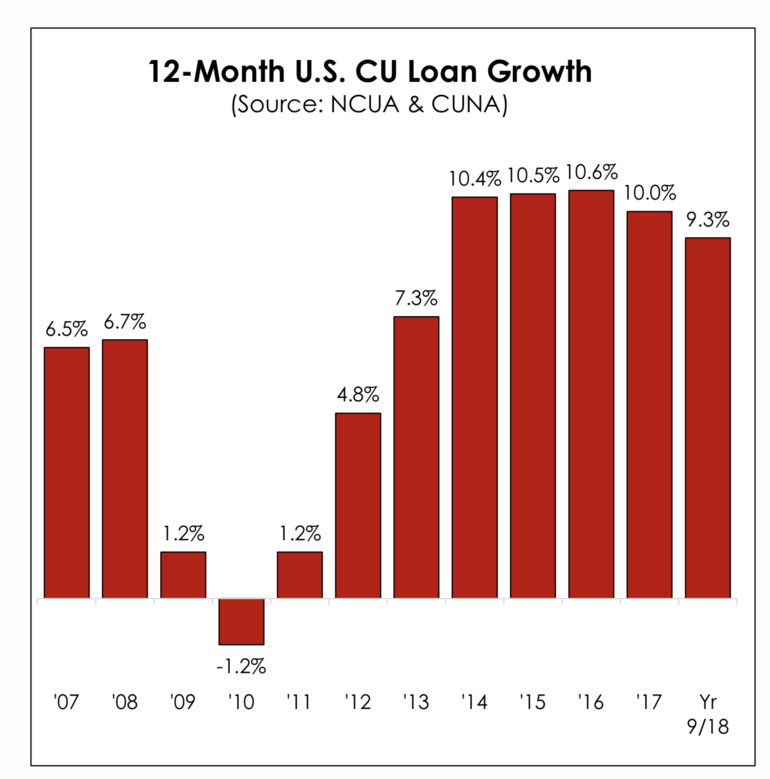
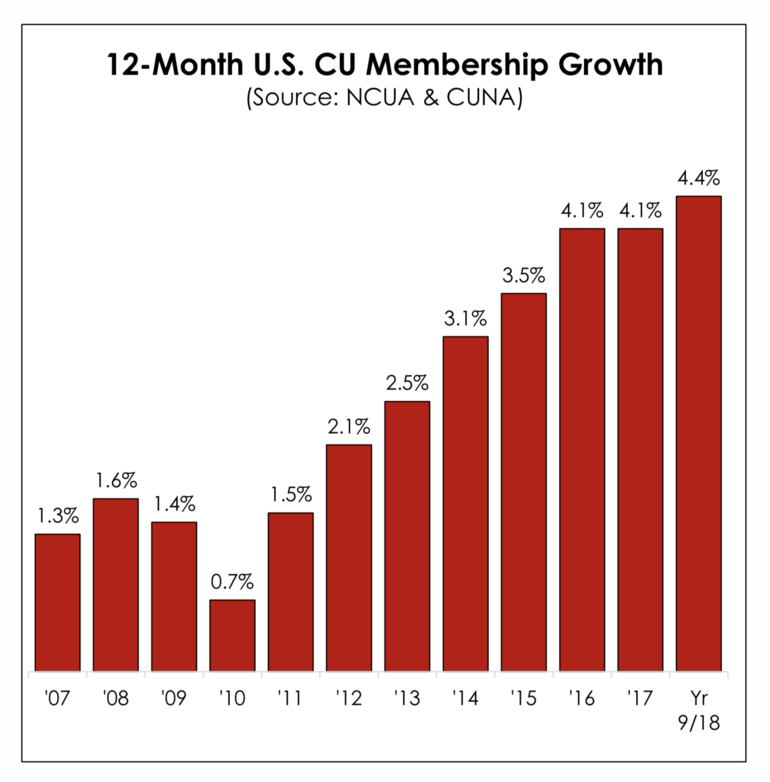
WASHINGTON–2018 will close as the fastest year for credit union growth since 1986, according to data released by CUNA.
The December CUNA Economic Update, which is sponsored by CUNA Financial Council, includes data through Q3 of this year.
In total, credit unions now report 117 million memberships—equal to roughly 36% of the U.S. population, according to the report. Membership is expected to grow 4.4% in 2018, after growth of 4.1% in both 2016 and 2017.
Loans were up 10.3% on an annualized basis through Q3, although Q3 growth was actually a bit slower than Q2, and year-over-year growth of 9.3% also trailed earlier performance, according to the report.
As CUToday.info has regularly reported, loan growth varies significantly according to asset size. The smallest credit unions, those with $20 million or less in assets, have seen 4.4% loan growth in the year ended Sept. 30. The nation’s largest CUs, those of more than $1 billion in assets, have seen 10.5% growth in loans over that same period.
New and used autos, as well as first mortgages, have been the strongest driver of new loan dollars.
“Strong labor markets, rising incomes and low energy prices should all help to buoy overall economic results,” said CUNA economist Mike Schenk. But, he added, “we are of course mindful of the challenges represented by rising geopolitical risks, the danger of escalating trade disputes and increasing stock market volatility.”
With loans growing fast and savings balances not keeping pace, the loan to-share ratio was 85.2% as of Sept. 30, its highest point since 1979. That has put pressure on liquidity, and it’s an issue that is likely to get “significant attention” from examiners, according to Schenk.
Margin pressures are also being felt, noted Schenk, who pointed to the 20% of CUs that hold 50% of assets and which also are reporting loan-to-share ratios of 90% or higher. Adding to those pressures are increases in returns being offered by money market accounts and mutual funds that are following rates north, meaning more expensive deposit balances if a CU wishes to attract and retain funds.
Looking Forward
Looking forward, Schenk said credit unions can expect healthy member and loan growth in Q4 and into 2019, even with the Fed rate increases. He said portfolio increases are likely to moderate, however, and it’s unlikely CUs will continue to see double-digit increases in loans.
Moreover, as rates rise, many consumers will be forced to look at adjustable-rate loans, meaning CUs will have fewer fixed-rate mortgages to sell, which will compress non-interest margins.
A new video on the most recent numbers can be found at cuna.org/economicupdate.