

ALEXANDRIA, Va.–Credit unions eligible for a new $9 billion federal program that provides emergency capital have expressed some frustrations over what they say have been inconsistencies in the process of filing applications, while also expressing other concerns.
Other sources have told CUToday.info some inconsistencies are understandable, given the newness of the program for both NCUA and Treasury, with NCUA telling CUToday.info the Emergency Capital Investment Program (ECIP) comes with unique requirements and that it has been in regular communication with Treasury.
The Consolidated Appropriations Act of 2021 created the ECIP in response to the coronavirus pandemic to encourage low- and moderate-income community financial institutions to augment their efforts to support small businesses and consumers in their communities.
Up to $9 Billion
Under the program, Treasury will provide up to $9 billion in capital directly to depository institutions that are certified Community Development Financial Institutions (CDFIs) or minority depository institutions (MDIs) to, among other things, provide loans, grants, and forbearance for small businesses, minority-owned businesses, and consumers, especially in low-income and underserved communities.
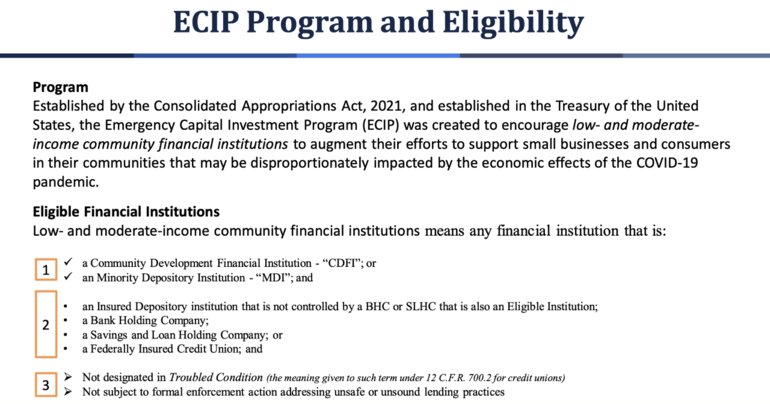
Treasury set aside $2 billion for CDFIs and MDIs with less than $500 million in assets and an additional $2 billion for CDFIs and MDIs with less than $2 billion in assets.
An eligible credit union that is applying for ECIP funds in the form of subordinated debt and also has a designation of low income status (LICU), may submit a secondary capital plan as per NCUA Part §701.34 to recognize the ECIP amount as net worth.
Money Going Unspent?
CUToday.info has spoken with numerous sources that further indicated one of their other concerns is the money will go unused, which will affect any future appropriations from Congress. Other concerns include claims of inconsistent treatment and responses related to ECIP by the NCUA regional offices and the headquarters office itself, and a lack of guidance related to treating ECIP differently than other capital.
Availability of Funds
Those issues and other concerns were also discussed by participants during one webinar after which CUToday.info agreed to respect the confidentiality of those sharing comments, as some were unaware a reporter was present.
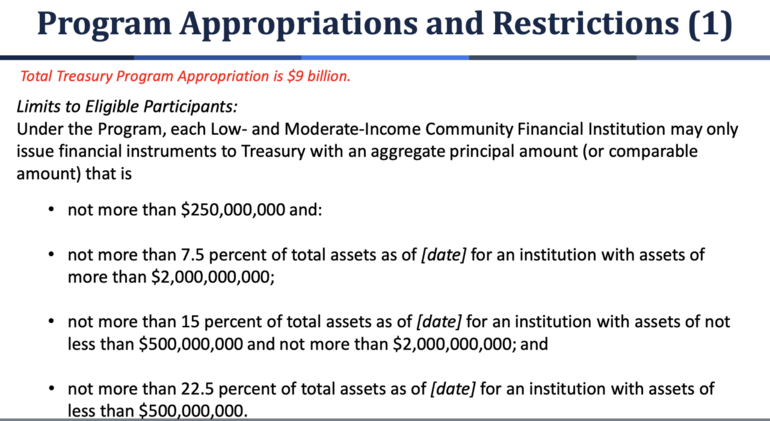
Under the new law, the maximum amount of funds available are dictated by asset size, including:
- Not more than 7.5% of total assets for an institution with total assets of more than $2 billion
- Not more than 15% of total assets for an institution $500 million and $2 billion
- Not more than 22.5% of total assets for an institution with assets below $500 million
Those caps on the ECIP funds are above what NCUA typically approves for credit unions receiving secondary capital.
In response to some of the ECIP-related discussion, NCUA responded to numerous questions from CUToday.info regarding the issues some credit unions have raised. The agency did so in writing, with those responses below:
CUToday.info: There were two themes CUToday.info has heard most often in speaking with credit unions and others, the first of which was that it’s much easier to qualify for funds via ECIP under Treasury than it is under NCUA’s interpretation/requirements related to the program? The first theme is this: How aligned is NCUA with Treasury’s requirements for participation in ECIP?
NCUA: The NCUA has been in regular contact with Treasury since the beginning of the program’s development and on any changes that occur as they build out their program. It’s important to remember that ECIP has unique requirements. Only CDFI-certified and MDI-designated financial institutions can access the program and must complete the application according to Treasury’s requirements. It is also important to remember that the ECIP funds are a form of subordinated debt, with their unique requirements for credit unions.
(NCUA instructed credit unions to view slides 14-20 here)
If an eligible credit union wants its ECIP funds to count towards its capital levels in the form of secondary capital, that requires a separate track of approvals through the NCUA. First, that CDFI-certified or MDI-designated credit union must qualify for or have the low-income designation to be eligible for secondary capital. Second, the eligible low-income designated credit union must submit a secondary capital plan that meets the requirements outlined in NCUA’s rules and regulations, and the plan is to be reviewed and approved by their respective NCUA regional office or the state, if applicable. Information on what is required for a secondary capital plan is available here.
CUToday.info: The second theme heard from credit unions is the regional offices seem out of sync with each other and with the general direction provided by NCUA headquarters.
NCUA: NCUA Headquarters has been regularly communicating with regional offices to ensure consistent messaging about the program, how the funding can be used as secondary capital, and the review process for the secondary capital plans received. These all are described in a Sept. 2019 letter to credit unions available here.
CUToday.info: To date, what has been NCUA’s experience with ECIP?
NCUA: NCUA is working with Treasury to ensure credit unions have what they need to apply for the program.
CUToday.info: Are any delays related to larger requests receiving more scrutiny? Are credit unions perhaps submitting requests for too much funding/more than they need?
NCUA: Each ECIP application into the Treasury program will be evaluated against the eligibility requirements and the responses to investment plan questions.
CUToday.info: What kind of applications/volume is NCUA seeing from credit unions (if any)? What kind of questions are you getting from credit unions interested in ECIP?
NCUA: NCUA has no estimates of the number of eligible credit unions that may apply to the program. Questions received from credit unions have been focused on the parallel process of submitting a secondary capital plan.
CUToday.info: What kind of conversations has NCUA had with Treasury regarding ECIP, and if conversations have occurred, what has come out of those? Any changes planned? Does NCUA believe Treasury needs to provide additional direction?
NCUA: NCUA worked closely with Treasury since the final legislation back in December 2020 on document processing, application consulting, and other documents.
CUToday.info: Has any guidance been issued by NCUA to the regional offices regarding treating ECIP differently than other forms of secondary capital?
NCUA: The planned Treasury investment into eligible credit unions will be in the form of subordinated debt, thus if an eligible credit union is also designated as low income and wishes to have the ECIP investment count as regulatory capital, then the credit union will also need to submit a secondary capital application to the Regional Director.
CUToday.info: CUToday.info has heard at least one member of Congress has concerns these issues are going to mean allocated funds going undeployed. Is that a risk?
NCUA: Congress has appropriated a total of $9 billion for all eligible financial institutions (banks and credit unions). At this point we do not know what the total amount of distributed funds will be until the application period expires on May 7, 2021.
CUToday.info: What do you recommend/advise for a credit union interested in ECIP do/be doing at this point?
NCUA: Interested credit unions should first determine if they are eligible to participate in the ECIP program. The U.S. Treasury ECIP website includes information about eligibility, application process and the investment instrument, along with answers to frequently asked questions.