

MADISON, Wis.–The nation’s credit unions have hit a number of “historical” milestones according to TruStage’s newest Trends Report, including:
- Small, medium and large asset sized credit unions reported similar double-digit loan growth “for the first time in living memory"
- Fixed-rate first mortgage loan balances fell 1.6%, “the biggest decline in credit union history"
- For the “first time in many years,” smaller credit unions are reporting a return on asset ratio very similar to the billion-dollar credit unions.
The analysis are included in TruStage’s September report, which is based on data as of July.
All of that is according to TruStage’s September Trends Report, which is based on data as of July.
Here’s a look at how credit unions performed by category, with analysis by TruStage Chief Economist Steve Rick.
Total Credit Union Lending
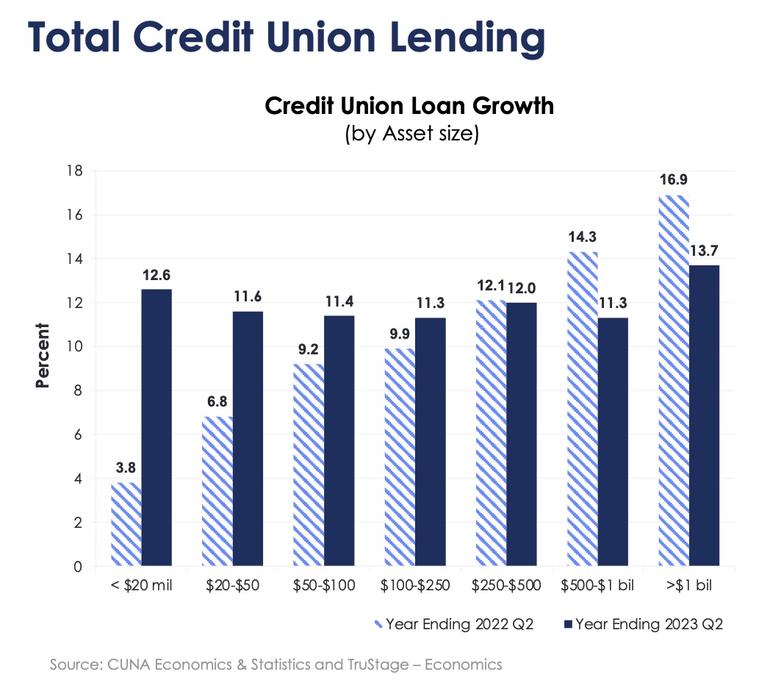
Credit union loan balances rose 12.5% in the year ending in June 2023, slower than the 15.4% pace reported in the year ending in June 2022, according to the Trends Report.
“This was due to larger credit unions (assets greater than $0.5 billion) reporting slower loan growth this year than last year, especially in the direct and indirect auto loan categories,” the analysis states. “Credit unions with less than $250 million in assets reported faster loan growth in the year to June 2023 compared to a similar period one year ago. For the first time in living memory, small, medium and large asset sized credit unions reported similar double digit loan growth.”
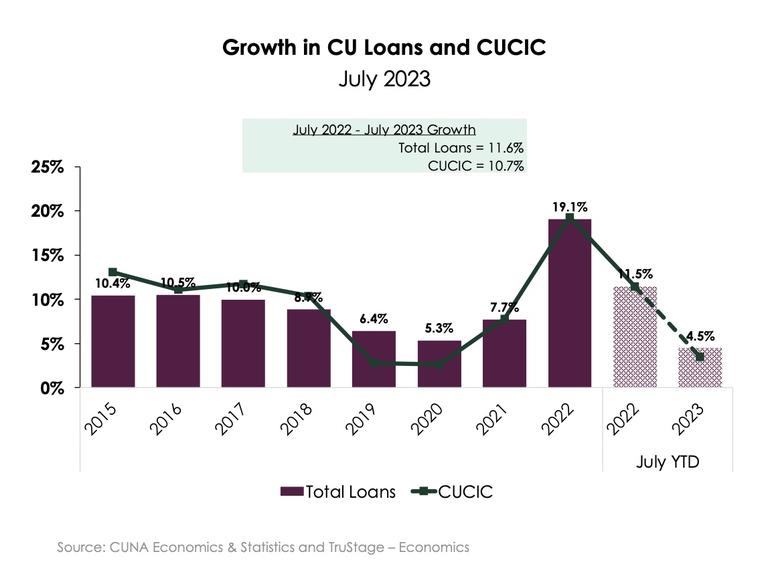
The Trends Report shows credit union loan balances grew at a 7.4% seasonally-adjusted, annualized growth rate in July, significantly below the 19% pace set in July 2022 when credit unions picked up market share in the auto loan space.
“Over the long run, credit union loan balances rise on average 7% per annum,” wrote TruStage Chief Economist Steve Rick. “We are forecasting below-trend credit union loan growth for the next two years (around 4%) as the economy slows under the weight of higher interest rates, and the unemployment rate rises to the natural rate of 4.5%.”
Consumer Installment Credit
For the first time in more than three years, the Trends Report is reporting credit union consumer installment credit loan balances (auto, credit card and other unsecured loans) rose at a slower pace than all credit union loans during the first seven months of 2023.
“Weak deposit growth at many credit unions is reducing the supply of credit while higher borrowing costs are reducing the demand,” the report states. “Credit union consumer installment credit rose 10.7% during the 12 months ending in July, above the 6.9% pace reported by all other lenders. Bank credit has been declining for the last few months as liquidity is becoming in short supply.”
According to the Trends Report, credit card balances grew at a 15.1% seasonally-adjusted annualized growth rate in July, slightly below the 16.4% pace reported in July 2022.
The report notes July’s credit card seasonal factors usually add 0.62 percentage points to the underlying trend growth rate as people venture out on vacations.
“Rising gas prices and consumers increasing their spending on services will keep credit card loan growth in double digit territory for the remainder of the year,” the analysis added.
Vehicle Loans
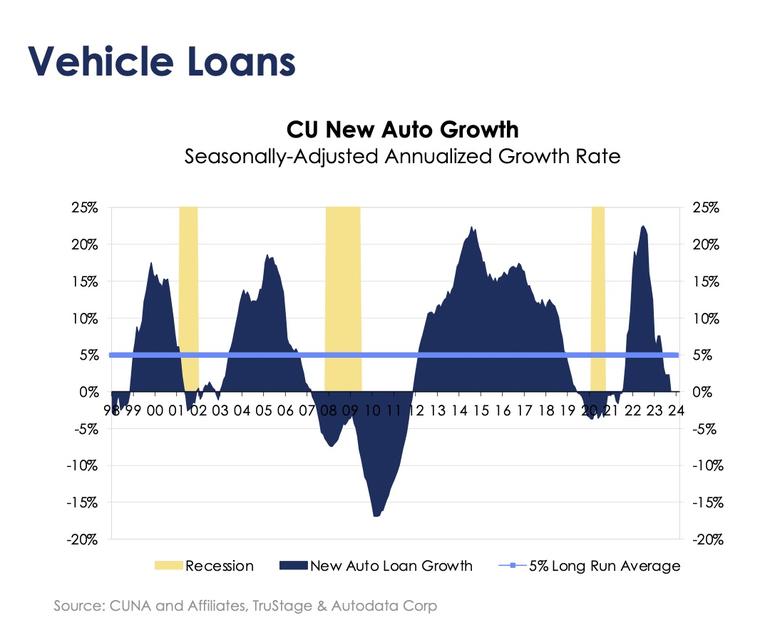
Credit union new-auto loan balances rose 0.2% in June, a big drop compared to the 4.7%
gain reported in July 2022, according to the Trends Report.
“Higher interest rates and increased competitive pressure from captive finance companies has reduced new-auto lending at credit unions,” the report states.
The Trends Report added that on a seasonally-adjusted annual rate new-auto loan balances rose only 2.8% in July, the slowest pace since the fall of 2021.
“The month of July is historically in the middle of the May through October new-auto lending season,” the report stated. “New-auto loan balances rose 1.5% year to date, significantly below the 15.4% jump reported during the first seven months of 2022 and below the 8% long-run average expected during a healthy labor market.”
The Auto Forecast
The report also cites data showing vehicle sales rose to a 15.8 million seasonally-adjusted annualized sales rate in July – up 0.6% from June and 18.3% above the 13.3 million sales pace set in July 2022.
“However, higher interest rates will ensure that new vehicle sales remain below the 16.5 million long-term equilibrium until 2025,” the Trends Report states. “We expect U.S. new vehicle production to return to 2019 levels by the end of the year. This follows on the heels of three years of COVID-19 related health restrictions and supply chain disruptions that reduced auto production and inventories. The increased supply of vehicles has reduced new car prices 3.2% below their recent peak. New vehicle prices, however, are still 30% above their 2019 average.”
Real Estate Information
Credit union fixed-rate first mortgage loan balances rose 0.01% in July, below the 2.4% increase reported in July 2022, with the Trends Report adding that credit union fixed-rate first mortgage loan balances fell 1.6% at a seasonally-adjusted annual rate in July, the biggest decline in credit union history. Adjustable- rate first mortgage balances rose 16% during the first 7 months of 2023, better than the 33% decrease reported for the similar period in 2022 and have increased 30% during the last year, according to the Trends Report.
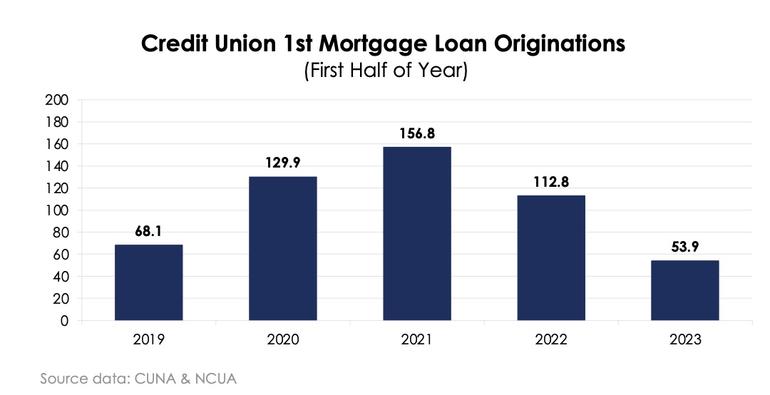
The data show credit unions originated $53.9 billion first mortgage loans in the first half of 2023, a 52% decrease below the $112.8 billion in originations in the first half of 2022 and a remarkable 65% decrease below the record $156.8 billion in originations in the first half of 2021.
Credit unions then proceeded to sell off 22.1% of those originations into the secondary market, slightly below the 22.3% sold off in the first half of 2022, the analysis added.
“The stage is set for a weak second half of 2023 due to the recent rise in mortgage interest rates above 7% and low supply of home for sale,” Rick wrote. “We expect both purchase and refinance mortgage activity to slow during the next six months.”
Rick is further forecasting that long-term interest rates will remain elevated this winter as the Federal Reserve continues its Quantitative Tightening program; reducing their purchases of Treasury bonds and agency mortgage-backed securities.
Savings & Assets
The Trends Report shows credit union savings balances fell 1.0% in July, below the 0.05% increase in balances in July 2022.
“July is normally the weakest month of the year for saving balance growth due to seasonal factors shaving off -0.6% from the underlying trend growth,” the report states. “These seasonal factors include things like vacation spending and auto loan down payments.”
The Trends Report further notes that during the first seven months of 2023, savings balances rose only 0.2%, the slowest in modern credit union history and below the 3.9% reported in the first seven months of 2022.
“With credit unions raising the interest rates paid on saving deposits, the interest paid by credit unions should have raised deposit balances by around 0.8%,” the report states. “Moreover, with membership growing 1.8% in the first have months of this year, deposit balances should have increased as new members opened checking and savings accounts and deposited new money into the credit union. Therefore, savings growth per member is currently falling at a remarkable -3.5% pace, the weakest pace in credit union history.”
What NCUA Data Show
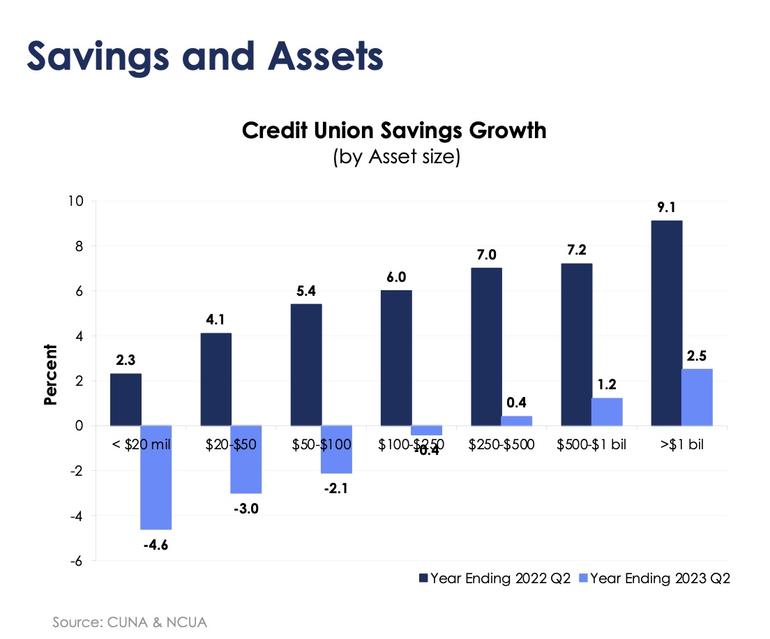
The report cites NCUA call report data showing credit unions of all sizes reported weak savings growth rates during the last year (as compared to 2022).
“We expect credit union savings balances to report no growth in 2023 and then accelerate to only 3% in 2024,” the report adds.
Capital and Other Key Measures
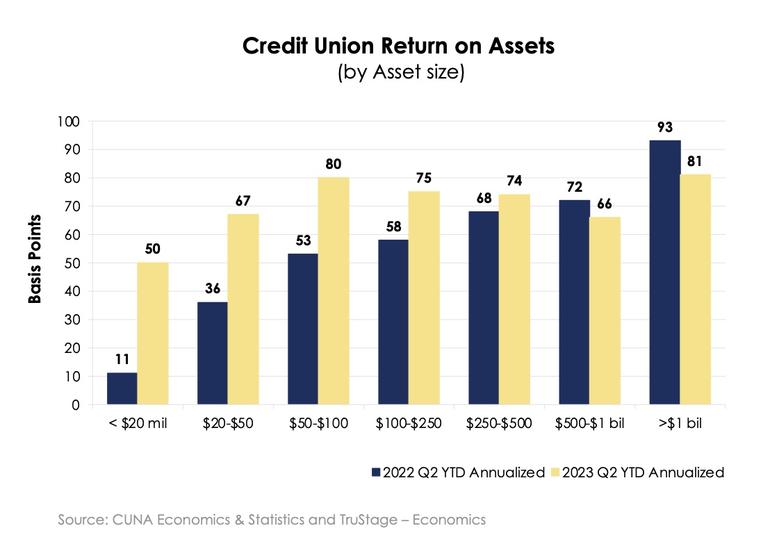
According to the new Trends Report the credit union return-on-asset ratio fell to 0.78% in the first six months of 2023 on an annualized basis, down from 0.85% in the first six months of 2022.
“The seven-basis point decrease in earnings during the last year was driven by a 26-basis point increase in provisions for loan losses as a percent of average assets, a 15-basis point increase in operating expense ratios and a one-basis point drop-in fee and other income ratios,” the report states. “Partially offsetting those negative factors was a 35-basis point jump in net interest margins as the yield on asset ratios rose faster than the cost of funds ratios.”
Additional Findings
Among other findings in the category, according to the Trends Report
- Credit unions with assets greater than $500 million in assets reported a drop in earnings while smaller credit unions reported higher earnings due to the difference in the increase in their cost of funds ratios. “For example, billion-dollar credit unions saw their cost of funds ratios rise from 0.40% during the first half of 2022 to 1.33% in the first half of 2023, a 232% increase.”
- Credit unions with assets between $50-$100 million saw their cost of funds increase from 0.21% in 2022 to 0.52% in 2023, a 147% increase. “This cost of funds disparity is due to bigger credit unions relying more on higher cost money market and certificates of deposit accounts for funding. So, for the first time in many years, these smaller credit unions reported a return on asset ratio very similar to the billion-dollar credit unions.”
Credit Unions & Members
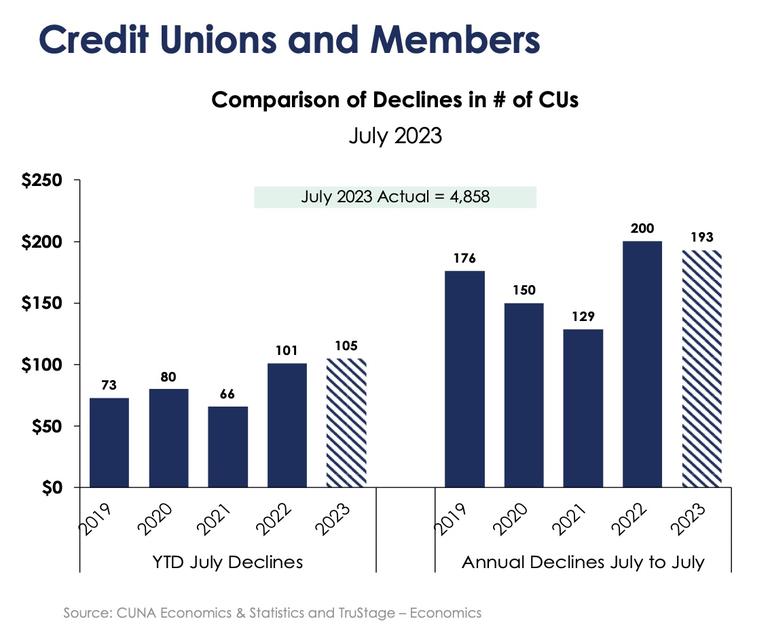
As of July 2023, CUNA estimates 4,858 credit unions are in operation, down two from June.
Year-to-date, the Trends Report found the number of credit unions fell by 105, which is more than the 101 reported in the first seven months of 2022.
“The recent rapid increase in interest rates has put downward pressure on many credit union net interest margins, and reduced deposit and loan growth,” the report forecasts. “These factors will increase credit union merger activity for the next couple of years.”
The report further notes that recently released mid-year NCUA call report data shows 426 credit unions with assets over $1 billion and 293 credit unions with assets between $500 million and $1 billion.
“The greater than $1 billion asset category represents 8.9% of all credit unions, but more than 75.2% of the credit union system’s assets and 77.1% of the loans,” the Trends Report states. “The median asset size of a U.S. credit union rose to $55.4 million in mid-year, up 4.3% from the $53.1 million reported at mid-year 2022. The average asset sized credit union rose to $469 million from $436 million compared to one year earlier. The average sized credit union is almost 10 times greater than the median asset size credit union due to a few very large credit unions.”
Just Because It’s Autumn Doesn’t Mean Falling for Schemes to Overcharge You for CU Industry News. Instead, Try This Crisp Offer
The biggest, best and freshest news reporting in credit unions remains free! Each morning CUToday.info delivers its daily Fresh Today news update offering the latest headlines and breaking news right to your email, with the easy-to-read headlines format allowing you to click on the stories that interest you most in order to learn more. So stop paying those bank-fee-like subscription prices from other so-called “news”” publications!
If you haven’t yet signed up for the new email solution on which CUToday.info has partnered with ResponseGenius, you can do so here. Signing up requires less than one minute of your time—and it’s free!
Please note that after signing up you may need to go to your Spam/Junk folder and mark the morning headlines email as safe. CUToday.info does not provide its list of readers and emails to outside parties, and we will not be contacting you to sell you an extended warranty or sending you any links so you may cash in on an inheritance you didn’t know was coming.
And did we mention it’s free?