

AUSTIN, Texas–There’s great risk in not understanding risk–just ask one credit union that lost membership for 13 out of 16 years until it finally turned things around.
That credit union, Infinity FCU, was able to stop falling out of the tree and start climbing it after bringing onboard a new CEO and implementing an enterprise risk management program.
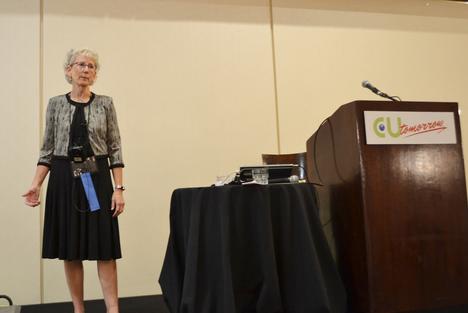
Sandy Cloutier
Sandy Cloutier, chief risk officer with the $358-million Infinity FCU in Maine, told the CUTomorrow Conference her CU has not yet returned to the number of members (20,100) it had in 1998, but it has since rebounded to approximately 16,500.
The long membership decline at the credit union was largely due to its refusal to embrace risk and change and to instead remain conservative and safe. As the trendlines made clear, it needed to make changes, said Cloutier.
“We were very siloed. Departments made changes based on what was good for them, without any thought over how it might effect someone else,” she said. “As we moved forward into ERM, we were hoping for more transparent communications and a culture shift. The first thing we needed to do was get a risk appetite profile for the board. That created clear boundaries for us, and allowed us to stretch our comfort levels, and to become comfortable when it felt uncomfortable.”
Cloutier said staff education was needed on why the credit union needed to change and to answer the question “What’s in it for me?” Infinity FCU also worked to ID what archaic processes were in place.
“People were really worried about their jobs. Change can be scary for them,” she acknowledged. “They were very comfortable waiting for members to come into the credit union and waiting for the phone to ring.”
The Opportunities
For Infinity FCU, the opportunities included:
- Process improvements and savings in time and money
- Embrace ERM philosophy
- Have a risk committee
Where 1 CU Started
Cloutier said Infinity FCU started its process with a risk assessment implementation in which she met with each functional area (not with managers) to discuss inherent risk, mitigation and residual risk.
“It was like opening the floodgates,” Cloutier said of the staff response. “We began to get the buy-in from our teams, and that’s what started the culture shift.”
Today, she said the credit union has moved 90% to 95% away from being siloed.
“I continue to do ongoing risk assessments to ID impact to strategic objectives,” said Cloutier.
The credit union now has a Risk Committee that meets quarterly in a dedicated session to talk about risk. The committee uses the same seven risk categories as NCUA: Compliance, credit, interest rate, liquidity, reputation, strategic and transaction.
Infinity FCU also has a Risk Action Plan to keep itself updated and to hold itself accountable. It also uses a Heat Map for the board to show shifts and to help the board to understand without having to read through a risk action plan.
The Results
After a long membership decline, Infinity has turned things around. From $273 million in assets in Q2 of 2015, it has grown to $343 million in assets by Q2 of this year.
“We have open communications and transparency. It’s a culture shift with employee empowerment,” said Cloutier. She noted the process changes it has identified have saved it 161 man-hours per month, especially in manual processes such as ACH, BSA, member address changes, fraud process and certificate processing.
“I’m very excited about our future. I don’t know where it’s going to go, but I know two things: In Maine, our CUs are very strong, but we have a very low share of market in relation to the banks and we are going after that, and our Risk Program will be a big part of that process,” she said.