

CHICAGO–Reading this story on a device while someone else is attempting to speak to you or get your attention? You’re failing as a leader.
The good news? One person here offered some practical advice and strategies for getting better.
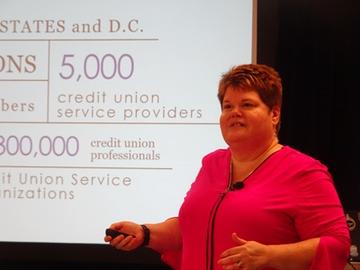
Angela Prestil speaks at the meeting
Speaking to the joint annual conference of the CUNA Operations & Member Experience Council and the CUNA Technology Council, Angela Prestil, VP of Business Development with CUNA, stressed that leaders, especially those who have risen to the C-Suite, must recognize that “what got you here won’t get you there,” which also happens to be the title of a book she highly recommends by Marshall Goldsmith.
After polling her audience she found many had started at the bottom in credit unions as tellers and other entry-level positions. That’s common, she said, but it brings with it an inherent challenge.
The Double-Edged Sword
“People know why you got where you are. You may have gotten to where you are because you worked hard and were never late and always a balanced your drawer,” she said. “The good news is people will know why you got that role. You pushed harder. The bad news is people will know why you got to where you are. It’s a double-edged sword in any leadership role. At some point you made the leap from being the best at the technical role to having to be the best at the behavioral side.”
Prestil’s focused her remarks on what can get a person to the next level of leadership, along with become better in their current role.
“Self-limiting behavior is what holds us back. It’s what Goldsmith calls ‘derailers,’” explained Prestil. “What once gave us that upper edge is now holding you back. That reputation, that perception stays with you throughout your career. So again, what got you here isn’t what’s going to get you to the C-Suite or even the corner office.”
Self-Limiting Behaviors
Among the self-limiting behaviors and ways those behaviors can be changed, according to Prestil:
Winning Too Much
“When you have someone who talks to you about their goals, their life, about whatever is going on, there are so many things that get in our way about truly hearing that person, being happy for them and trying to one-over them,” Prestil said. “If you find yourself in too many arguments at work, it’s a sign you can’t let things go because your idea is the best.”
Adding To Much Value
Referring to the classic TV program Cheers, Prestil described adding too much value as the “ Cliff Clavin Principle,” where someone always has to add their two cents.
“No matter the idea, someone has to one-up it,” explained Prestil. “The more you rise up in your ranks, the more you know. Nobody can really tell you a lot that you don’t already know. So, if someone comes to you to talk to you about a project they are working on and are excited about, if you try to win too much, their motivation is going to drop for that project.”
Not Listening
“We are a world that’s interconnected. Do you have a culture where you take laptops to meetings? The meeting goes on too long, and that flashing light for your emails is calling. What you’re telling people if you stop listening is you are smarter than they are, you know more than they do and they are wasting your time. You are crushing that other person and don’t even realize it.”
Failing to Give Proper Recognition
This issue is so many managers have a lot going on and often need to get on to the next task, Prestil said.
One audience member said her own failing is, “I don’t need a lot of positive reinforcement, so I forget a lot of other people do.” Another added, “We tend to focus on the task rather than the people.”
“One of the recommendations in the (Goldsmith) book is to take time to list out all the important people in your life and then list out the people most important to you in those groups, and every week you go through the list and ask, ‘Did anybody on any of these lists, do something worthy of my recognition?’ If they didn’t, you do nothing, and maybe get a little concerned if that happens week after week. If they do, don’t be false about, be sincere.”
Failure to Express Gratitude
“Say please and thank you. But if all you do is just say thanks, it can be a slippery slope as a leader,” said Prestil. “It’s not just saying thank you, it’s failing to give the whole story as to why you’re grateful. Thank you is not gratitude. We need to say specifically what it is we are appreciating them for. Making it personal. Make them excited to come to work.”
What Will Get You There?
According to Prestil, the kinds of behavior that can help a leader to stop, start and continue on a better track in their careers includes:
Apologize
“When you apologize you are acknowledging something you may regret and you are making a contract with that person that you want to get better. Step one: you say I’m sorry for (fill in the blank). Step two: You say, ‘I’ll try to do better in the future.’ Now, drop the mike and walk away.”
Advertise
“If you go on a diet, what they tell; you is to tell people about it so they will hold you accountable. They want to see you succeed, unless they are evil people. When you are putting it out there, when you say, ‘I’ve been distracted by my phone, I pledge to you I’m going to put it away during meetings,’ when you come to that next meeting and are holding your phone, people say, ‘She’s not really trying.’ Or, they see that you are.”
Follow Up
“You’ve heard the adage it takes 21 days to form a habit. How long do you think it takes to change a behavior? Twelve to 18 months, because it’s so ingrained,” said Prestil. “At any point, if you forget to follow up with your team and say, ‘How do you think I’m doing’ about X, they know it’s still top of mind for you and they know you are working hard on it.
The good news is when you tell people you are trying to change, you only have to get incrementally better for them to perceive you’ve gotten significantly better.”