

WASHINGTON–With more than seven-in-10 consumers still choosing their financial institution as the result of the branch they see, changing that experience and look can be critical—or the source of critical mistakes, according to one expert.
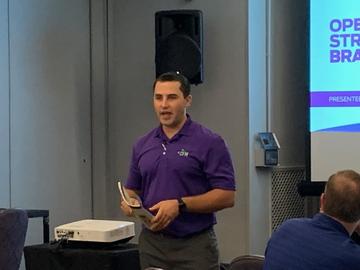
Cody Willis adresses the meeting
Among those mistakes: creating layouts where members don’t feel like “co-pilots” and selecting a board member’s general contractor.
Reminding the branch remains the “face” of the credit union, Cody Willis told CUs gathered here for the CUNA Operations & Member Experience Council and the CUNA Technology Council, branch transformation is much discussed, but not so often practiced.
Citing research, when consumers were asked how they see differentiation between products and providers, a category such as soap was scored 100 on a 1-100 scale. Financial institutions scored a zero. “In banking, a checking account from Bank XYZ and a checking account from Credit Union XYZ look alike,” said Willis, senior integrations specialist with CFM.
Whether FIs want to admit it or not, many consumers rate most branches as “cold and boring,” Willis added.
Despite the move to mobile services, branches and ATMs still represent 65% of the cost structure of financial institutions, even as there remains a steady decline in transactions.
For credit unions looking to transform their branches, whether as new builds or as remodels, Willis offered this overview, including where many FIs make what can be expensive mistakes.
The Trends
Willis said every financial institution is engaged in the same trends when it comes to branches and operations, including universal associates, tablet banking, micro-branches, onboarding to mobile, migration of transactions to self-service, looking to increase walletshare, demonstrate remote expertise, etc.
“Our largest opportunity isn’t in new markets and new members, it’s with the members we already have,” said Willis.
Ten Points
There are 10 points in mapping out the various steps involved in operationalizing the “branch automation path,” according to Willis, including:
- First impression (“Do I feel cold or warm?”)
- Engagement
- Wait times
- People choice. (“Do you let me choose who I bank with?”)
- Problem resolution
- Cold transition
- FSR confinement
- Partial service
- Getting started
- Attraction
“You advertise that your member service is better than banks’. All we talk about is our people. Yet a lot of banks and credit unions don’t allow us to choose the people we want to bank with,” observed Willis.
As an example of how difficult it can be to differentiate physical locations, Willis asked his audience to name the brands that come to mind when they are driving. The audience listed Chick-fil-A, McDonalds, and Starbucks. “There are two million different retailers, yet people always mention the same ones,” said Willis, noting another challenge is how frequently drivers are distracted by devices. “Standing out and catching the new member is really a challenge for your financial institutions,” said Willis.
Three Barriers
There are three barriers institutions must address to successfully transform a branch, according to Willis: Design, technology and process.
Design.
“Why do we even care about branch transformation?” he asked. “Some will say when people walk into our branches it feels friction-y. It doesn’t feel like an Apple Store or Verizon—they have reduced the friction of waiting with demo areas. A lot of credit unions recognize they feel the exact same at the bank or credit union down the road. To invite more foot traffic, members have to be attracted with a more inviting branch design. So, it’s how do we make the branch feel more like a destination? How do you make a space away from transactions where people can ask questions and feel comfortable?”
To do that in an environment when most CU members still have multiple products with other providers, Willis offered these three design elements of what he termed a “smooth operation”:
- Teller Towers. These are sometimes called pods or teller towers. “These types of service areas are designed to take the place of your traditional teller line. They are amazing at doing everything that teller line cannot do. Teller lines do not allow for a very good sharing of information. This allows you to move to a retail experience.”
- Service Spots. “These encourage warm member hand-offs from teller to an associate and eliminate confining office spaces with service spots any associate can use to quickly service a member. A lot of members are thinking, ‘Ugh–we’re going into a closing room? This is going to take forever.’ The office perception is negative and you don’t want your members thinking about it. Offices give all of the control to the associate and not to the member. People feel locked in when they want to feel like a co-pilot. And the third thing this does is the CU associate feels like a sales person. If you use cubicles, there is usually something of a privacy issue. So, what I recommend is more of a service spot or service area. People then feel they are only going to be there for a minute and it’s more side-by-side with that copilot feeling. And with no walls, the member realizes they can get up and leave anytime they want.”
- Flex Spaces. “These are areas where universal associates will thrive. It’s informal, but still secure. Leave the conference rooms and intimidating sales-driven atmosphere behind. Instead, offer open, flexible workspace for associates to advise their members on banking requests. These are getting much more popular.”
What Goes into a Branch Transformation Project
Some of the things to step about in a branch transformation project, recommended Willis, is to begin with project guidelines. This is the first step in building out a projected budget.
Other steps include:
- How big will the branch be? Is it a microbranch, a “transformed” branch (usually 1,200 to 3,000 square feet) or a traditional branch of more than 3,000 square feet.
- What’s the current occupancy status? Is it vacant or occupied? This makes a big difference. If its occupied with branch staff, you’re going to have to work weekends and maybe nights, and keep it clean. That has to be managed.”
- What’s your delivered level of finish: Low, medium or high? “There is a large range here and based on your member base and what other branches look like, costs can vary from $300 per square foot to more than $1,000 per square foot.”
Willis said experience has shown branch budgets are often under-allocated and more expensive than many expect, due in part to not counting indirect branch expenses.
The Process
It’s critical to have a process in place before beginning, said Willis.
“Don’t have a vendor hand off what they are responsible for to you, and you have to figure out what’s next. This is the biggest delay in building branches and can be challenging. It’s a common story that a branch opens eight months late. There has to be a perfect hand off of the baton every time.”
The Big Mistake
“Don’t hire the board’s contractor or designer,” cautioned Willis. “This has happened to me three times in last 18 months to two years. When designing a branch, it can be easy to shoot for the stars and miss. The board may say they know a general contractor who says ‘I can do it for cheaper.’ It takes an expert to get it right; otherwise your project could be over budget, past deadline, riddled with change orders, require updates a year later, and fall far below expectations. And you can’t hold the board responsible for any of this because they are your boss.”
Create a Playbook
Willis stressed he is an advocate of having a Transformation Playbook.
“Once you’ve decided on an approach and a design firm, everyone on the core team must stack hands-on the strategic intent for not just one branch, but network-wide adoption over time,” said Willis. “All your challenges, desires and research in-between are summarized in an executive summary to ensure executive alignment is obtained, and we are all on the same page. This aligns everyone 12 to 18 months prior to the branch opening. There is so much that can change; minimize that change.
Technology
When looking at new technologies, Willis urged CUs to ask themselves:
- Is the goal to be less transactional and more advisory?
- Do you have intentions of building up other service categories, such as real estate and investments?
- Better penetration of add-on services; showcasing of promotes and reasons why?
- Focusing on the member: is your cash flow automated?
- Moving to digital services: are you trying to have all members use mobile deposit?
Do the Math
Willis said CUs must also ask themselves:
- Does this technology reduce transaction cost and time?
- Does it eliminate FTEs or require more support?
- Do the solutions make the banking experience better for the member?
- Do these technologies, or the impact they’ll provide, have a clear and measurable ROI?
People
Willis offered a final observation on branch transformation:
“If your employees don’t get the science behind the transformation then the members won’t either,” he said.