

MADISON, Wis.–No credit union leader needs to look far for a very real example of how the underlying assumptions in forecasting the future can be completely wrong and why SWOT analyses often don’t work, according to a futurist with the Ford Motor Co. But that doesn’t mean they should give up forecasting—instead, they need to think differently, she said.
Cheryl Connelly
Cheryl Connelly, manager of global trends and futuring with Ford, told the audience for the opening keynote session of CUNA Mutual Group’s virtual Discovery Conference that what no leader can do is be fearful about the future.
“My job as a futurist is to get you to think about what if the consequences of your underlying assumptions turn out to be wrong? What happens to the plan? Can they weather them?” said Connelly.
And there’s no better example of what can happen to plans than the coronavirus pandemic, which was most certainly not the dominant agenda item when CUs were putting together their 2020 plans in the fall of 2019.
“Let’s talk about the pandemic,” said Connelly. “It shocked the world. But why? Experts have been warning us for two decades about their concerns. I’m not saying COVID 19 could have been predicted, but I am saying it could have been anticipated, and that’s what futuring is all about. It’s a difficult task; the scale, the pace of change is so rapid these days and most companies are struggling to stay abreast of it. And the truth is, the older your organization, the harder it is to stay ahead. It often means we have to blow up our current business model, even if things are working successfully.”
So where to begin? According to Connelly, the following are some of the “tricks of the trade” on how to think like a futurist:
Think Differently
“Those people who never learn to think differently will always be surprised by the future,” said Connelly, citing the famous example of the once dominant Blockbuster, to which Netflix’s founders attempted to sell the company only to be laughed at. Everyone knows how that turned out, reminded Connelly, adding, “A business that penalizes its customers isn’t long for this world.”
Beware the SWOT Analysis
The problem with the popular Strengths, Weaknesses, Opportunity and Threats (SWOT) analysis, according to Connelly, is it’s “basically exaggerated naval gazing” that starts with an internal analysis. “But you don’t own your space,” said Connelly.
As an example, Connelly cited her own industry, auto manufacturing, which was churning out as many SUVs as possible in the run-up to the Sept. 11 terrorist attacks. That suddenly led to concerns over the price of gas, while at the same time evangelical ministers started to take on environmentalism, and all those long-haired tree huggers of the ’60s grew up to become respected business leaders who said “We can no longer deny the way they people are living their lives is having an impact on the world around them.”
“So, here was a situation where an industry relied on its strengths and was blindsided,” said Connelly. “None of those things would come up in a SWOT analysis.”
Math Can Really Mislead
Connelly noted when it comes dealing with uncertainty, many business leaders like to turn to mathematical models.
“But last I checked no one had a mathematical model for the future,” said Connelly. “Mathematical models always look back. Consider how unprecedented technology is. And consider big data. It’s an exciting opportunity, and many think ‘If I take all this information and model it, I can understand where customers’ heads are.’ But there is bias from whomever is slicing the data…And the challenge is it’s very difficult to think about every single factor as you move forward.”
Be Provocative
Connelly called being provocative the “bread and butter skill in getting people to think differently. The best way to start, she said, is with a wild card analysis, such as what might happen to plans in the event of something like a tsunami or a pandemic.
“Those have a low probability of happening, but if they do happen, they have a high probability of really changing things,” said Connelly.
Be Plausible
Connelly said it’s one thing to be provocative, “but if you want to stay employed, you must balance your provocation with plausibility.”
“Not everyone has the same appetite to be challenged,” Connelly told the meeting.
The best strategy for being plausible, suggested Connelly, is to look at trends while also keeping in mind, “Everyone is watching this their own unique set of values. Your values rarely change,” she said. “When I talk about values from a futuring perspective, I’m talking about events that might cause those values to change.”
One point Connelly said she wanted to emphasize is there is danger when someone says the trend or forecast doesn’t apply to them or their industry.
“The problem is, sometimes when we focus only on our region or our industry, we miss the big picture. Industries excel at putting the spotlight on the one area in which they are interested, and then they get blindsided,” said Connelly. “You need to have a floodlight on the global market.”
Global Trends
One of the global trends worth watching, according to Connelly, is global population growth. She noted in 1800 the global population was approximately one billion; by 1900 that was 1.5 billion, by 2000 it was 7.0 billion, and today is closer to 8.0 billion. Forecasts see 9.0 billion by 2040.
“That’s an extraordinary feat, but it should give you some concern,” said Connelly. “How do we make sure we have enough resources for a population of that size. Today, there are about one billion people without access to clean drinking water. People spend three hours per day looking for a clean water source…I point this out because these resource restraints aren’t something we think about on a daily basis, but they do change our world as we know it and in the coming decades we can expect to see more and more shortages.”
Where population is growing is changing, with populations actually shrinking in developed nations where higher levels of education among women has led to lower birthrates (the map below shows the size of countries according to where population is expected to grow).
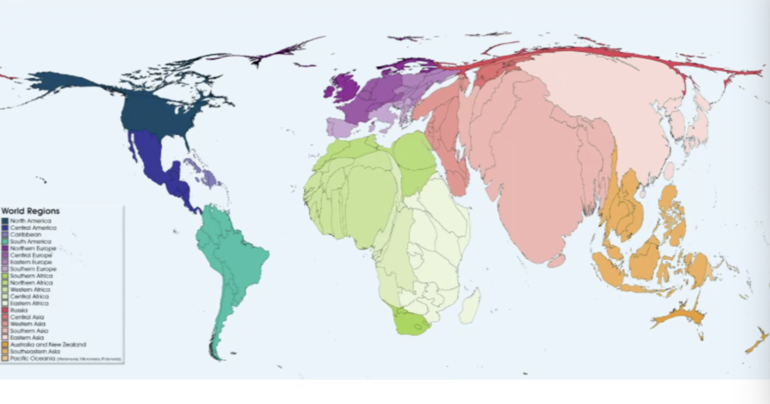
“The U.S. is below the replenishment rate and our population is shrinking,” said Connelly. “Closely tied to that is our base customers in mature markets are rapidly aging. This will continue to be exacerbated by advances in health care and medical science. The first person to live to 150 years of age has already been born. It will have a huge impact on the world as we know it.”
Today’s Marketplace
What is on minds of today’s consumers is shaping their values, said Connelly. But the problem is they often have too much on their minds.
“We have information addiction,” said Connelly. “We live in a world where the information we’re getting online is becoming more divisive. Google uses an algorithm that reinforces the news they think would be of interest to us. It creates an echo chamber and the serendipitous moments where we encounter something in a newspaper we might not have otherwise are not happening anymore. People are holding on to their values now. Now, it’s not just that people disagree, it’s that other person doesn’t have values and must be evil.
“It shouldn’t surprise any of us that mistrust in business, government and media has never been higher,” continued Connelly. “ Credit unions stand apart from that—this trend tells us this is the moment in time to lean into that change and seize it. Consumers are tired. They have information overload. The irony is information had never been more available to us, but our ability to discern it never been more difficult. We now have analysis paralysis.”
What It Means
What does all of that mean for credit union leaders? One challenge, said Connelly, is so many workers feel disengaged from their employers.
“Perhaps because work has become so fractionalized, people don’t understand how their contributions matter,” suggested Connelly. “It has no meaning. It’s a bigger problem for people under age 40 if the company doesn’t share their values. There is nothing to incent them to stick around. What is your purpose? How are you manifesting the values?”
Ethical Consumption
While consumers and workers now have an unprecedented level of choice, Connelly said both constituencies increasingly want to know the purpose behind products/services and the values of those selling those products/services.
“We are moving to a time when more and more companies are called to take a stand, an ethical position,” said Connelly. “For credit unions, which are so community based and based on a membership model, it’s really important to know what your organization stands for. You may not use in your marketing, but internally they want to know. You should know in case you’re ever asked to take a stand.”
Thinking Like a Futurist
According to Connelly, the easiest way to start thinking like a futurist is to do so the next time a person finds themselves in a meeting and someone says, “That’s not going to happen, not under this leadership.”
“Just say, ‘Hold on, let’s just talk about what would have to be true for that to happen, and how does that undermine our plans?” said Connelly. “Something really wonderful happens when an organization lets go of the idea they can control the future. It forces them to be resilient and flexible. The only way to predict the future is to create it.”