

SAN FRANCISCO–From one-person departments in rural areas to billion-dollar CUs serving high-profile sponsors, business development specialists shared how they are approaching their jobs and overcoming the roadblocks they encounter.
In comments to the CUNA Marketing & Business Development Council’s annual meeting here, three people who work in business development discussed their jobs and responded to questions posed by fellow BD managers in the audience.
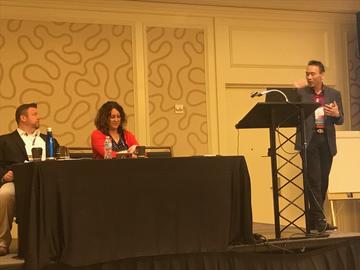
Speaking to the meeting were Royce Ngiam, VP-Marketing at the $1.6-billion Partners FCU in California (who acted as moderator); Julie Monahan, Business Development Officer at the community chartered, $451-million First Heritage FCU in upstate New York, and Jeremiah DeGollon, AVP-business development at the $2.9-billion Summit Credit Union in Wisconsin.
Here’s a look at some of the discussion:
Ngiam: How does collaboration work between you and your marketing departments?
Monohan: I don’t report to marketing; I am a department of one. But I work in the same building as our marketing team, which has four reps. I share my calendar with them, they know where I’m heading, what my upcoming events are, so I can work with them to make sure I have the proper materials. If I have something big or exciting happening that needs to be tailored, we have more of a strategic meeting. You have to work with your marketing team hand in hand.
DeGollon: It wasn’t until a couple of years ago that I put business development into our marketing areas. If you’re not part of the marketing umbrella, that’s the biggest challenge. I was trying to push what I wanted to do and it was seen as just more work, and I was just Public Enemy #1. But when we finally got everything moved over into marketing it became an outlet for our marketing team to accomplish their goals. That’s how we add value to that team. Since establishing that partnership we’ve been able to create ideas around other opportunities. We have put together a cross-collaborative group to work across events.
Ngiam: How did you get there and why?
DeGollon: We had to get there, because it was such a challenge. Every day was you had to fight for this and that. We were using Microsoft Word materials I basically created. Now we have actual materials we can be proud of and that’s a big win for me. It’s now something people take seriously.
Monohan: For myself, sometimes ‘it’s there she goes again, she’s out the door.’ It’s good humor but that’s how it’s perceived. Explaining to them where I’m going and what I’m doing really helps. I try to be in the office on Mondays and Fridays, with a meeting on Monday. On Mondays, I can sit down and tell them where I’m going, who we are targeting, and what the purpose is. The meetings are quick, but we have become more partners.
Audience Question: I am a department of one. My problem is when I hold an event for Realtors, for instance, I bring back a bunch of referrals, and the branch feels I dumped a bunch of stuff on them. How do I help make that connection with the branch staff and others so they see me as an asset?
Monohan: The establishment of goals for our branch has really helped me, as they see me as a partner who can help them meet their goals. You have to explain to them ‘I’m going to this event and I’m going to bring this back.’ Or maybe you take your branch manager with you so they see the importance of the event. I look at it as we are feeding loans to the branch, which makes your branch look really great.
Ngiam: This is about delivering value back to them, regardless of whether they have goals. Cookies and food doesn’t really work on branches, but what really works is loans.
Monohan: Try a promotion with them. If you can help process X amount of loans, maybe you can have a jeans day.
DeGollon: Largely for me it’s preparation and development. It’s important that information and expectations flow down to everyone. They need to be prepared and to report back on what they are doing. We started this sort of Speakers Bureau helping people to learn the public speaking process. Only a certain number of employees sign up for that and it’s people interested in getting outside of the branch. Business development activities are used to advance that learning opportunity, so now we have a pool of people to go out and do that for us.
Ngiam: What would it look like if you put as much effort into staff as you put into your SEGs or business development?
DeGollon: If people walk in your doors and don’t get the experience you promised, they are disappointed. They come to understand why you are doing what you are doing. They become part of the team. They are the internal of your external work.
Audience Member: What are some of the challenges you see in our industry and how is that changing with digital technology?
DeGollon: I think one of the biggest challenges is scaling our efforts (40% or so of audience indicated they are a one-person shop. Summit has a department of two). So, we’re all challenged with resources. The thing we are looking to do is taking our financial education to reach more people by digitizing it. What we found is that in-person financial education gets maybe 20 people, a great group is 50. That’s great, but not large enough for us to scale. So, we have started to do webinars and we get 200. I can do six webinars per day if I want to. It really allows us to personalize better if we are working with a specific employer, or to reach many audiences at once.
We’re also looking at taking some of that content and creating an online university. Other thing I’ve noticed is we have a lot of great resources, such as calculators and blogs and a subscription to BALANCE, but it’s such a pain to self-drive it. One thing I think we can do is to simplify the process for our members.
Ngiam: As much as we like technology, education for us is face-to-face. Very conservatively we can drive back $16 million in value to our credit union from our education.
Monohan: Education is definitely face-to-face for us. I really enjoy small sessions, such as our Coffee Chat sessions. For me, it’s an hour with 15-20 members to pick their brains, and they are brutally honest and we get great feedback. Education in schools is all face to face, so for me the challenge is scheduling.