

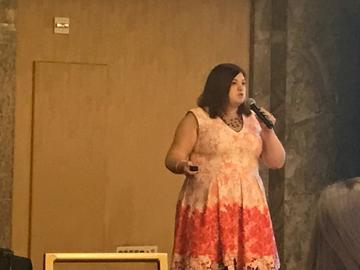
Melina Palmer
SAN FRANCISCO–Have you put together a logical, rational offer for your members, and then been surprised when it wasn’t that popular? You shouldn’t be, according to one person, because people often make irrational choices. But there are three ways to take advantage of that type of human behavior, according to one person.
Speaking to the CUNA Marketing & Business Development Council annual meeting here on the topic, “Consumers are Weird: How Irrational Behavior Impacts Your Membership Growth,” Melina Palmer, founder of the consulting firm Defying Gravity, said credit union marketers need to pay more attention to behavioral economics.
“If traditional economics and psychology had a baby, we would have behavioral economics,” said Palmer. “Traditional economic models don’t properly take into account consumer behavior. It assumes consumers will make logical choices. You don’t know what people are going to do if they don’t know what they are going to do.”
Addressing cognitive processing, or how the human brain works, Palmer said the brain is much like an iceberg.
“Your subconscious brain can process 11-million bits of information per second. Your conscious brain can process 40. Period,” she said. “The problem for us as marketers is when you’re thinking about a product, how to price it, how to market it, you are actively thinking about it in a conscious space.”
The good news: According to Palmer, it’s that “even though people are not logical, they are very predictable.”
To help improve predictability, Palmer reviewed credit unions on three concepts: Loss Aversion, Anchoring & Adjustment, and Relativity.
Loss Aversion
The concept here is “shocker, people don’t like to lose things,” said Palmer. “Our society has built a lot around the idea that people like things, we should give them more things. Buy one, get one. Get miles. That’s why there are loyalty programs that sit unused, because they focus on a gain instead of a loss. Studies have shown the pain from a loss is essentially double the pleasure from a game.”
But people are often concerned that Loss Aversion means a credit union has to go to the negative space and have some sort of negative message or advertising, said Palmer. “But that isn’t the case.”
Case in point: BMW’s Overnight Test Drive program. “Your brain took ownership of that car when it saw the car in the driveway,” said Palmer. “They know you are a lot more likely to buy the car if you take it home. There is a lot of study around the power of touch. If you don’t want to buy something, don’t touch it.”
How does a credit union bring the power of touch? It’s about adding tangibility to something, said Palmer.
As an example of a credit union that stopped focusing on gains and instead focused on loss, Palmer pointed to the frequent CU promotion offering a cash reward for swiping a plastic card a certain number of times, something a show of hands indicated many in attendance had done.
Instead, Palmer worked with a CU that said, “We put $50 in your account. If you use your card 20 times this month, you get to keep it.” It was added to the current balance, not the available balance.
“(The member wants) to move it from current to available,” Palmer explained. “You have perceived ownership; you don’t want to lose it. I guarantee you people might not get to 20, but they are sure as heck are more likely to swipe their card for money they can mentally touch rather than money they will theoretically receive in X number of days.”
Anchoring and Adjustment
Anchoring and adjustment is the practice of putting an “anchor” number or concept into a consumer’s mind. The first number shown the consumer becomes the anchor, and then adjustments are made from it.
“It’s really hard to set a new one,” said Palmer. “If you’re putting pricing out there, put the highest number out there first, and then work your way down.”
Anchors can also include things that people are talking about or are in the world. When Palmer was with Verity Credit Union in Seattle, the Pokémon Go craze was at its peak. The CU promoted branches near Poke stops, put in charging stations, and got people talking about it.
What’s also important with anchoring, said Palmer, is to keep it simple, whatever the offer might be.
“Your conscious brain is really quick to be overwhelmed, so if you think about your new member experience, how much ‘stuff’ are you putting in front of someone? How many things is the front line putting in front of them? How much is really necessary?” asked Palmer. “When someone says, ‘I need to think it over,’ that’s a sign you are overwhelming them.”
Relativity
The human brain really likes to compare things, according to Palmer, but it can’t make valuations if it doesn’t have things to compare. Bundles of products or services is one strategy for helping people to make comparisons.
“Give your best option a decoy to make it more appealing,” she advised. “When you are putting things together for pricing, find the thing that you want to sell, the thing that is best for your members that you want them to choose, and make it the most appealing option and show why it’s better. The member’s brain will say ‘Wow, what a great value.’”