

ANAHEIM, Calif.–In a fast-moving hour of one-liners about the economy and more, credit unions here were given an overview on everything from how the world is changing, what’s ahead for inflation and a recession, and the “four most dangerous words in finance.”
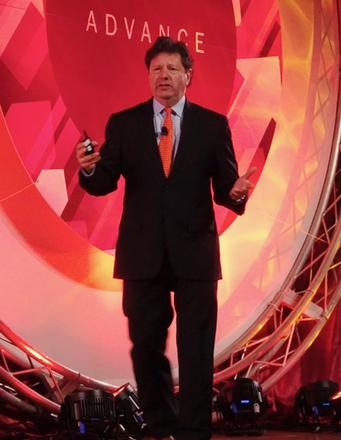
Peter Ricchiuti
Peter Ricchiuti, a professor in the Freeman School of Business at Tulane University in New Orleans and founder and director of research with Burkenroad Reports, covered a wide range of economic issues for attendees at the CUNA Lending Council’s annual meeting here.
Here’s a look at the topics, insights and wry observations shared by Ricchiuti:
The Global Economy
“The bottom line for us is it’s a real positive for us that the United States is considered a safe haven,” said Ricchiuti.
But the cloud on the horizon, he said, are President Trump’s tariffs.
“If you talk to any economist, tariffs and trade wars are a bad idea. They don’t work and they are prosperity killers,” he said.
The U.S. Economy
Ricchiuti said it’s a misnomer, though oft-repeated, that the U.S. doesn’t manufacture much anymore. “U.S. manufacturing is at its highest level ever, but with far fewer workers,” he said. “Eighty-seven percent of job losses in manufacturing are due to efficiencies from automation and robotics.”
Ricchiuti said U.S. business likes President Trump’s cuts to corporate tax rates, move to lower regulations and plans for infrastructure spending (which it can’t afford due to the tax cuts). What business “loathes,” he said, is protectionism (tariffs) and immigration restrictions, due to a shortage of labor, which includes demand for 50,000 truck drivers right now, plus 790,000 pilots over the next 20 years.
“The labor force participation rate of 63% is at its highest rate ever, and this number will go lower and lower because 10,000 baby boomers retire every day,” he said.
The Stock Market
In 1995, there were 8,000 public companies; today only 3,600, he said. “That’s one reason the stock market is going up; it’s supply and demand, more dollars chasing fewer stocks,” Ricchiuti told the meeting.
A Recession?
Ricchiuti said the economy is now late in the growth cycle in which fiscal and monetary restrictions are in place and employers having trouble finding workers. He believes the economy is closer to a recession than many believe.
“And a recession isn’t necessarily the end of the world. A regular recession doesn’t last that long—most remember the recession of 08 and 09, which was very deep,” he said. “Wage growth and tariffs lead to higher inflation, which forces the Fed to raise interest rates, and higher interest rates create competition. Over next two three years you’re going to see lower stock returns. Many people say, ‘This time it’s different.’ Those are the four most dangerous words in finance.”
Immigration
Over next 30 years the population or working age people will slowly and steadily increase in the U.S., and most of that will come from immigration). It will be declining in most industrialized parts of the world, including Europe, Japan and China.
“Forty percent of Fortune 500 companies were started by immigrants or their children. At Intel’s recent Science Talent Search, only 17% of the applicants had parents born in the U.S.”
Inflation & The Markets
Ricchiuti said the country is going to see inflation for the first time in 34 years, something most people don’t remember, he said. That inflation is being driven by wage growth. With the increase in inflation, bond prices are going to sink, he reminded.
Inflation Joke: “People are going to call brokers and say ‘Excuse me, what are these parenthesis in my account?’”
Noting the federal deficit annually is approaching the size of GDP, while rates are on the increase, Ricchiuti said the stock market is also starting to react. “Things are going to get bumpy.”
Popular Myths & Missed Forecasts
Ricchiuti said “People hold things as gospel that aren’t true. Since 1948, stock market returns have been three times as high in periods where unemployment rates have topped 6.6%.
To make money in the markets, you have to swim against the tide.”
Ricchiuti added to the point, observing, “You can’t follow the herd, because most people are wrong. In the early 1990s, two-thirds of Americans felt the country was on the right track, and we had a recession. In 2000, 80% believed country was on the right track, and the economy went down. In 2010, nearly every thought the country was on the wrong track and the market soared. Now, people are very upbeat…”
Energy
“I don’t think people realize how close we are to alternative power,” said Ricchiuti. “Seventy percent of oil today is used for transportation. But the big German automakers’ goal by 2030 is to phase out the internal combustion engine.”
Approximately 1% of auto sales today are made up of electric vehicles, with some analysts saying the tipping point is believed to be at the 2% or 2.5%.
Lower oil prices, he said, have helped to defang U.S. enemies like Iran, Russia and Venezuela.
He added that about $50 billion has been invested in the build-up of the liquefied natural gas industry in south Louisiana.
“Electricity is generated by natural gas, coal, solar and wind, but planes, trains, automobiles and boats are nearly entirely powered by gas,” he said. “Moving forward, we are going to need significantly more electricity.”
The energy joke: “It’s just this administration that thinks coal matters as part of their Black Lungs Matter initiative.”
Random Thoughts
Before closing, Ricchiuti offered four random thoughts:
- Tax evasion has added about three-trillion dollars to national debt over past decade
- As a percentage of GDP, federal taxes are now at their lowest levels since 1950
- Just one in eight workers is of normal weight without a chronic health problem