

John Best
FORT LAUDERDALE, Fla.–The embrace of data analytics in credit unions must also include human resources, according to one expert. Indeed, HR should be a critical part of that embrace.
John Best, CEO of Colorado-based Best Innovation Group and who has spent 25 years in credit unions, told the CUNA HR, Training & Development Council meeting here that data analytics aren’t limited to just the IT department. He stressed that human resources and especially people remain a fundamental part of the deployment of analytics.
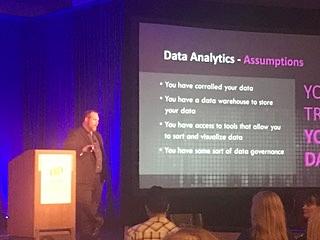
First, said Best, there are some basic assumptions when it comes to data analytics:
- You have corralled your data
- You have a data warehouse to store your data
- You have access to tools that allow you to sort and visualize data
- You have some sort of data governance. (“This is where I think HR can help. This is a team that meets to talk about data.”)
- You trust your data. “This is the most important one. It means if someone gives you a report and you think something doesn’t smell right, then you no longer trust that data. With computers, the trust is there until it’s not. The challenge is it’s really hard to get the trust afterwards. But if you trust the data you can act on it.”
Questions to Answer
Every credit union needs to answer a number of questions when employing data analytics, with HR involved in a number of the steps, according to Best. Those questions include:
- What are your key growth strategies?
- What are the leading indicators for your strategy?
- What are your related key performance indicators?
- How often are they measured?
- Who is measuring them?
- Who is accountable?
- What is your plan if they increase or decrease?
“It comes back to our people. Our strategy starts with people. If we have a strategy that says we are going to be a service-based organization, we need service-based people. If it’s a sales-based organization, we need sales-based people. That’s two different types of people and cultures,” said Best.
The second most important thing in the credit union is the culture, according to Best. “It defines who we are. It helps attract talent, but people also like to fit in. Your culture is the second most important thing. The people dictate the culture, and it starts at the top. It’s the stories we tell. Whether a sales or service culture, you have a culture around this. So how do we drive that?”
Challenging Assumptions
What everyone within a credit union must do, according to Best is challenge conventional wisdom. For instance, Best offered the following as assumptions worth challenging:
- Bill pay is a sticky feature. “I hear this a lot, that once someone has bill pay, they will stay forever. That may have been true at one time, but it might not be true now.”
- Digital transactions are cheaper than human transactions. “That’s not always true. Are we keeping track of the costs of our transactions?”
- Mobile members are made up of mostly Millennials.
- All Millennials are mobile.
- Only 25% of members use branches. “Is that really true? We did a test, and guess what was the number-one indicator of whether someone uses a branch? It was whether they bought products over the counter at Walmart, or whether they use Amazon.”
- Members who have two or more products are better credit risks.
“We make decisions based on these every day,” said Best. “But we have to learn how to use data. There are no assumptions.”
The PFI Vs. The AFI
Another of those assumptions, said Best, has to do with the whole concept of being a primary financial institution, or PFI.
“I don’t believe there is any such thing as PFI,” said Best, who found in a show of hands that just four people in the room had only account relationships in their wallet with their credit union. “I believe what you are shooting to be is an active financial institution, an AFI. We want to be the active credit union where the member cares about your products and services.”
To that end, Best said that creating a data-driven culture means:
- No more assumptions
- Use data to improve processes
- Increased accountability
- Better scenario planning
- All staff communications feature data as support
- Data is used to determine deadlines
- Use data analytics to assess risk
- Dashboards are used to monitor progress
Along the way, Best said, mistakes will happen and there will be failures. But that shouldn’t stop progress, he said.
“Credit unions tend to confuse failure with incompetence,” he observed. “Failure is really simple. I had an idea, someone told me let’s put that idea out there, and it didn’t do what we planned on it doing. Incompetence is similar. You have an idea, but skipped all the steps, and then it failed.”
The good news, said Best in challenging another assumption, is that “failure is a symptom of trying.”
The bad news, is that what often happens is that fear of failure restrains organizations from trying anything, and as a result they fall behind. That includes HR, added Best.
The Three Types of Analytics
Best told the HR execs they need to understand the three main types of analytics:
- Descriptive: How many people went into the branch last Wednesday?
- Predictive: How many people will go into the branch next Wednesday?
- Perscriptive: How can I influence the number of people who go into the branch next Wednesday?
“Technology always has to fight for a seat at the table and the credit union has to grow into it,” observed Best. “And data analytics is the same. We have to incorporate it into our work structures.”
As an example, Best asked, “If a member used your credit union credit card to buy all of their airline travel and suddenly stopped, would someone from your credit union call them and ask why?”
Best said his own research in working in credit unions has found that while 90% of the membership holds an Amazon account, just 7% of a credit union’s cardholders had their card with Amazon.
“What is that costing you per member in interchange income? Interchange is 23% of our bottom line revenue. And what do we do to get interchange? We wake up and put on our pants. We’re not monitoring it and curating it,” Best said. “My challenge to you in HR: Go back and get your entire staff to use your cards in all of their digital places. If you live in a Starbucks world, give away Starbucks cards for putting your cards in their Starbucks app.”
Using analytics give a credit union the powerful ability to act in members’ best interests and to show it cares, according to Best. And all of that still comes down to one thing, he told the HR meeting.
“As I said, the most important thing is the people. It’s about trust, mutual respect, care. We want to have a relationship not just with our members, but our employees,” he said. “Predictive analytics are coming. Why not use it in every aspect of the business?”