

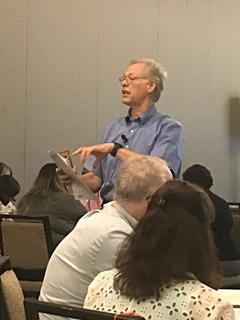
Jeffrey Russell
FORT LAUDERDALE, Fla.–When it comes to employee performance reviews, those involved on both sides are usually in one of two states: fearful or fearless. And it’s almost always the former.
But there’s a way to move to the latter, according to one expert.
Speaking to the CUNA HR, Training & Development Council here, Jeffrey Russell, co-director of Russell Consulting in Madison Wis., offered an overview of the performance review process along with strategies for moving toward more effective “fearless” reviews.
“I am advocating transforming these reviews into progress reviews that change the relationship from stress and anxiety to one of learning and growth,” said Russell.
Quoting Edwards Deming, “Quality is impossible if people are afraid to tell the truth,” Russell noted that if employees are too intimidated to have an honest discussion, resolutions can’t be found. The same holds true for HR execs conducting the reviews.
What Makes for Fear?
What makes an employee job review a “fear-inducing” one?
In a poll of his audience, audience members mentioned being surprised, lack of consistency among managers, everyone expects a “superior” rating, the perception that “meets expectations” is bad and the related anxiety, concern over only what the raise might be, bad environments/attitude, and more.
What makes for a “fearless” review?
Again, according to a survey of attendees, transparent communications, consistency, year-round, forward-looking, active participation by the employee in a plan of action, and no surprises.
“In fearless reviews, each party knows the other person’s heart. They understand what you are doing is for their growth and they understand your intent,” said Russell.
The Seven Big Reasons the Employee Review Process Goes Awry
- It feels as though there is a lot of stake. “For the employee, their self-worth is on the line. For the manager, there is the issue of retaining employees, and for employees not performing well, it’s a drag on the team. It’s the 80/20 rule; 20% of your employees suck up 80% your time and energy. Also at stake is your own self-esteem.”
- The process feels overly judgmental. “It feels like we are reducing an entire year to a number. Congratulations, you’re a three.” Russell shared a personal story in which he asked a supervisor what it would take to improve his evaluation and the person responded, “When I see it I’ll let you know.”
- The process sometimes raises uncomfortable truths.
- People may feel “blamed” for a problem.
- People aren’t very skilled at it. “We often don’t know how to deal with issues that need to be discussed.”
- There’s too much uncertainty.
- People feel a loss of control. “Control is an illusion. It’s not worth pursuing. We forget that, as we feel we need to control that environment. But it’s not going to work, and we need to use different levers. Not control, influence.”
Ten Characteristics of Fearless Reviews
- Forward looking. “You can’t change the past. It’s not what you’ve done it’s what you’re going to do.”
- It’s more developmental than evaluative. “Lose the number system. Fundamentally, I’ve never seen a numbering system I like. All the number does is erode the relationship. Look at growth and development.”
- Focus on improvement in performance behaviors and outcomes.
- Anchor to “Great Performance” outcomes and goals that redefined early in the performance cycle.
- Employee-centered. The employee takes the lead in the process.
- Frequent. Conducted as often as necessary to keep performance on track and getting it back on track if and when problems occur. Holding reviews just once a year is a mistake, said Russell, who recommends monthly coaching conversations of any length without any forms.
- Conversational and informal leading to a shared understanding. “It’s not about filling in the boxes.”
- Based upon a collaborative mindset vs. my-way mindset.
- Objective and data-based—using observable and countable behaviors and results as its foundation.
- Meaningful. Both the employee and the supervisor have learned something about themselves and each other.
“Conducting a fearless performance progress review is about the quality of the conversation,” said Russell. “It’s not about the form.”
Exploring the “Mindset Continuum,” Russell noted organizations and individuals tend to move toward the “My Way” mindset, which is where people retreat when feeling vulnerable or challenged. “In these situations, we tend to move in the opposite direction of where we need to go. So, we need to address that right up front by creating a safe place.”
Collaborative Mindset: The Winning Approach
Moving in this direction is not an overnight sensation, said Russell. When polling his audience on “transformative practices” in job reviews, audience members responded with personal commitment (“so the employee knows it’s his or her choice of the path chosen—every employee is responsible for his or her success”); mindfulness, authenticity, good information and suspension of judgment.
“Before we put a person in a box and duct tape it and ship it, we need to suspend judgement and find out if there is an alternative interpretation to what is going on,” said Russell. “It’s also important for us and them to share reasoning. Set expectations.”
When things go wrong, it’s critical to focus on cause, not blame, he said, adding that people run away from problems.
“What we’re trying to do is create an alternative to the fight or flight. The emotional brain is in one of two places: fight or flight, or approach and appreciate. So, we’re trying to create safety by moving away from blame.”