

AUSTIN, Texas–Credit union leaders thinking about the evolution of their own roles and how the credit union will need to change and how to reinvent the experience for the member need to understand they are NOT competing in a “digital age.” Instead, they would be smarter to look to eight-year-olds to understand where they are really competing, according to one person.
“We spend a lot of time thinking about how the stuff around us might change,” observed futurist Mike Walsh. “But we don’t spend as much time thinking about how the people around us will change.”
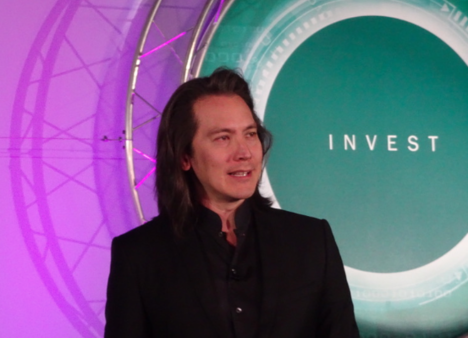
Mark Walsh speaking to CUNA CFO Council meeting in Austin.
What is driving the change in people–or more correctly, their expectations– is algorithms, said Walsh in remarks to the CUNA CFO Council annual meeting here.
“Algorithms are already shaping and influencing our lives in so many ways that are often hard to fully comprehend,” said Walsh, who is based in London. “But it’s important to remember we’re not in the digital age, we’re in the algorithmic age. In this context the question we have to grapple with is ‘what is this ultimately going to mean to all of us as leaders?’ I think this is a time to reconsider some of these changes happening around us. There is a widening gap between the analog leader of the 20thcentury and the algorithmic leader of the future.”
When credit unions start to think about the next generation of members, Walsh said a CU needs to ask itself what those members are going to expect. And that’s where they need to avoid making another mistake–looking to Millennials for insights.
“Millennials don’t matter.” That’s because America is now a Millennial country, and as a majority they are no longer as indicative of the future as they used to be.”
The real generation to watch, he said, is the “most terrifying,” also known as eight-year-olds.
“If you’re wondering why this generation is going to be so different, you have only yourselves to blame,” he said. “How many of you have been guilty of using technology to make a child happy. Growing up today is almost like growing up in an age of miracles. Almost every experience you have is being designed and curated for you based on your data. And the only way this possible is we are now living in an age of machine learning, in which we let AI create experiences for us.”
As a result, the biggest indicator of the future of business is to look at what kids are doing on a daily basis, according to Walsh.
Three Big Shifts
Walsh said there are three big shifts credit unions should be watching.
Expectations. “Your members of the future will expect that you and other companies and brands will be able to predict their needs without ever having to tell you. Your kids are growing up expecting companies will anticipate their needs.
Interfaces
Walsh pointed out that children today are “talking to everything,” and are the first generation being “partially raised by artificial intelligence.”
That means big changes in how people are interacting with information, primarily a move away from keyboards and a mouse to voice recognition. Google recently upgraded its voice-activated devices to reward kids for saying please and thank you. “They realized kids getting into bad habit of shouting at the device,” said Walsh.
Persuasive
Walsh, who is the author of the book “Futuretainment,” said credit unions need to be more persuasive about how people lead their lives. “We’re getting used to this idea of being nudged, and this will even change financial products, as well,” he said. “This is a world made for your kids. As this generation gets older, they will expect organizations to be able to predict their needs, and that their interactions are more human and personal and that you are going to be more persuasive. This is a wake-up call for credit unions.”
Constantly challenge your expectations of the future, said Walsh, saying that many in credit unions, even himself, are too old to really grasp how all of this is changing the way the lead their lives. He urged CU managers to speak with younger employees about how they envision the future of the delivery of financial services.
Throughout his remarks, Walsh offered several of what he calls “mind grenades,” the first of which was this:
“When you hire someone fresh out of college, ask them what do they find the strangest about the way your teams work, make decisions and communicate,” he said.

Mike Walsh's book, Futuretainment.
If a leader accepts that there is a new world coming, then the next question is what does it ultimately mean for the design of a 21stcentury credit union, according to Walsh. In response, he said he’s heard often that the answer is to act more like start-ups. But he disagrees with that analysis. Anyone can be agile, he said, when the team consists of four people. But most credit unions employ far more people than that.
“Change and transformation isn’t easy. The minute you get a critical mass of human beings together, it gets hard. And that’s OK. The starting point of transformation isn’t technology. Unless you can change the software and make culture your operating system, then nothing changes at all.”
Three Key Levers
Walsh said there are three key levers to leading change.
People. Netflix, he said, seeks to hire “people who can make good decisions in ambiguous situations. (CEO) Reed Hastings knows if you bring in people who like rules, you will quit making mistakes, but the minute the market changes you will be unprepared to react. They ask, ‘Is this person someone who would be energized by unknowns?’ How many people on your team fall into these categories. How agile are your people?”
Productivity. “Automation is going to change a lot of your back office processes. We are going to get to the point where every organization has eliminated the routine work. So where will productivity come from then? It will come from us. How do you get the best from the humans that work in your business?”
One way to get more out of people, said Walsh, is to bring them together and not allow them to work from home. “If you actually want to get the most out of people and make sure they are solving problems and being collaborative, you need to give them a physical location where they are working together. I know it sounds counterintuitive. But IBM found when it looked at its most disruptive projects, they were driven by people collocated in one location. Sometimes old school works.”
Performance. The question here, said Walsh, is how to manage what the future workplace will look like. The best way to approach it isn’t to “tell” people, but to have a “fact-based discussion about change.”
“Data is your objective weapon to transform people’s behavior,” said Walsh.
Moving forward–and that begins today–Walsh said credit unions need to find agile thinkers, rethink human productivity, and use data to hack their cultures.
“See if you can partner up with other leaders in your organization and see if you can identify some of the high performers in your organization, and brainstorm with them. What is it they do that works? If you can build a model of what great performance looks like, you can scale it up.”
Mind Grenade 2.0
Walsh’s next “mind grenade” for credit unions was this: “If you were going to design an AI-first competitor to your business today, what kind of internal and external data would you need to succeed?”
“Ultimately, the real question isn’t who is going to lose their job as the result of technology. The most interesting question is always how will jobs change,” he said. “And I think this is particularly true of leaders. The future is going to demand algorithmic leaders who are different in two ways: They have a deep understanding of human complexity, and they also have a flair for computational thinking.”
Solving problems in an age of algorithms means being able to go back and reason from first principles, explained Walsh. “When someone says something is impossible, you have to be able to take it apart and think about it a new way. Your real job in the future isn’t to work, it’s to design work.
He urged credit unions to conduct a “decision audit” by asking themselves what are the types of decisions that might be better made by machines.
Mind Grenade 3.0
Finally, Walsh urged credit unions to think about this: “In the future, what kinds of roles will automation, AI and algorithms take over in your team, and what will be the human capabilities most in demand.”