

ORLANDO, Fla.–Approximately 10% of credit union CEOs are expected to retire over the next two years, with reverberations that will be felt across CU management chains, according to one person, who said the trendline puts additional pressure on compensation plans.
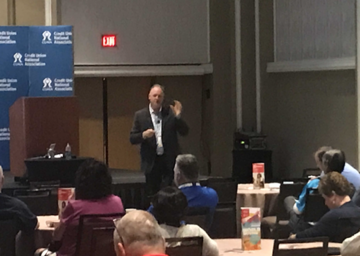
Andy Roquet discusses executive benefits during CUNA's ACUC
Speaking to CUNA’s America’s Credit Union Conference here, Andy Roquet of CUNA Mutual Group spoke to “The Transformation of Executive Benefits: What it Means for Your Next Executive Search.”
If the 10% retirement projection is current, it means more than 500 CEOs will need to be replaced, and that will lead to changes among CFOs, VPs and more as management teams are reshuffled. For boards, Roquet said, it means taking a hard look at the how their pay plans stack up in the market.
Currently, 88% of CEOs’ pay is made up of base salary, with median base salaries increasing 6% annually, he said. Eighty-three percent of CEOs earn some sort of variable compensation.
The ‘Income Gap’
What CEOs and senior execs are particularly keen to address, according to Roquet, is the “income gap” that occurs after retirement. “The average person wants to retire at 60% to 80% of their pay,” he said.
To fill that gap, credit unions have stepped in with a number of plans, including supplemental executive retirement plans (SERPs).
But many boards express concerns over assembling attractive packages for senior execs, while also protecting the credit union, according to Roquet. Many boards are concerned non-qualified deferred compensation plans (NQCPS) aren’t a credit union competency, that there are confusing rules related to comp plans offered by non-profits, and that the regulatory environment is constantly changing.
But there are other issues, as well, said Roquet.
The ‘Most Interesting Thing’
“Probably the most interesting thing is when someone leaves, what are the unintended consequences?” he observed. “Your strategy goes on hold for a while. Hiring for other positions goes on hold. The board becomes more involved in the credit union, which takes more time. The unintended consequences are important to consider.”
It is frequently observed in credit unions that the role of the board is to manage one employee, the CEO. But when it comes to compensation, that responsibility is broader, he said. “With these deferred comp plans for the executive level, however, it’s important that the board is involved in those, as well.”
Seven Generations of Succession Planning
Roquet said there are “seven generations of succession planning” that a board must ensure are addressed, including:
- Board of Directors
- CEO Disaster Replacement
- CEO Strategic Succession
- Executive Roles
- Middle Managers
- Internal Talent Pools
- Identify External Talent
“The whole point is succession planning is not a drive-by event that leaves leadership to chance, nor is it a singular recruitment event,” reminded Roquet.
Other Points Raised
Other points made by Roquet during his ACUC presentation:
- There are three basic types of plans used by non-profits: 72% offer a 457(b) plan; 56% of CUs have 457(f) plans, and 21% of credit unions offer split-dollar life insurance plans
- Among the benefits of SERPS are they help resolves the income gap; help put teeth in succession plans; help retention; reward top performers and are attractive when recruiting top talent
“We tried to design these plans so there is not an expense to the credit union,” said Roquet, referring to CUNA Mutual. “You can invest funds and that will help with earning income. You can invest here in things you can’t normally invest in, such as the market or annuities, and earn more income, which helps offset the expense of the executive benefits. We try to design these to be neutral.”
In looking to a provider with which to partner on executive comp plans, Roquet recommended a company that has:
- Customized, unbiased plan design with an open architecture platform
- Experienced specialists, with licensed insurance and securities agents. “This is very complex with regulations and accounting,” noted Roquet.
- Institutional sales and servicing model. “You want someone with a long-term service model in place, as these plans last years.”
- Thorough due-diligence and compliance support
Final Advice
Finally, Roquet offered this advice:
- Be planful with your executive departures
- Design plans to align the credit union’s and executives’ objectives
- Follow guidelines for NCUA scrutiny of NQDC plans
- Project out the net effects of NQDC plan design
- Do your due-diligence. “Regulators want to see that.”