

ORLANDO–If there’s a recession in the near future, it will come at the end of next year due in large part to a certain event in November of 2020—but perhaps not for the reasons some might believe, according to one expert.
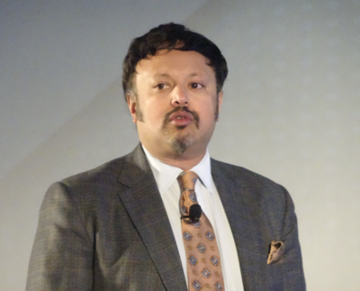
Anirban Basu speak to CUES meeting
The question of when a recession might arrive is common to credit union meetings and one Anirban Basu says he hears often. Basu, an economist with Sage Policy Group, shared with the CUES Directors Conference here his own forecast for what’s about to come.
But that forecast also came with a caveat, as Basu also acknowledged he’s an economist, which means he’s an expert on explaining tomorrow why yesterday’s prediction was wrong.
Basu cited former Fed Chair Janet Yellen’s observation that economic expansions “don’t die of old age,” which means the current expansion, now in its 11th year, has “little predictive power for the next recession.”
The Omens
Instead, Basu said forecasters are looking to other predictors, or “omens,” of when a downturn might occur. Among those omens:
- The inverted yield curve. As has been widely reported, the yield curve has inverted in recent times, with longer-term rates dipping below short-term rates. Many have seen that as a sign of a pending recession. “Occasionally, the yield curve sends a strange message. When people are trying to preserve capital rather than grow it, the 10-year yield falls below the one-year. Every economic downturn since the 1960s has been preceded by a yield curve inversion.”
- The U.S. unemployment rate and the natural rate of unemployment. The actual rate of unemployment is below the natural rate, which has proven to be a harbinger in the past of recessions.
- The Conference Board Consumer Sentiment Survey, which probes for consumer confidence in the current economy as well as the future economy. Consumers have shown confidence in the present economy, but expressed worries about what’s ahead. “Economists are really bad at predicting recessions, but consumers are really good,” said Basu.
- Income inequality. Data show that since 1917, periods where the share of wealth held by the top 1% hits a high, as it has in recent years, has been a predictor of recessions.
- The Global Economy. Basu said there is evidence the global economy has begun to stumble. For example, the estimated growth of numerous countries begins with a zero, such as Mexico, which is projected to show 0.4% growth in 2019.
A ‘Strange Change’
Basu noted all of this is a “strange” change from where most economists were at the beginning of this year, when forecasts called for a synchronized global expansion and most were concerned with inflation due to strong economic growth and low unemployment.
“The financial markets were performing breathtakingly well. In 2018, 2.9% growth, and then 3.1% growth in Q1,” Basu said. “But it’s been slowing ever since,” although some aspects of economy continue to do well, including industrial production.
However, GDP, production, and U.S. capacity utilization all show slowdowns.
Basu pointed to employment growth data among the 25 largest MSA and its dominated by cities in the West and South. The one exception is the unemployment rate in the Boston/Cambridge/Nashua market, with 2.3% unemployment rate.
It seems mathematically impossible to have wage inflation without high inflation broadly, and yet it’s happening, said Basu. So, we’ve got full employment, low inflation and falling interest rates.
Other Economic Observations
Other points touched on by Basu, concluding with his prediction for when that recession might arrive:
- Basu said it would be expected more Americans would be moving into homeownership, but that hasn’t happened, as the rental rate has risen significantly for several reasons. “But homeownership is about to come back in America with a vengeance. One reason is age demographics; the most common age in America is 27; the second most common age in America, 28. We have a lot of twenty-somethings in America. (This generation) has been willing to pay more in rent on a monthly basis to live downtown than they would for a mortgage in other communities. It’s a lifestyle choice. But you watch those 27-year-olds leave those fancy downtown apartments. They’re about to have babies. People say Millennials aren’t like us, but once you have kids, you are the same. You care about schools and communities.”
- The last two surveys in the Conference Board Leading Economic Indicators Index have “been wobbly. What this suggests is an economy that has continued to slow is going to soften.”
- Who has lost a lot of confidence recently? Small business owners, said Basu.
- Total U.S. Debt Volume by Select Loan Types, including auto, mortgage and credit card are all up, while the student debt trend line is up sharply. The federal debt is $23 trillion. Corporate debt has never been greater at $9.2 trillion in 2018. “This is what happens when you buy back your shares every year,” said Basu.
- “There is lots of debt out there but we haven’t seen meaningful increases in delinquency ratios at banks and credit unions, which have been in decline. I am aware of that. But it definitely has to be repaid at some point and we continue to amass more and more of it.”
The Big Question
Basu said much of the negativity in economic forecasts has to do with things “people believe will happen,” but he again noted many parts of the U.S. economy continue to perform well, such as consumer spending, corporate earnings and construction.
Moreover, he said there is “significant upside: around a trade deal with China, an infrastructure spending plan with revenue sources identified, elimination of tariffs on steel and aluminum, and the Fed’s continued accommodation.
But…
“My hypothesis is 2019 will be remembered as a solid year for the economy. But if we don’t check some of these boxes, watch out for late 2020,” cautioned Basu. “My number-one reason for concern for late next year is the elections. The problem facing America’s business today isn’t the cost of capital, that’s low. It’s uncertainty. You say we have a presidential election every four years, what’s the big deal? I can’t remember a time when there was such a difference between Bernie Sanders and Donald Trump, between Elizabeth Warren and Donald Trump, between any human being and Donald Trump.
“That not a pejorative. But there are big differences. If there’s uncertainty, how much office space are you going to lease, how many people are you going to hire?”