

ORLANDO, Fla.–Credit union board members here were given some advice on how to pay attention to “non-obvious” trends in order to make better decisions, especially in the long term.
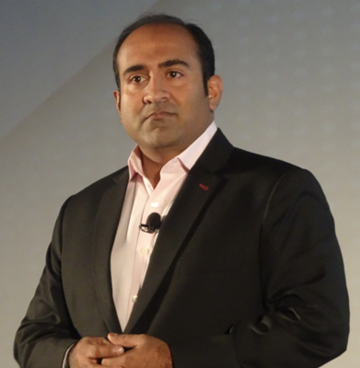
Rohit Bhargava addresses CUES conference
Rohit Bhargava, who calls himself a trend curator, an “occasional professor” and a nice guy, who has also been the author of more than a half-dozen best-selling books, including a series on spotting non-obvious trends that can become business drivers, runs The Non Obvious Company and told the CUES Directors Conference there are things people can do to see what others don’t see. “Sometimes they are called innovators. Sometimes they are called creative people,” he said.
Bhargava said there are some big barriers to seeing the non-obvious, including:
Unquestioned Assumptions. “There are things we have that are habits, things that are truths.” As an example, he cited Sr. James Dyson’s initial difficulties in getting any company to license his bagless vacuum cleaner, as every manufacturer knew they made the real money on the bags and always would.
Disruption. “We have to embrace this disruption, but what does it mean?” As examples, Bhargava pointed to the “produce butcher” who cuts up fruits and vegetables for customers in some Whole Foods stores; a food sniffer to tell you if the food has gone bad; and an app that allows you to have gas delivered to your car while it’s parked in San Francisco.
“Think about that person who is about to come into your credit union to have a meeting and they expect to have every option presented to them as the empowered consumer, and then they walk in and you present them with a financial plan that gives them one option,” said Bhargava. “Are they thinking, ‘Thank goodness someone distilled this into one option? They expect to see those now. Do we show people the undesirable option?”
The Believability Crisis. Constant sensationalism is making people feel skeptical, said Bhargava. “Marketing has to take some of the blame. We have all kinds of ads that tell us we could be better.” He showed an ad for Cocoa Krispies that included the word “Natural,” and then he asked his audience to consider how that is even possible. He also reminded Evian is just naive spelled backward.
“When it’s harder to build trust, that affects all of us,” said Bhargava. “It is harder to build trust than ever before.
Five Ways to Predict the Future
Bhargava offered these five behaviors to improve one’s ability to see future trends.
Be Observant. That means paying attention to everything around you all the time.
Be Curious. “This means find something you would ordinarily never look at. One of my favorite ways to do this is to look at magazines not targeted at me, like Teen Vogue, or Modern Farmer or Hispanic Mother. Every time you do that you have a chance to step into someone else’s world. Unlike a Google search, what you see in a magazine is what I see. Algorithms create divisions. We have to be more open-minded and be independent nonobvious thinkers, and magazines are great way to do that. I get to go to all these events and learn about different industries.”
Be Fickle. “That’s usually not seen as a good thing, but being fickle with ideas means you save something and move on and find the connections later on.”
Be Elegant. “This probably comes from my English/advertising background, where we choose words really carefully. Variety of vocabulary helps.”
Be Thoughtful. “When you put these pieces together, the last piece is being thoughtful.”