

MADISON, Wis.–Credit union yield on asset ratios hit a record low, and every real estate loan category reported positive growth while every consumer loan category (except used cars) saw negative growth through April, according to the newest CUNA Mutual Trends Report, which is also predicting a “surge” in CU mergers during 2023-26.
The June Trends Report, which is based on CU community data through April of 2021, also predicts loan growth will “accelerate” in 2022 for a number of reasons.
According to the Trends Report, CU yield on asset ratios fell to 3.04% in the first quarter of 2021, the lowest in credit union history. The report notes the ratio has fallen a full one percentage point from the 4.04% set in 2019, right before the COVID-19 pandemic.
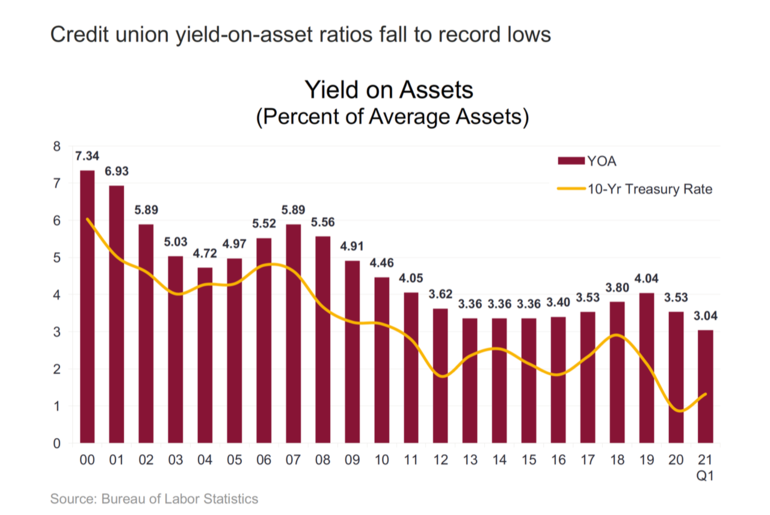
“This 25% drop in interest earnings as a percent of assets is a serious concern for credit unions since 72% of their total revenues come from interest revenues,” CUNA Mutual noted in its analysis. “The other 28% of revenues come from fees, interchange income, gains on sale of mortgages, etc.
The Trends Report notes that over the last year, yield-on-asset ratios fell from 3.81% in Q1 2020, to 3.04% in Q1 2021.
“Two thirds of this 77-basis point decline was due to amortizing loans and investments rolling over or repricing into lower interest rate loan and investments, called the ‘rate effect’,” CUNA Mutual said. “The other third of the 77 basis point decline was due to the mix of assets shifting towards investments and away from loans, the ‘mix effect.’ Expect the yield on asset ratio to decline further this year, ultimately falling below 3%.
Here’s how credit unions performed by category, according to CUNA Mutual:
Total Credit Union Lending
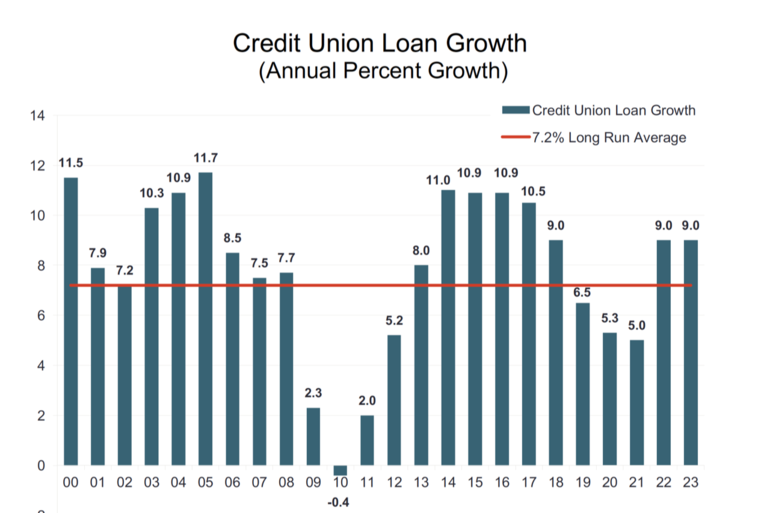
Credit union loan balances rose 0.6% in April, double the 0.3% pace reported in April 2020 and 5% during the last 12 months. Every real estate loan category reported positive growth rates while every consumer loan category reported negative loan growth except used auto loans, according to CUNA Mutual.
“April is historically the beginning of the credit creation seasons with seasonal factors typically adding 0.2 to 0.4 percentage points to the underlying trend loan growth rate through the second and third quarters,” the Trends Report stated, forecasting CU loan balances to rise only 5% in 2021, and 9% in 2022, which will be above the long run average rate of 7.2%.
“Loan growth will accelerate next year due to strong job creation, rising consumer confidence,” CUNA Mutual is predicting.
Consumer Installment Credit
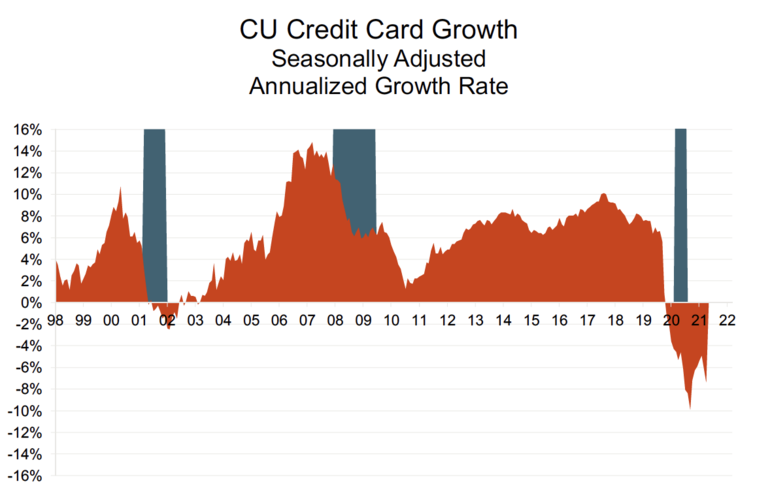
Credit union credit card loan balances fell 1% in April, but not as bad as the 4% drop reported in April 2020 when the effects of the COVID-19 economic lockdown were in full force, the Trends Report observed.
“On a seasonally adjusted annual rate, credit card balances fell 7.4%,” CUNA Mutual said. “Credit union members have been using their $1,400 stimulus checks, cash out funds from mortgage refinances and tax refunds to pay down higher rate credit card debt.
“Expect consumer credit to begin accelerating once herd immunity from the COVID-19 virus is reached sometime in the fourth quarter of 2021 or first half of 2022,” the report forecast. “Revolving credit balances (which include credit card spending) will continue to be weak for the remainder of this year while auto lending is expected to surge in the second half.”
Vehicle Loans
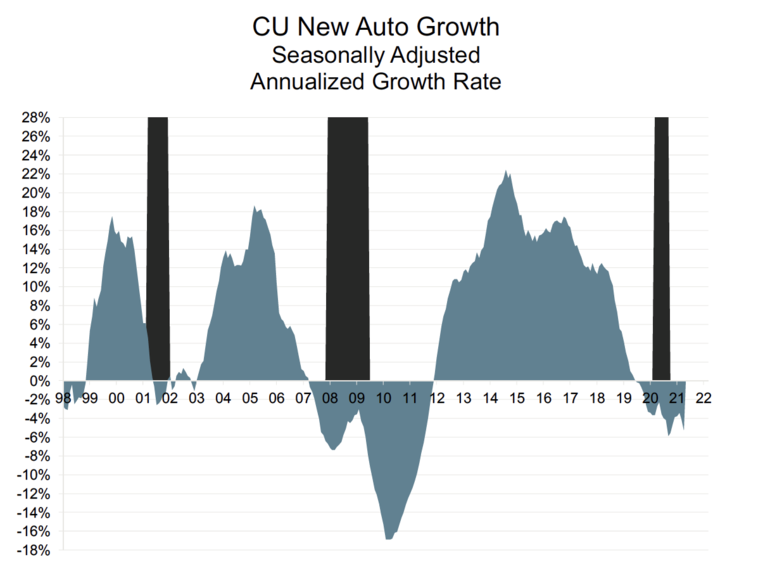
The Trends Report notes credit union new-auto loan balances fell 0.2% in April, a smaller decline than the 0.6 drop reported in April 2020.
On a seasonally adjusted annual rate, new auto loan balances fell 5.3% in April, the 21st monthly decline.
“The month of May is historically the beginning of the new auto lending season, so we expect a credit union lending turnaround soon,” CUNA Mutual said.
Real Estate Information
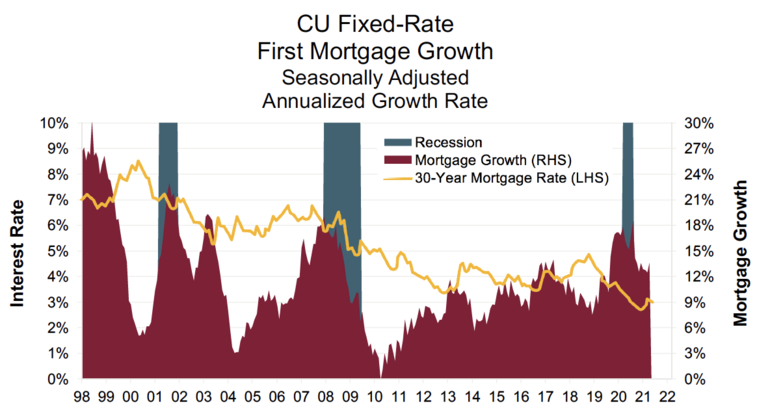
Credit union fixed-rate first mortgage loan balances rose 0.9% in April, above the 1.4% increase reported in April 2020, due to very low mortgage interest rates, the report states.
“Credit union fixed-rate first mortgage loan balances rose 14% at a seasonally adjusted annual rate in April,” the report’s analysis notes. “Adjustable-rate first mortgage balances rose 1.2% in April, much better than the 2% decline reported in April 2020. Fixed-rate first mortgages now make up 78% of all credit union first mortgage loan balances, up from 75% last April and the highest in credit union history. This raises concerns for interest rate risk when market interest rates rise.”

Surplus Funds & Investments
According to the Trends Report, credit union surplus funds as a percent of assets rose to 36.4% in April from 29.2% last year, as credit unions placed strong deposit growth into investments as loan growth remained tepid. Yield on surplus funds fell to 0.8% in the first quarter, from 1.5% one year earlier. During March, a 1.7% surge in savings balances funded a 0.6% increase in loans and a 4.1% increase in surplus funds. External borrowings rose 4% (or $1.5 billion) in April.
“During the last year, credit unions added $57 billion in loans to their balance sheets and $233 billion in investments, roughly four dollars in new investments for every one dollar in new loans,” the analysis states. “These assets were funded by $297 billion in new savings deposits and $15 billion in additional capital (net income). Borrowings fell by $21 billion.
“Surplus funds are expected to rise to 38% of assets by the end of the year, the loosest liquidity position since the second quarter of 2013, as loan balances grow only 5% and savings balances rise a very strong 15%,” the report added.
Savings & Assets
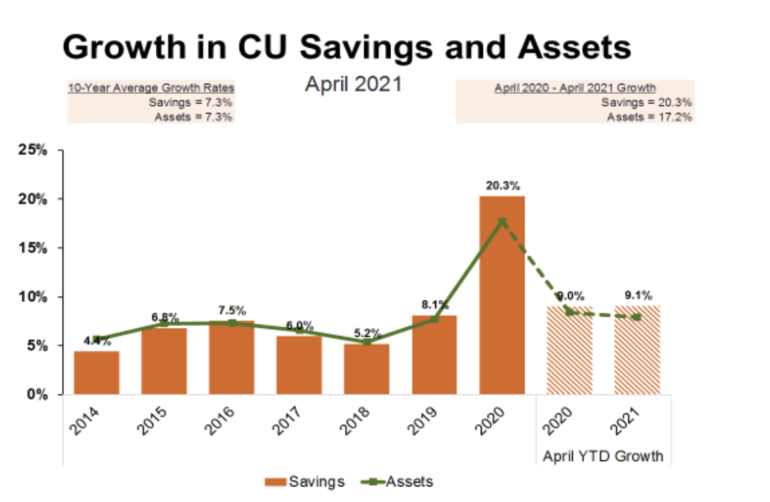
Credit union savings balances rose a strong 1.7% in April, but lower than the 4.6% surge reported in April 2020. The surge last year was caused in part by the first round of stimulus checks, with savings balances growing at a “remarkable 20.1% seasonally adjusted annual rate in April,” the Trends Report stated.
Expect savings balances to grow 15% in 2021, below last year’s record setting pace of 20.3%, the report predicts.
Capital & Other Key Measures
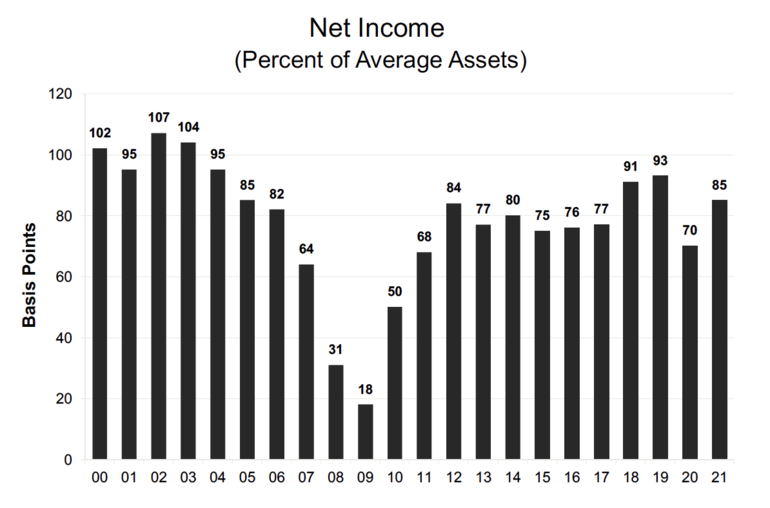
Credit union return-on-asset ratios averaged 1.04% in the first quarter of 2021, almost double the 0.53% reported in the first quarter of 2020, due to falling provision for loan losses, lower operating expense ratios from surging assets, lower funding cost and rising noninterest income, according to the Trends Report.
The “big negative” line item was a 77-basis point drop in the yield-on-asset ratio, which fell from 3.81% in March 2020 to 3.04% today, the lowest in credit union history.
“This crushed net interest margins, which fell from 2.95% last March to 2.56% today, which is also the lowest in credit union history,” CUNA Mutual stated. “The net interest margin ratio measures the profitability of financial intermediation, i.e., taking in deposits and originating loans.”
For the full year, CUNA Mutual is forecasting credit union net income as a percent of average assets to rise to 0.85% in 2021 from 0.70% in 2020.
“Earnings will be higher due to credit unions removing funds from the overfunded allowance for loan loss account and lower operating expense ratios,” the report states. “Unfortunately, this boost to earnings is only temporary, while the drop in net interest margins will be more long term.”
Credit Unions & Members
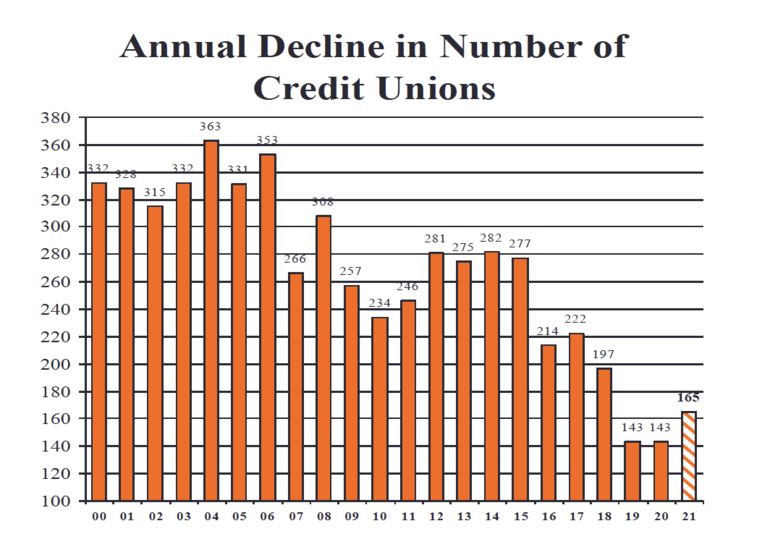
As of April 2021, CUNA estimates 5,256 credit unions were in operation, three fewer than in March. During the first four months of 2021, approximately 61 credit unions ceased to exist because of mergers, purchase and assumptions or liquidation, the report states.
The rate is slightly above the 39 credit union decline reported during a similar time period in 2020, according to CUNA Mutual, adding that in 2020 the number of credit unions declined by 143 with 76 occurring during the first half and 67 taking place in the second half of the year.
“Expect the pace of credit union consolidation to accelerate in 2021 and 2022 due to some credit union managers focusing on possible merger opportunities as the COVID-19 pandemic and its related issues recedes,” CUNA Mutual stated. “This is what happened in the wake of the Global Financial Crisis in 2009-2011 when the number of mergers dipped in 2010 and 2011 but surged in the four years following the crisis. So once the economic seas calm, expect a surge in mergers during 2023-2026 as smaller credit unions with limited digital capabilities look for merger partners to increase the products and services offered to their members.”