

ALEXANDRIA, Va.—Greater accountability and efficiencies, an extended examination cycle, and improved transparency with regard to how the Overhead Transfer Rate (OTR) is determined were key issues addressed by the three CU trade groups Wednesday during the agency’s annual budget briefing.
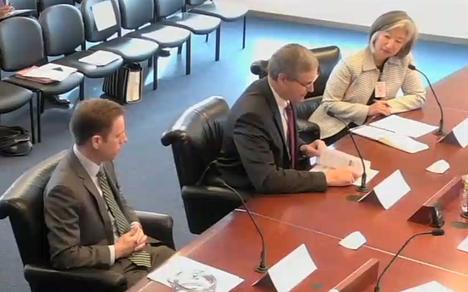
L-R: Curt Long, Mike Schenk, Lucy Ito
Representatives of three organizations—NAFCU, CUNA, and NASCUS—offered input and feedback on where they want to see the agency take action on its 2020-2021 budget.
NAFCU Chief Economist and Vice President of Research Curt Long reiterated the association's call for prudent management of funds by suggesting ways to improve accountability, specifically through cost-benefit analysis of NCUA programs as well as rules.
Noting the agency's proposed 2020 operating budget represents a 57% increase in the NCUA's budget over the past decade, while the industry has seen a 32% reduction over the same period, he cautioned against yearly budget increases.
In order to achieve more accountability and transparency, Long detailed four recommendations from the association related to:
- Cost-benefit analysis for NCUA programs, as well as its rules
- Exam modernization efforts
- The expiration of the NCUA Guaranteed Notes (NGN) program
- Ensuring the rulemaking process effectively addresses risk
“The credit union industry remains focused on the efficient use of resources and encourages the NCUA to do so as well by achieving year-over-year budget reductions. A cost-benefit analysis for every portion of the NCUA’s budget, combined with regular look-backs for the NCUA’s programs, could bring the agency closer to achieving such efficiencies,” stated Long. “Periodic lookbacks at agency programs and rulemakings to determine their efficacy and evaluate potential cost-savings and other efficiencies is in congruence with the administration’s directive to reduce burdens and eliminate duplicity in existing and new regulations. The agency has indicated it would voluntarily follow the spirit of Executive Order 13771 and this is another method through which the agency can alleviate burdens and potentially reduce the size of its budget.”
Long said that although the agency continues to point to a decline in the relative size of the NCUA budget compared to the balance sheets at federally insured credit unions, industry asset growth alone does not mean the budget is more efficient.
“As has been said in the past, the NCUA examines and supervises credit unions, not assets,” Long said. “Additionally, although the size of a credit union is a useful measure of its importance to the credit union system, size alone does not determine complexity or riskiness.”
Long said NAFCU recommends the agency focus on holistically improving a couple key supervisory elements and evaluating ways to find economies of scale and other efficiencies in the continued operation of its various programs as well as the implementation of new programs and initiatives.
Long stressed these supervisory improvements include examination modernization and cybersecurity enhancements.
“Considering credit unions continue to struggle with procedural inconsistencies and other exam-related issues, the NCUA should prioritize its examination modernization initiatives, including the Flexible Examination Pilot Program (FLEX) or offsite examination procedures and the Virtual Examination Program to standardize examinations and relieve burdens,” stated Long. “NAFCU is also pleased to see significant advancements in the implementation of the Enterprise Solution Modernization (ESM) program, which includes the replacement of the Automated Integrated Regulatory Examination System (AIRES) with the new Modern Examination and Risk Identification Tool (MERIT) system. Successful deployment of this new platform could provide cost savings for both credit unions and examiners.”
For Long’s complete testimony, go to CUToday.info’s The Gov.
Examinations a Focus For CUNA
The NCUA’s Proposed 2020-21 budget reflects a 3.9% increase, which seems “reasonable in the context of approximately 2% inflation and with the 6% increase in credit union operating expenses which is the point of reference for most credit union CEOs,” stated Mike Schenk, CUNA deputy chief advocacy officer and chief economist. “CUNA fully understands and appreciates how personnel costs have a dramatic effect on overall agency expenditures and recognizes that regulatory and contractual obligations drive a substantial portion of the changes in overall agency budgeted expenditures each year.”
Schenk said CUNA appreciates NCUA’s focus on holding headcount in check.
“And we look forward to seeing more obvious evidence of the savings that remote and extended examinations might have on overall costs,” he said.
Schenk outlined key themes CUNA is hearing from member credit unions regarding the agency’s budget, with examinations being one.
Citing CUNA’s 2018 CUNA Examination Survey, Schenk said, “Overall, 35% of respondents indicated they believed new examination teams would have an ‘extremely negative’ (12%) or a ‘modestly negative’ (23%) impact on their examination experience. Inconsistency in the interpretation and application of rules and regulations are especially challenging for credit unions that have new examiners. These inconsistencies can throw strategic plans off track resulting in significant service disruption and misallocation of resources. Indeed, the top examiner/exam team issue in our Exam Survey was examiner willingness to account for credit union business plans when discussing exceptions. This issue received an average rating of only 3.9 on a five-point scale.”
In addition, only 70% of survey respondents agreed that examiner/exam teams are flexible and open to discussion and exchange of perspectives with credit union staff, noted Schenk.
“Over half (51%) agreed that examiners apply ‘guidance’ as if it was enforceable regulation and nearly half (46%) agreed that examiners applied ‘best business practices’ as a regulatory standard,” he said.
Schenk pointed to how the Wall Street Reform and Consumer Protection Act of 2010 for community financial institutions included in Section 210 a provision that amended the Federal Deposit Insurance Act to increase the asset limit below which depository banks are eligible for an 18-month examination cycle (rather than a 12-month examination cycle) from $1 billion in assets to $3 billion in assets.
“In December 2018, the federal banking agencies issued a final rule to implement this provision, giving banks holding under $3 billion in assets an examination only once every 18 months, leaving credit unions on an uneven playing field,” Schenk said. “Credit unions, however, remain eligible for an 18-month examination cycle only if their asset level is below $1 billion. This regulatory disparity now serves as a comparative advantage for community banks.”
Schenk emphasized Congress has already delegated authority to NCUA to set the frequency of examinations for credit unions.

Mike Schenk
“Credit unions deserve the privilege of providing customer service subject to comparable regulatory supervisory thresholds as applied to banking organizations – and this issue continues to be a concern among industry leadership: We urge the NCUA to extend the credit union asset threshold from $1 billion to $3 billion,” Schenk said.
NCUSIF Normal Operating Level
In December 2018, the NCUA board approved a reduction of the Share Insurance Fund Normal Operating Level from 1.39% to 1.38% for 2019.
“CUNA encourages the NCUA to issue additional share insurance fund distributions whenever possible with the expectation that the initial increase in the Normal Operating Level was temporary,” stated Schenk. “While the NCUA believes an increase in the Normal Operating Level was necessary while the Share Insurance Fund holds corporate legacy assets, we look forward to a phase-down of the NOL to 1.30% by 2021. In the interest of transparency, CUNA welcomes the NCUA’s views on the possible return of capital from conserved corporate credit unions, including more information and discussion on the mechanics and considerations surrounding the decisions to sell or manage securities of the various estates after the NCUA Guaranteed Notes are retired.”
Schenk also addressed Board Member Harper’s proposal to expand the agency’s Office of Consumer Financial Protection with the goal of creating a dedicated consumer compliance examination program for large, complex credit unions.
“While this proposal may be well-intentioned, CUNA and our members believe altering the agency’s risk-focused examination process and substantially increasing examination-related expenditures is not warranted,” said Schenk. “There has been no supplementary evidence introduced or observed to suggest credit unions’ consumer compliance management has become a risk area warranting an increased expenditure of agency resources…the current safety and soundness examination procedures include an evaluation of a credit union’s consumer compliance risk – which is subsequently incorporated into a credit union’s CAMELS rating.”
For Schenk’s complete testimony, go to CUToday.info’s The Gov.
NASCUS Looking Closely at OTR
NASCUS’ budget focus Wednesday, as it has been over the years, was the overhead transfer rate.
“Two years ago, in a bold departure from past practice, NCUA re-conceptualized the OTR and approved a completely different and substantially improved overhead transfer rate methodology,” stated NASCUS president and CEO Lucy Ito during her testimony.
Ito emphasized “reinventing” the OTR was not an “easy lift.”
“Cost allocation models are inherently difficult to design—with the OTR being no exception,” she said. “We recognize the unprecedented level of effort that was undertaken by NCUA to conceive of an entirely different approach—a very elegant solution that is rational and easy to comprehend. The far easier path would have been to merely tweak the previous methodology. NASCUS and the state credit union system applaud the board and staff for your boldness, the open dialogue with various stakeholders, and your commitment to ongoing transparency and fairness.”
Noting how the OTR has fluctuated over the years, Ito pointed to how the transfer rate has increased in the latest budget and addressed how greater clarity around the increase is needed.
“The +0.8% increase from 2019 (60.5%) to 2020 (61.3%) is presumably due to an increase in time spent on the examination and supervision of federally insured state-chartered credit unions or a decrease in time spent on federal credit union examination and supervision,” said Ito. “Perhaps the extended 18-month exam cycle for well-managed credit unions up to $1 billion is a factor. In any case, the reason for the first increase in the OTR since 2017 cannot be determined by the 2020-2021 Budget Justification: Staff Draft and the NCUA’s 2020 OTR Summary is not yet available. Even if the 2020 OTR Summary were available, it may still be difficult to ascertain the specific explanation for the increase.”
Ito said that in NCUA’s third year of implementing the new OTR methodology, NASCUS has arrived at two realizations and attendant requests.
“The first realization is that it would be helpful and constructive to publish NCUA’s annual OTR summary in conjunction with NCUA’s annual budget justification document. We ask that the NCUA board consider issuing the two documents in tandem. Secondly, it has become clear to us that we do not understand how federal examiner hours are calculated and to what extent state examiner hours are calculated and valuated. In the interest of transparency and federal-state interdependency, NASCUS would welcome the opportunity to review with NCUA’s its valuation process of federal examiner and state examiner hours.”
For Ito’s complete testimony, go to CUToday.info’s The Gov.