

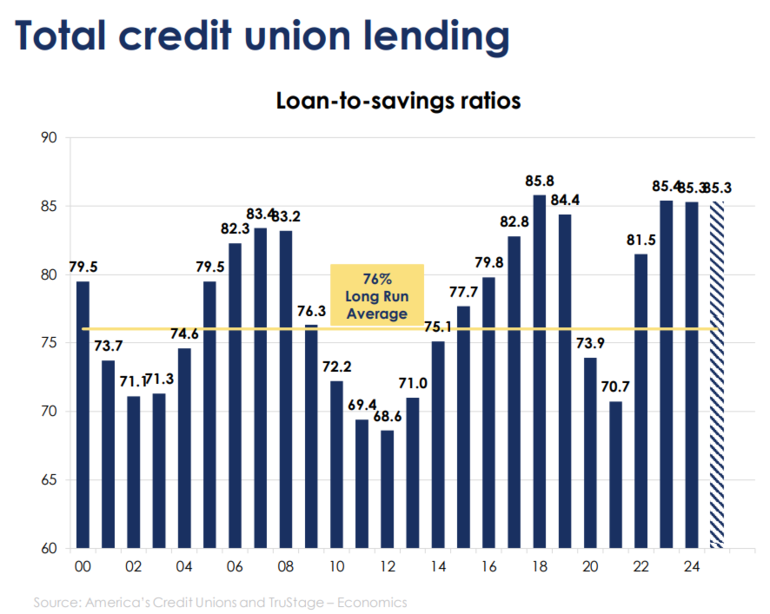
MADISON, Wis.—There is good and bad news for credit unions in the latest TruStage Credit Union Trends Report: Equity levels are soaring and CU loan-to-savings ratios are expected to remain above 85% in 2025 for the third year in a row. However, the industry’s mainstay—used auto lending—continues to struggle.
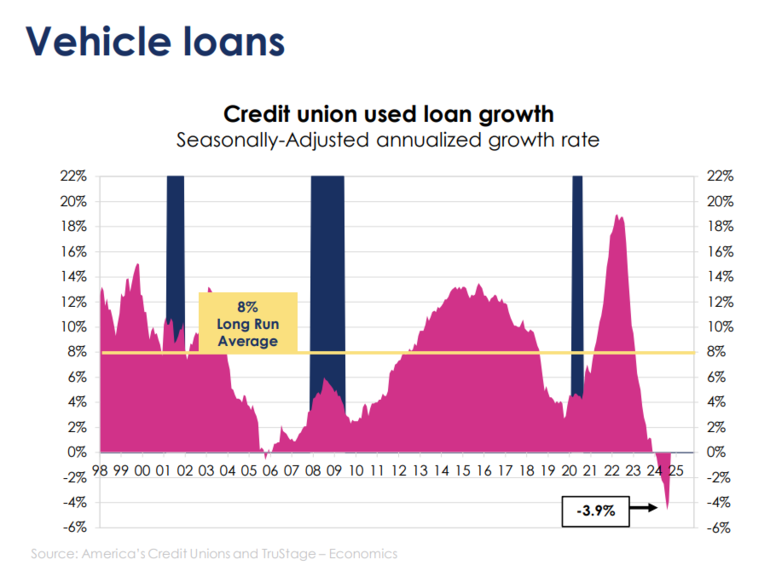
According to the report, which is based on data through November, credit union used auto loan growth is the slowest on record, falling 3.9%. Moreover, credit union overall consumer installment credit loan balances fell 0.5% in September, below the 0.3% rise set in September 2023.
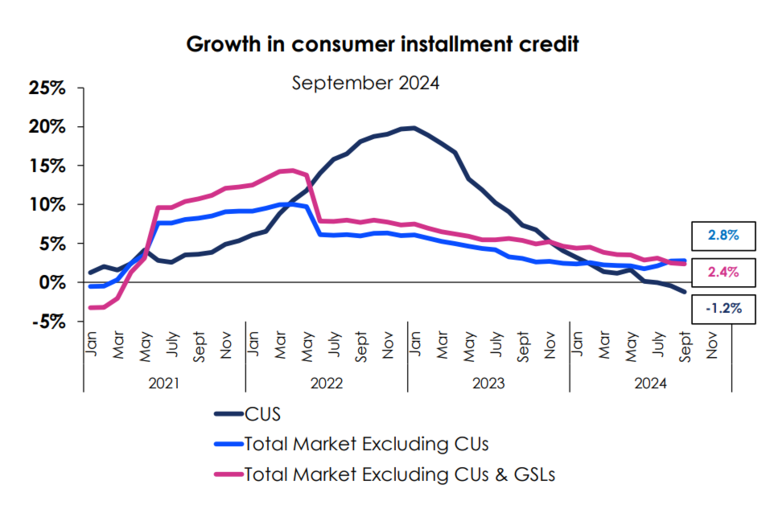
During the last 12 months, credit union consumer installment credit fell 1.2% below the total market excluding credit unions and government student loans (2.4%). This is first time since the 2008-2011 Great Recession era that credit union consumer installment credit growth has dropped into negative territory, the report states.
Here’s a look at how credit unions performed by category, with analysis by TruStage Chief Economist Steve Rick.
Total CU Lending
Credit union loan balances rose 0.4% in September, the same 0.4% pace reported in September 2023. Driving overall loan growth was strong growth in adjustable-rate mortgages (2.6%) home equity loans (1.4%), and unsecured personal loans (1.4%). The credit union average loan-to-savings ratio rose to 84.3% in September, down from 84.8% in September 2023, due to savings growth (3.6%) exceeding loan growth (2.9%) during the last 12 months.
“Loan-to-savings ratios traditionally peak right before recessions and may contribute to the economic slowdown that follows due to tight liquidity at credit unions reducing their pace of lending and high levels of members’ debt reducing their demand for loans,” Rick said.
Based on current trends, credit union lending growth is expected to rise 6% in 2025, and savings balances are also expected to rise 6%, the report states. This is expected to keep the average loan-to-savings ratio above 85% through year’s end 2025, significantly above the 20-year average of 76%.
“This will be the third year in a row the ratio will be above 85%, which hasn’t happened since the late 1970s,” Rick said. “This high loan-to-savings ratio can boost credit union earnings, heighten liquidity concerns, attract regulator scrutiny, lead to the need to borrow additional wholesale funds, require higher interest rates on deposits, reduce the investment portfolios to maintain lending volumes, and increase the need for additional capital reserves.”
Consumer Installment Credit
Noting the issue CUs face with consumer installment credit, the report points out that, according to the Federal Reserve, outstanding consumer credit for all lenders rose a modest $3.2 billion in September, significantly below the $15 billion monthly average, with balances up only 2% during the last year.
Credit unions now hold 14.8% of all consumer credit, down from the 15.0% reported in September 2023.
“Going forward, expect nonrevolving credit growth to be below its 7% long run trend in 2025 due to satiated consumers’ demand for autos and interest rates remaining elevated through most of next year. Revolving credit growth will also slow due to tighter lending standards and households trying to pay down high-cost debt,” Rick said.
Vehicle Loans
Credit union used-auto loan balances fell at a very low -3.9% seasonally-adjusted annualized growth rate in September, the slowest pace on record due to high auto loan interest rates, high used car prices, little pent-up demand for used cars, more new-car inventory and the accelerating amortization of the massive amount of loans originated in 2022.
Used car prices rose dramatically over the last couple of years due to a shortage in new car production. But as new car production has ramped up recently, used-car prices have fallen 18% from their record high in February 2022 but are still 28% above pre-COVID 19 prices set back in 2019. Credit union new-auto loan balances fell at an 8.3% seasonally-adjusted annualized growth rate in September, the slowest pace since the spring of 2011 due to competitive financing offers from competitors. On a monthly basis, credit union new-auto loan balances fell 0.4% in September, worse than the 0.1% decline reported in September 2023. New-auto loan balances fell 5.6% during the last 12 months while used auto loan balances fell 1.2%.
Vehicle sales rose to a 15.8 million unit seasonally-adjusted annualized sales rate in September, a 3.5% increase from the prior month but still below the 16.5 million normal pace. New vehicle sales are up only 0.5% on a year-ago basis due to high interest rates, and tighter credit standards among lenders. Expect auto sales to pick up during the next few months as interest rates fall and worries over future tariffs incentivizes car buyers to purchase sooner rather than later, the report states.
Real Estate
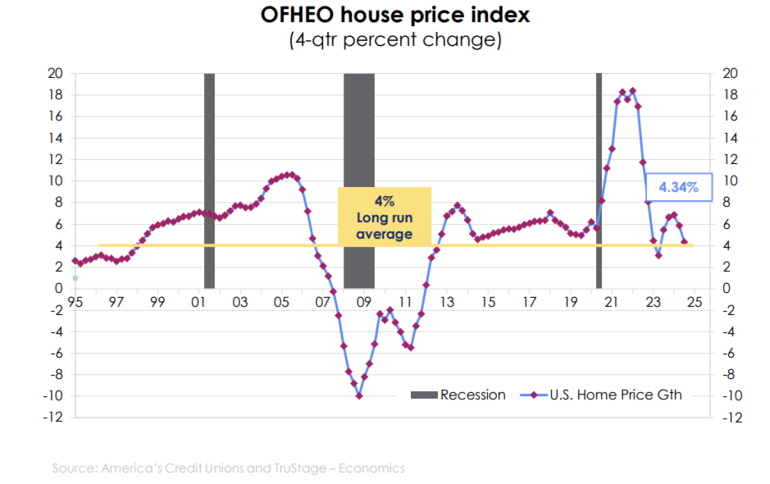
Credit union fixed-rate first mortgage loan balances declined 0.3% in September, below the 0.2% gain set in September 2023. Credit unions sold 33.7% of their mortgage originations into the secondary market during the first half of this year, up from 22.3% in the similar period of 2022 and 22.1% in 2023. Adjustable-rate mortgage loan balances rose 2.6% in September, above the 2.1% gain recorded in September 2023. The contract interest rate on a 30-year, fixed-rate conventional home mortgage fell to 6.18% in September from 6.50% in August but down from the 7.20% reported in September 2023. House price appreciation is moderating due to the lowest housing affordability in four decades and a modest increase in the inventory of homes for sale.
Savings And Assets
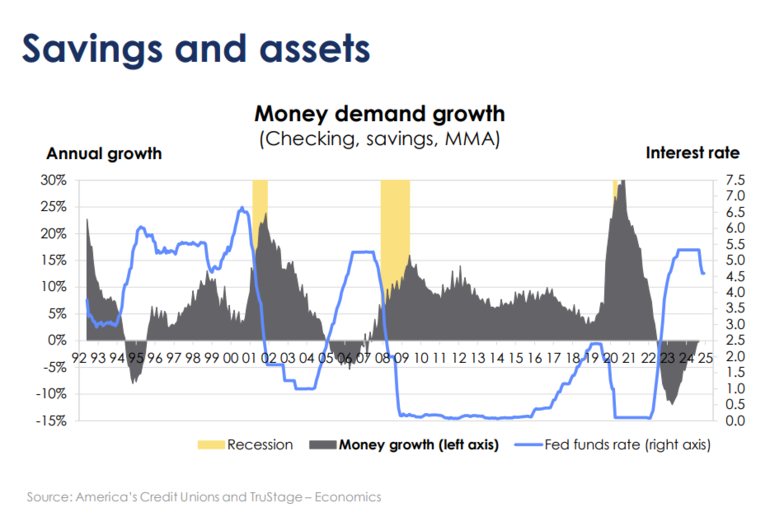
Credit union members’ demand for “money deposits” (i.e., checking, savings and money market accounts) fell at a 0.2% seasonally-adjusted annualized rate in September and has been in negative territory since July of 2022.
“This is a dramatic reversal from the greater than 30% growth rate recorded in the summer of 2020 when COVID-19 stimulus checks were being sent out to millions of Americans. Meanwhile, demand for investment type accounts like certificate of deposits are growing at an 18% annualized rate,” Rick said. “The high federal funds interest rate is the major factor causing this decline in money deposits as members withdraw funds from low-yielding savings deposits and place them in higher yielding certificate of deposits or money market mutual funds.”
Rick noted there is a strong negative correlation between short-term interest rates and holdings of checking, savings, and money market deposit accounts.
“This shift in credit union deposits helped increase credit union cost of funds from 0.36% in the first half of 2022 to1.88% in the first half of this year. This is known as the ‘mix effect,’” explained Rick. “But there is also a ‘rate effect,’ whereby credit unions are raising their deposit interest rates to prevent deposit runoff or what is known as disintermediation.”
Savings balances per member rose $224 during the last 12 months, from $13,480 in September 2023 to $13,704 today. This 1.7% increase in savings per member is significantly below the 25-year average of 4.4%. Some members are spending some of their savings due to falling real wages, while other interest-rate-sensitive members are moving funds out of their credit union to higher-yielding alternative investments. As the Federal Reserve lowers the fed funds interest rate in 2025, expect money deposits to experience growth once again, Rick said.
Equity And Other Key Measures
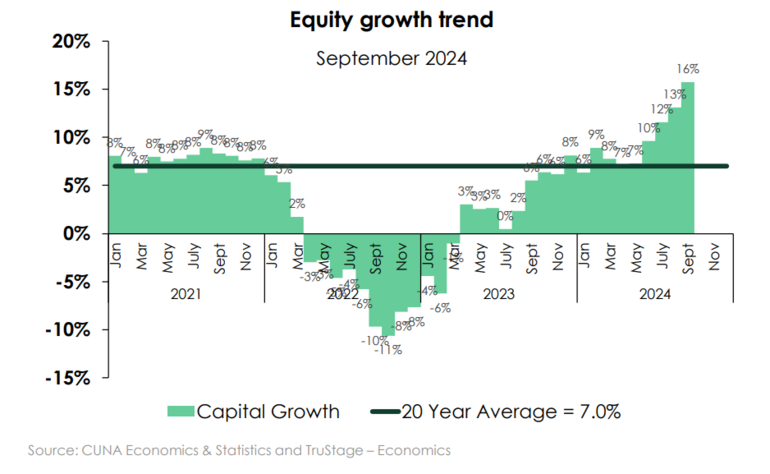
The credit union system’s equity-to-asset ratio rose to 9.7% in September, up from 9.6% in August and 8.7% in September 2023 due in part to falling interest rates increasing the market value of investments classified as available for sale. This past June credit unions classified 75% of their investments as available for sale and therefore were reported at fair value.
“Many believe the Federal Resave will decrease short-term interest rates by 1 percentage point during the next 12 months, which will then boost investment valuations,” Rick explained. “Changes in securities value between accounting periods are included in the equity section of the balance sheet. For example, a one-year 5% Treasury note would rise in value by 1.0% if interest rates fell 1 percentage point, a two-year 5% Treasury note would rise by 1.9%, a four-year 5% Treasury note would rise by 3.6% and a nine-year 5% Treasury note would rise in value by 7.4%.”
In June, credit unions held 15% of their surplus funds in the 5–10-year maturity bucket, down from 18.6% one year earlier. If the Federal Reserve lowers interest rates another 100 basis points over the next 12 months as inflation falls to their 2% target, expect investment values to continue to rise as well as equity levels, the report states.
“The above-mentioned equity tailwind along with the net income earned during the last year increased credit union equity levels 16% during the last 12 months the fastest pace since February 1994,” Rick said. “This equity growth rate is also known as the return-on-equity ratio and is one of the most important credit union financial ratios. For the last eight months, the return-on equity ratio has been running above the 7% average recorded over the last 20 years.”
Credit Unions And Members
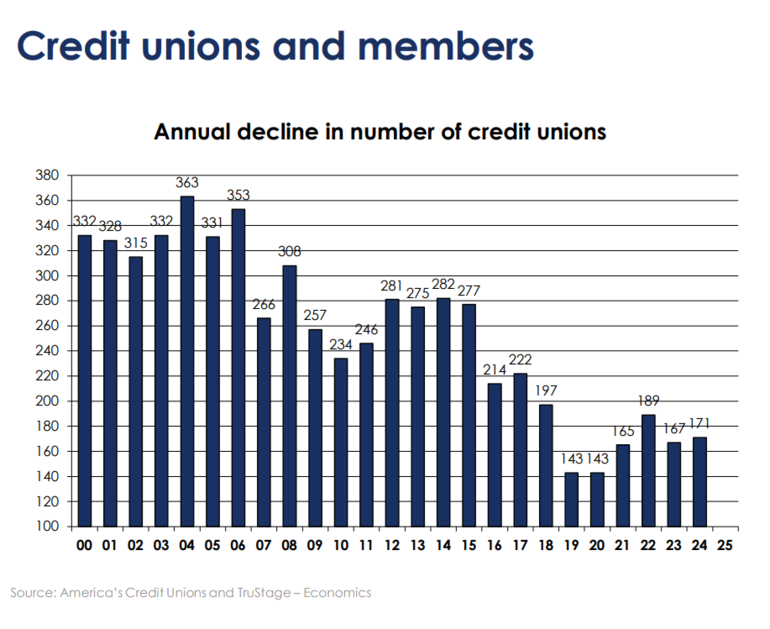
As of September 2024, 4,668 credit unions were in operation, down 171 from September 2023. Year-to-date, the number of credit unions fell by 128, slightly faster than the 124-decrease reported in the first nine months of 2023. NCUA’s Insurance Report of Activity showed 50 mergers were approved in the third quarter (up from 39 in the third quarter of 2023), with an average asset size of $100 million. The average asset size of the continuing credit union was $849 million. Forty of the mergers were due to credit unions wanting expanded services, six were due to poor financial condition, two because of poor management, and one was due to an inability to find officials.
“Expect mergers to accelerate to 175 during 2025 due to the ongoing liquidity crisis and smaller credit unions wishing to expand the services offered to their members,” Rick said.
Credit unions added more than 2.2 million memberships in the first nine months of 2024, below the 3.6 million added in the similar time period of 2023. Weak demand for consumer loans was the major factor leading to the slowdown in membership growth. Also contributing to the membership growth slowdown was the decline in job growth as only 1.7 million new jobs were added in the U.S. economy during the last nine months, which was significantly below the 2.4 million added during the same period in 2023.