

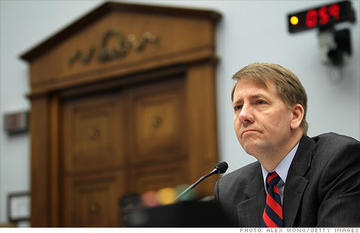
Richard Cordray
KANSAS CITY, Mo.—Credit unions may have been spared from being directly affected by proposed new rules from the CFPB on payday and small dollar loans, but there are concerns CUs will be inadvertently caught up in the significant new rulemaking.
Specifically, the CFPB is exempting from its proposed rules loans that are made in compliance with NCUA’s payday alternative loan (PAL) program, with the CFPB even holding up PALs as an example of responsible small-dollar lending.
The CFPB proposal, however, is 1,549 pages long, and it remains to be seen how credit union loans might be affected, even indirectly. The CFPB said the proposal, which is is now out for comment, is aimed at those who attempt to trap consumers in a cycle of debt.
The proposed rules have not been embraced by everyone, with the Pew Charitable Trusts saying the proposal does not go far enough in protecting consumers and “misses the mark.”
“The very economics of the payday lending business model depend on a substantial percentage of borrowers being unable to repay the loan and borrowing again and again at high interest rates,” said CFPB Director Richard Cordray in prepared remarks shared before today’s field hearing in Kansas City, Mo. “It is much like getting into a taxi just to ride across town and finding yourself stuck in a ruinously expensive cross-country journey.”
Cordray emphasized that the Bureau is not intending to “disrupt existing lending by community banks and credit unions that have found efficient and effective ways to make small-dollar loans to consumers that do not lead to debt traps or high rates of failure. Indeed, we want to encourage other lenders to follow their model.”
Three Main Conditions
The new rules apply more “mainstream banking” measures to payday and auto title lenders, including requiring lenders to determine the ability of borrowers to afford the monthly payment before issuing a loan. Among new requirements are a “full-payment test” to loans covered by the payday lending proposal (and not PAL loans), which would require that a lender determine the consumer will be able to repay a loan up front without having to reborrow. The number of times that people could roll over their loans into newer and pricier ones would be curtailed, as well.
“Specifically, lenders would need to verify the borrower’s income, borrowing history, and certain key obligations,” stated Cordray. “This would determine whether the consumer will have enough money to cover their basic living expenses and other obligations and still pay off the loan when due without needing to reborrow in the next thirty days. The proposal further protects against debt traps by making it difficult for lenders to press distressed borrowers into rolling over the same loan or reborrowing shortly after paying it off. And it would cap the number of single-payment loans that lenders can offer to a consumer in quick succession.”
Cordray explained that the proposal also would not require the full-payment test for certain installment loans that pose less risk to consumers.
“These loans would have to meet three main conditions. First, they must be for a term of no more than two years and be repaid in roughly equal payments,” he said. “Second, the total cost cannot exceed an all-in percentage rate of 36%, plus a reasonable origination fee. Third, the projected annual default rate on all of these loans must not exceed 5%. The lender would have to refund all of the origination fees paid by all borrowers in any year where the annual default rate of 5% is exceeded. Lenders would also be limited as to how many such loans they could make to a consumer each year.”
Credit Unions, Trade Groups Begin Review
Credit unions and their trade associations are now carefully reviewing the lengthy rule to see if any aspects of the proposal impact credit union lending.
NAFCU stated that Cordray phoned NAFCU President and CEO Dan Berger Wednesday to discuss the proposal, noting it would include the PAL provision. Berger thanked Cordray for reaching out to credit unions and called the carve-out a “very good sign.” He added that NAFCU plans to fully review the proposed rule—including its full impact on credit union lending—and provide additional comments. Comments are due by Sept. 14.
CUNA stated that it will develop its comments for the CFPB with its Consumer Protection Subcommittee, led by Bill Cheney, president/CEO of SchoolsFirst FCU, Santa Ana, Calif., and its Advocacy Committee, led by Patrick Jury, president/CEO of the Iowa Credit Union League.
“Credit unions exist to meet the credit and savings needs of their members. Credit unions are proud of how they have engaged their members with short-term, small-dollar lending needs,” said CUNA President/CEO Jim Nussle. “We believe that any rulemaking in this area should encourage credit union participation in this market, not impede it. In response to CUNA’s advocacy efforts, the CFPB has indicated that it aims not to include credit union products in this proposed rule. We are closely analyzing the 1,549-page proposal and, as needed, we will strongly advocate that CFPB reevaluate any aspects of its proposal that impact credit unions’ ability to serve their members.”
Specifically, the proposal includes the following consumer protections:
- Full-payment test: Under the proposed full-payment test, lenders would be required to determine whether the borrower can afford the full amount of each payment when it’s due and still meet basic living expenses and major financial obligations. For short-term loans and installment loans with a balloon payment, full payment means affording the total loan amount and all the fees and finance charges without having to reborrow within the next thirty days. For payday and auto title installment loans without a balloon payment, full payment means affording all of the payments when due.
- Principal payoff option for certain short-term loans: Under the proposal, consumers could borrow a short-term loan up to $500 without the full-payment test as part of the principal payoff option that is directly structured to keep consumers from being trapped in debt. Lenders would be barred from offering this option to consumers who have outstanding short-term or balloon-payment loans or have been in debt on short-term loans more than 90 days in a rolling 12-month period. Lenders would also be barred from taking an auto title as collateral. As part of the principal payoff option, a lender could offer a borrower up to two extensions of the loan, but only if the borrower pays off at least one-third of the principal with each extension.
- Less risky longer-term lending options: The proposal would also permit lenders to offer two longer-term loan options with more flexible underwriting, but only if they pose less risk by adhering to certain restrictions. The first option would be offering loans that generally meet the parameters of the National Credit Union Administration “payday alternative loans” program where interest rates are capped at 28% and the application fee is no more than $20. The other option would be offering loans that are payable in roughly equal payments with terms not to exceed two years and with an all-in cost of 36% or less, not including a reasonable origination fee, so long as the lender’s projected default rate on these loans is 5 percent or less. The lender would have to refund the origination fees any year that the default rate exceeds 5%. Lenders would be limited as to how many of either type of loan they could make per consumer per year.
- Debit attempt cutoff: Under the proposal, lenders would have to give consumers written notice before attempting to debit the consumer’s account to collect payment for any loan covered by the proposed rule. After two straight unsuccessful attempts, the lender would be prohibited from debiting the account again unless the lender gets a new and specific authorization from the borrower.
The CFPB’s proposal follows what the agency said has been “extensive research” on the products. That research confirmed what other research has also found, that most borrowers end up in high-cost loans that seem to only grow in size even as payments are made, often leading to scarred credit for consumers and the repossession of automobiles.
The interest on storefront payday loans averages 391%, the CFPB said, which might explain why there are more payday lenders in the U.S. than McDonald’s franchises. CUToday.info has coverage of the CFPB’s research on storefront payday loans, online payday loans, and auto title loans here.
‘Forced to Shutter Their Doors’
Some are forecasting that small-dollar loan volume could fall at least 55%, and the $7 billion a year that lenders collect in fees would drop significantly.
That change may force a large number of small lenders out of business, The New York Times reported. The $37,000 annual profit generated by the average storefront lender would instead become a $28,000 loss, the Times stated.
“Thousands of lenders, especially small businesses, will be forced to shutter their doors, lay off employees, and leave communities that already have too few options for financial services,” said Dennis Shaul, chief executive of the Community Financial Services Association of America, a trade group for payday lenders, told the newspaper.
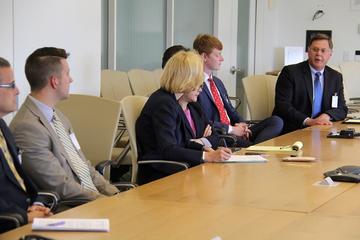
Pennsylvania credit union leaders met with the CFPB in Washington last week--payday lending was discussed.
‘It Misses The Mark’
Not all consumer groups are embracing the new rules. According to the Pew Charitable Trusts, the CFPB’s proposal does not go far enough in protecting consumers, and also limits financial institution innovation in small-dollar lending.
“It misses the mark. It lets 400% APR payday loans flourish, but locks out lower-cost loans from banks,” Pew stated in a release. “The rule requires lenders to document applicants’ income and certain expenses, but that does not make loans safe. Installment loans at 400% APR are still harmful even with more underwriting. Strong CFPB rules are badly needed, but this proposal focuses on the process of originating loans rather than making sure those loans are safe and cost less.”
Pew continued, saying that the CFPB should put clear product safety standards in its rule, like limiting payments to 5% of a borrower’s paycheck.
“All payday loan customers already have a checking account—it’s required to get a payday loan—and at least three large banks were planning to use the 5% payment provision to offer small-dollar loans at prices six times lower than payday lenders. But the CFPB’s proposal would stop that pro-consumer innovation in its tracks. Banks need clear product safety standards to save millions of borrowers billions of dollars.”
‘A Better Choice’
In Pennsylvania, where 4,414 CUs offer a payday lending alternative through the Pennsylvania CU Association’s Credit Union Better Choice Program, the league is optimistic about the CFPB’s proposal, but will be wading through its pages to make the final call.
“Better Choice is a blueprint for conducting small-dollar loans or payday alternative loans the right way: reasonable terms, financial education and a savings component,” said Michael Wishnow, SVP, marketing and communications. “We have presented Better Choice to the CFPB and they have acknowledged its merits. PCUA adapted Better Choice loans to comply with NCUA’s PAL rule as well as military lending regulations. As we analyze the proposal, we will continue to demonstrate the value of Better Choice and seek to amend any aspects of the rule that would deter credit unions from offering such loans.”