MADISON, Wis.—During December, credit unions picked-up 373,000 in new memberships and loan and savings balances grew at a 10.2% and 6.2% seasonally adjusted annualized pace, respectively, according to CUNA Mutual’s latest Trends Report.
The company is predicting that credit union membership growth will exceed 3.5% in 2018.
Credit union loan balances rose 1.0% in December, slightly better than the 0.9% pace reported in December 2016. Driving overall loan growth was strong growth in credit card loans (2.2%), new-auto loans (1.6%) and fixed-rate mortgages (1.06%). December credit card seasonal factors – holiday shopping – typically add 3.1 percentage points to the underlying credit card trend loan growth, CUNA Mutual stated. The muted December credit card growth was caused by the continuing windfall from lower gasoline prices.
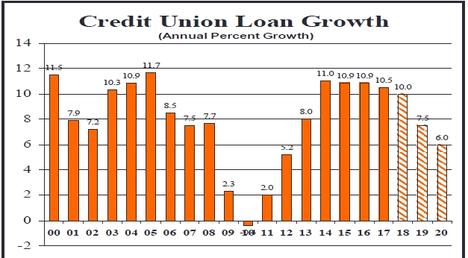
Credit union loan balances rose 10.5% in 2017, down from the 10.9% reported in 2016 due to a surge in new auto, used auto and fixed-rate first mortgage growth rates. Expect loan growth to decelerate to 10% in 2018 but remain well above the past 25-year average of 7%. Rising household formations of 1.6 million and continued job creation will keep home and auto sales strong.
Credit Union Consumer Installment Credit (CUCIC)
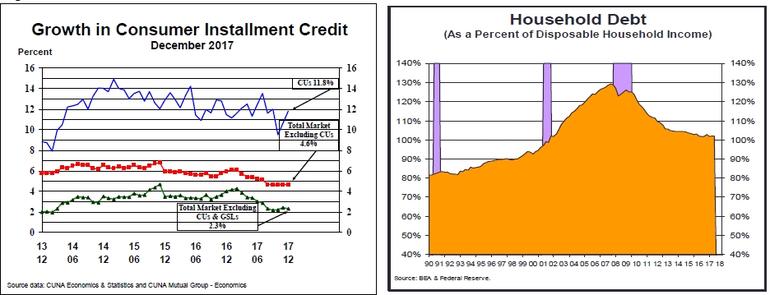
Credit union consumer installment credit balances (auto, credit card and other unsecured loans) rose 1.0% in December, faster than the 0% pace set in December 2016. During 2017 credit union consumer installment credit grew 11.8%, faster than the total market excluding credit unions, which grew only 4.6%. If guaranteed student loans are removed, then consumer credit increased only 2.3% for non-credit-union lenders. Household debt burdens, as measured by household debt as a percent of disposable household income, fell to 102% in the third quarter of 2017, the lowest rate since the first quarter of 2002, according to the Federal Reserve’s Flow of Funds report. This improvement in household debt should help the economy avoid a recession for the next couple of years, CUNA Mutual said.
Vehicle Loans
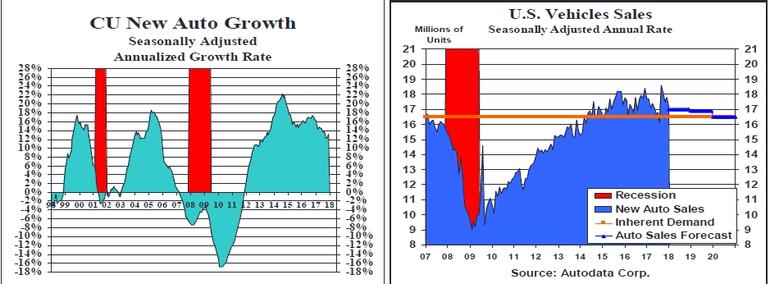
Credit union new auto loan balances rose 1.6% in December, similar to the 1.7% pace set in December 2016, and rose 14.3% for the full year. On a seasonally-adjusted annualized basis, new auto loan balances rose 13.2% in December, which is below the 16.5% pace reported in December 2016. Strong consumer fundamentals are driving auto sales and auto loan growth: an improving labor market, low gasoline prices, faster wage growth, low interest rates, expanding driving-age population, improving construction activity and better household balance sheets, the report shared.
Real Estate Secured Lending – First Mortgages and Other Real Estate
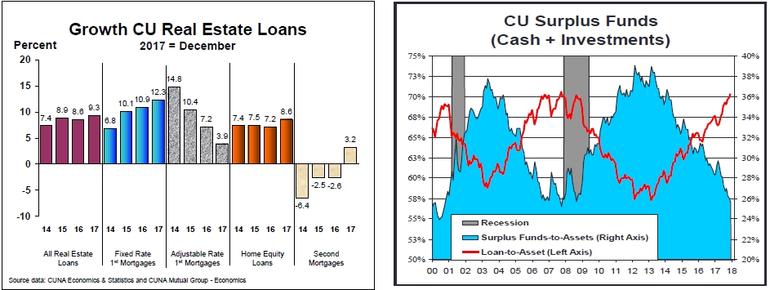
Credit union real estate loan balances grew 9.3% in 2017, the fastest pace since 2008. Second mortgage loan balances finally reported positive growth in 2017, 3.2%, after eight years of falling balances due to members rolling second mortgages into refinanced first mortgages. By year-end, fixed-rate first mortgages made up 29.2% of all loans, up from 22.6% in December of 2007, the beginning of the Great Recession.
Credit unions are making headway in serving their members’ mortgage needs. Currently 2.4% of members have a first mortgage loan at their credit union, up from 1.9% in 2009. First mortgage credit quality improved significantly in 2017, with delinquency rates falling to 0.57%, down from 0.63% in 2016 and 0.78% in 2015.
The housing market tightened in December as the inventory-to-sales ratio dropped to 3.4 months, the lowest level on record, from 3.9 months in November. A housing market rule of thumb is that when the ratio approaches four months, expect a surge in residential construction activity, CUNA Mutual explained. “Housing demand is expected to trend upward over the next several years as fundamental drivers, including a tightening labor market, rising wages and surging confidence push home sales higher. This will help support credit union purchase mortgage originations,” the report stated.
The contract interest rate on a 30-year, fixed-rate conventional home mortgage rose to 3.95% in December, up from 3.92% in November but lower than the 4.2% reported in December 2016. The tight labor market is pushing up labor costs, which is leading to a surge in inflation expectations. This pushed up the 10-year treasury interest rate to 2.4% in December, from 2.35% in November.
Home prices rose 0.5% in December from November, according to the Core Logic Home Price Index, and 6.6% year-over-year. Rising household incomes in 2018 will allow first-time homebuyers to save for a down payment and give trade-up homebuyers the financial wherewithal to purchase higher priced homes, CUNA Mutual said.
Surplus Funds (Cash + Investments)
In December credit union liquidity fell to the lowest level since October 2007. Credit union surplus funds as a percent of assets declined to 25.6% in December, down from 28.4% one year earlier, due to loan growth outpacing savings growth. Credit unions are decreasing the liquidity of their surplus funds. In December, 46.5% of surplus funds had a maturity of less than one year, down from 47.3% one year earlier.
During 2017 credit union savings balances rose $70.7 billion, down from $79.6 billion in 2015. These “sources of funds” helped fund the $95.2 billion increase in credit union loan balances in 2017. The resulting $24.5 billion loan funding deficit was made up with a $16 billion reduction in investments and $8.5 billion of the total $11 billion increase in capital.
Loans rose to 70.4% of assets in December, up from 67.5% one year earlier, which was the highest level since October 2007.
“With loan and asset balances expected to increase 10.5% and 6%, respectively, in 2018, the credit union aggregate loan-to-asset ratio will reach 73.4% by the end of this year. Alas, the last two recessions have been preceded by credit union loan-to-asset ratios climbing above 69%. Is this correlation or causation? In any event, this richer mix of assets should help boost credit union yield-on-asset ratios from the 3.49% set in 2017 to the 3.60% expected this year,” CUNA Mutual said.
Savings and Assets
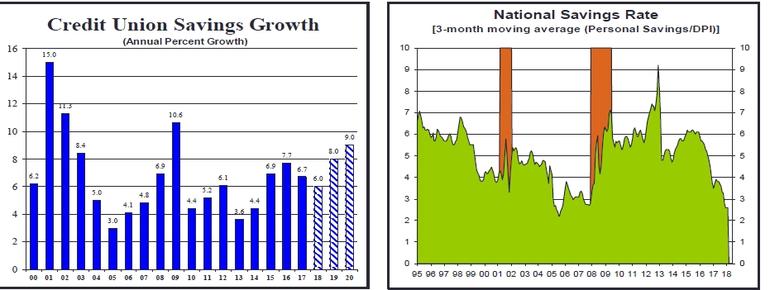
Credit union savings balances rose 1% in December, down from the 1.3% reported in December 2016, as falling expenditures on gasoline left more of members’ paychecks in their checking accounts at the end of the month. Savings balances typically decline 0.14% in December due to recurring seasonal factors such as holiday spending. Savings balances rose 6.7% for all of 2017, slower than the 7.7% pace set in 2016.
“Expect slower savings growth in 2018 of around 6% as gasoline prices rise, members’ increase spending and stock prices reach new highs,” the report stated.
With spending growth outpacing personal income growth over the last year, the national savings rate (savings to disposable personal income) has moved lower. In December, the savings rate fell to 2.4%, the lowest since the third quarter of 2005, due to rising fuel prices and higher consumer confidence boosting spending. The recent increase in the stock market could induce a “wealth effect” as stock capital gains reduce households’ incentive to save out of current disposable income. This will weigh on deposit growth at credit unions in 2018.
Capital and Other Key Measures
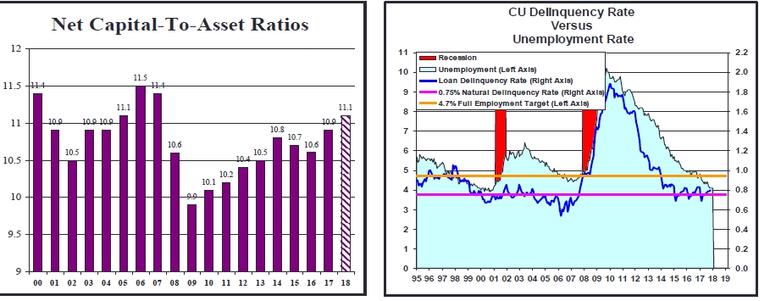
The credit union industry’s net capital-to-asset ratio ended 2017 at 10.9%, up from the 10.6% reported at year-end 2016, as capital growth outpaced asset growth. The capital ratio is expected to rise to 11.1% in 2018 as the pace of capital growth will rise to 8%, faster than the expected asset growth rate of 6%.
The credit union loan delinquency rate (loans two or more months delinquent as a percent of total loans outstanding) fell to 0.79% in December from November, and down from the 0.83% reported one year earlier.
“With the labor market at ‘full employment’ it appears the delinquency rate has settled in to an equilibrium range of 0.7-0.8%. During 2017, the delinquency rate’s annual seasonal pattern reverted back to what we saw in the 2001-2008 period. During that era, delinquency rates typically reached their nadir in the first quarter, and then slowly rose as the year progressed and reached their apex late in the fourth quarter,” CUNA Mutual said.
Credit Unions and Members
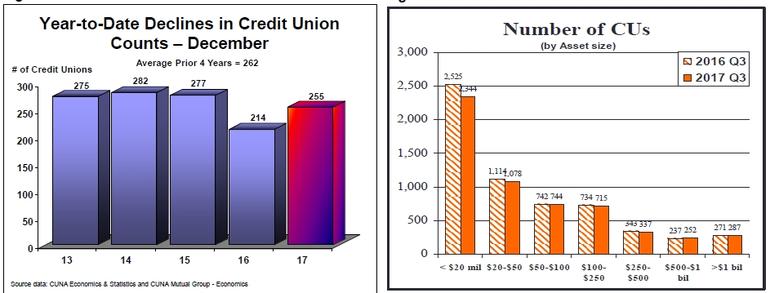
As of December 2017, CUNA estimates 5,767 credit unions are in operation, down 255 from December 2016. Consolidation of the credit union movement will continue due to retiring baby-boomer CEOs, rising regulatory/compliance burdens, low net interest margins, rising concerns over scale and operating efficiency, rising competitive pressures and members’ demand for more products, services and access channels.
NCUA’s Insurance Report of Activity showed eight mergers were approved in December with an average asset size of $19 million. This is down from the 18 mergers reported in December 2016 with an average asset size of $91 million. The reasons given for the mergers were the following: six for expanded services, and two because of the inability to find officials. There are now approximately 287 credit unions in the U.S. with assets greater than $1 billion, according to NCUA call report data.
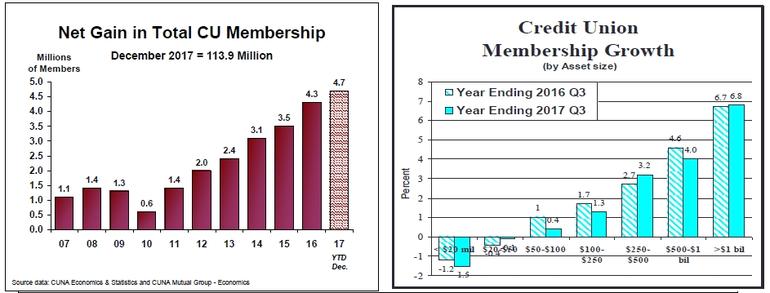
Credit unions added 373,000 memberships in December, bringing the 2017 membership growth to 4.7 million new members, the biggest annual increase in credit union history and four times the pace set a decade earlier. This membership surge is due in large part to the strong job market and rising credit demand, CUNA Mutual explained. “When people get jobs, they may also join a credit union. In 2017, the economy added 2.173 million jobs according to the Bureau of Labor Statistics. For 2018, expect another two million jobs to be created and credit union membership growth to exceed 3.5%.
Total credit union memberships reached 113.9 million at year-end 2017, which is 34.8% of the total U.S. population of 328 million. This is up from 33.7% of the population at year-end 2016. Large credit unions reported the fastest annual growth while credit unions with less than $50 million in assets reported falling memberships.