MADISON, Wis.–Credit union membership surged again during November of 2015, while overall lending also continued to rise and credit unions’ yield on surplus funds fell to 0.92% during the first nine months of 2015 – a new record low – down from 1.21% for the similar period last year due to a greater percentage of cash holdings and shorter maturity investments.
But once again the data indicate it’s a tale of two CU movements, with large credit unions far out-performing their smaller brethren, according to the newest CUNA Mutual Trends Report, which reflects data through November of last year.
The data show that CU memberships grew 376,000 in November, or 0.36%, which is much better than the 174,000 new members, or 0.17%, added in November 2014. Through November, credit unions added 3.6 million new members. Meanwhile, lending was also up overall by more than 10%, but as CUNA Mutual noted, “industry growth rates mask big disparities between large and small credit unions.”
“In the year ending in the third quarter of 2015, credit unions with assets greater than $1 billion reported a 12.9% increase in loan balances, which was up slightly from the similar time period one year earlier,” CUNA Mutual said. “Credit unions with assets less than $20 million reported loan growth of only 2.8%.”
Here’s what the Trends Report shows through November:
Overall Lending
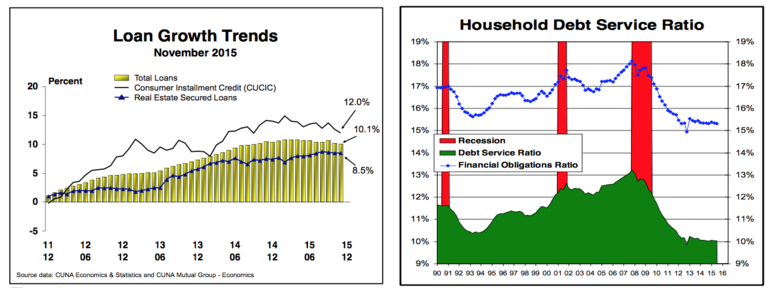
Overall, total credit union loan balances rose 0.63% in November, slightly slower than the 0.68% pace reported in November 2014, CUNA Mutual reported. Driving overall loan growth was strong growth in home equity lines of credit (1.5%), unsecured personal loans (1.4%) and new-auto loans (1.1%). Over the last 12 months, total credit union loan balances rose more than 10%, but industry growth rates mask big disparities between large and small credit unions.
Credit Union Consumer Installment Credit (CUCIC)
Credit union consumer installment credit balances (auto, credit card and other unsecured loans) rose 0.5% in November, half the 1.0% pace set in November 2014. Consumer installment credit grew 12% over the last year, faster than the 8.5% rise in real estate loans. The household debt service ratio (mortgage and consumer debt payments required to remain current on that debt as a percent of disposable income) was 10.03% in the third quarter according to the Federal Reserve, slightly above the record low 10.01% set in the fourth quarter of 2014, CUNA Mutual said.
Vehicle Loans
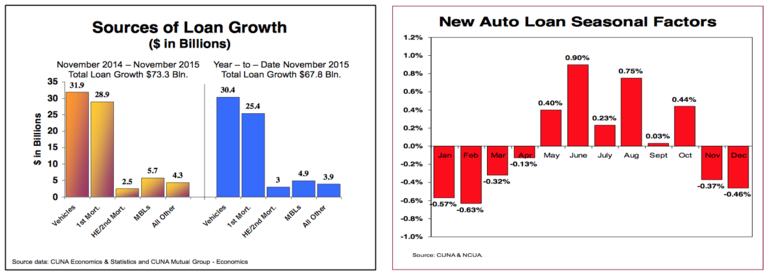
Auto loans remain credit unions’ “bread and butter” loan product, the Trends Report noted, with vehicle loan balance growth outpacing the growth in mortgage and business loans. During the last 12 months, vehicle loan balances increased $31.9 billion (13.7%), slightly better than the $28.9 billion increase for first mortgage loans (9.8%). New auto loan balances rose a robust 1.1% in November, although slightly less than the 1.3% pace set in November 2014, despite November being typically one of the slower months of the year for auto loan originations. Vehicle sales remained at the recovery high of 18.2 million units (seasonally-adjusted annualized rate) in November, 5.8% higher than the 17.2 million pace set in November 2014.
CUNA Mutual is projecting that auto sales will fall to 17.2 million units in 2016 from the record 17.4 million units in 2015. By 2018, auto sales will settle down to the inherent sales rate of 16.5 million units.
Mortgages
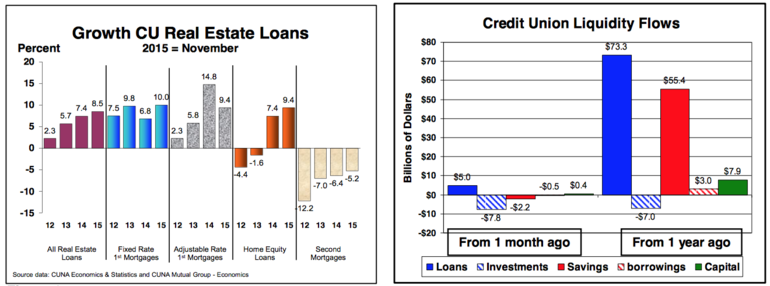
Credit union fixed-rate first mortgage loan balances grew 0.5% in November, greater than the 0.4% pace set in November 2014, despite existing-home sales dropping 10.5% in November from October. “It is always difficult to decipher why home sales rise or fall in any particular month, but one factor leading to significantly longer closing times in November, according to the National Association of Realtors, was the implementation of the Consumer Financial Protection Bureau’s ‘Know Before You Owe’ mortgage disclosure rules,” the Trends Report pointed out.
From January to November, fixed-rate first mortgage loan balances grew 10%, slightly faster than the 9.4% increase in adjustable-rate mortgage balances and the 9.4% growth of home equity balances, CUNA Mutual said. Second mortgage balances continued its multiyear decline (-5.2%) as homeowners refinance second mortgage balances into new first mortgage loans. This effect is limiting the growth in overall real estate loan balances to 8.5%, according to CUNA Mutual.
Surplus Funds (Cash + Investments)
Credit union surplus funds fell $7.8 billion, or -2.1%, in November to help fund strong loan demand ($5.0 billion), deposit outflows ($-2.2 billion) and the paying down of borrowings (-$0.5). To make-up the loan funding shortfall, capital growth contributed $0.4 billion. Credit union surplus funds as a percent of assets fell to 30.5% in November, down from 32.9% in November 2014, as credit unions partly funded $73.3 billion in new loans with $7.0 billion of cash and investments. The obverse of the falling surplus funds ratio is the rising loan-to-asset ratio, which reached 65.5% in November, the highest level since September 2010, CUNA Mutual said.
According to third quarter NCUA call report data, credit unions’ yield on surplus funds fell to 0.92% during the first nine months of 2015 – a new record low – down from 1.21% for the similar period last year due to a greater percentage of cash holdings and shorter maturity investments. Average annualized loan yields fell to 4.66% – also a record low – during the first nine months of 2015, from 4.83% for the similar period in 2014 as old higher-rate loans repriced into today’s lower interest rates. Yield on asset ratios were unchanged (3.35%) during the year due to the positive “mix effect” offsetting the negative “rate effect,” CUNA Mutual said in its analysis.
Savings and Assets
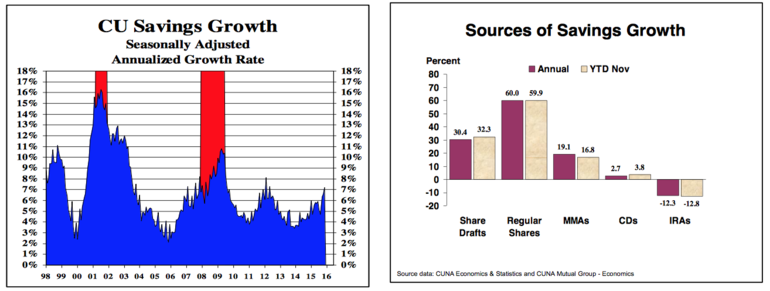
Credit union savings balances fell 0.2% in November, the same decline reported in November 2014. Savings balances are currently growing at a 7.2% seasonally-adjusted annualized growth rate due to falling fuel prices and rising household incomes, CUNA Mutual said. Expect savings growth to slow in 2016 as interest-rate sensitive members move some of their funds to higher-rate-paying competitors, the company forecast.
Credit unions reported a savings inflow of $55.4 billion during the last 12 months, a 5.7% increase. Sixty percent of this inflow ($33.3 billion) was deposited into low-cost regular share accounts and 30% ($16.9 billion) was deposited into share draft accounts. Share certificate accounts’ growth made up almost 3% of the total growth over the last year as credit unions began raising interest rates to attract and lockdown longer-term deposits.
Capital and Other Key Measures
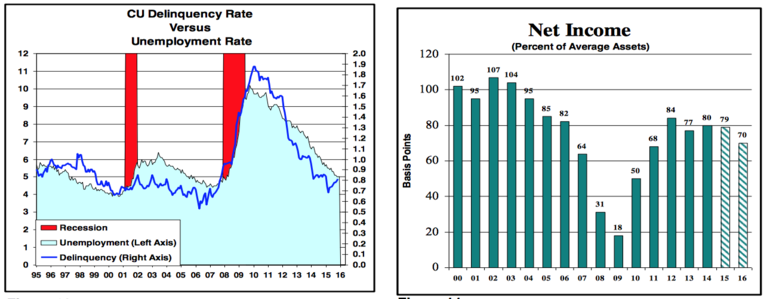
The loan delinquency rate (loans two or more months delinquent as a percent of total loans outstanding) rose to 0.81% in November from the March low of 0.68%, demonstrating its seasonal pattern, according to CUNA Mutual. Delinquency rates typically reach their nadir in the first quarter as members use their tax refunds and bonus checks to catch up on any late loan payments.
Credit union return-on-asset ratios came in at 0.79% (annualized) for the first nine months of 2015, similar to the rate set during the previous three years. Expect ROA to fall in 2016 due to tighter margins and rising loan loss provisions, CUNA Mutual forecast.
Credit Unions and Members
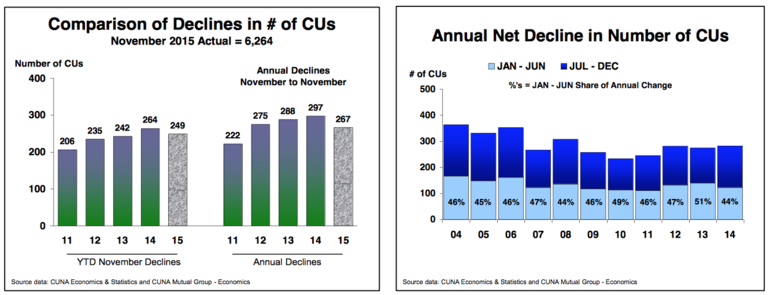
As of November 2015, CUNA estimates 6,264 credit unions were in operation, down 267 from November 2014. Year-to-date the number of credit unions fell by 249, slightly slower than the 264 reported in the first eleven months of 2014. The annual contraction rate of the credit union industry reached 4.1% in 2015, faster than the 3.5% set in 2005. NCUA’s Insurance Report of Activity showed 19 mergers were approved in November with an average asset size of $18.3 million. This is down from the 22 mergers reported in November 2014 with an average asset size of $19.8 million.
CUNA Mutual reported that the data show that starting in 2004, 46% of the annual decline in the number of credit unions took place in the first half of the year and 54% in the second half.
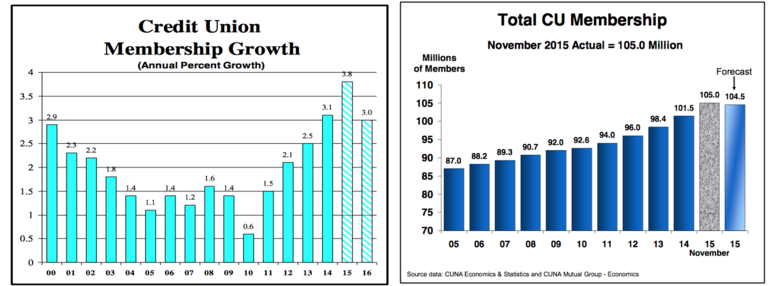
Credit union memberships grew 376,000 in November, or 0.36%, which is much better than the 174,000 new members, or 0.17%, added in November 2014. Year-to-date credit unions added 3.6 million new members, faster than the 2.8 million members added during the similar period in 2014. During the last 12 months, credit unions memberships rose 3.8%, the fastest pace in over 20 years.
Total credit union memberships reached 105 million in November, 3.5 million more than December 2014, CUNA Mutual said. Rapid U.S. job growth and strong loan demand are two major factors driving the surge in credit union memberships.
“For 2016 expect another 2.4 million jobs and credit union membership growth to exceed 3.0%,” CUNA Mutual forecast.