

MADISON, Wis.–Credit union membership growth has slowed dramatically recently when compared to the last six years, according to new analysis by CUNA Mutual’s Trends Report, which suggests what membership growth is taking place is unintended consequence of the Durbin Amendment of the Dodd-Frank Act.
Separately, as the economy rebounded in Q3, credit union loan growth slowed to just 0.2% in August, total auto loan balances fell, s net interest margins continue to shrink and a double-dip recession is possible, the Trends Report further found.
Here’s a look at the latest Trends Report analysis:
Total Credit Union Lending
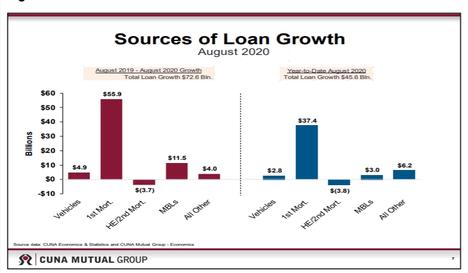
Credit union loan balances rose 0.2% in August, below the 0.9% pace set in August 2019. During the last 12 months, credit union loan balances increased 6.6%, slightly faster than the 6.4% pace set in the year ending August 2019. Of the $72.6 billion increase in total credit union loans outstanding, $55.9 billion was due to first mortgage loans, or 77% of the total.
According to the Trends Report, home equity lines of credit and second mortgage loan balances fell $3.7 billion during the last year as credit union members paid off outstanding balances with funds obtained from a cash-out mortgage refinance. The credit union share of the first mortgage originations market rose to 8.7% in the first half of 2020, up from 8.2% during the first half of 2019 and up from 2.6% prior to the 2008-09 financial crisis.
The analysis found credit unions sold off 40% of their first mortgage originations to the secondary market in the first half of the year, up from 35% one year earlier. The credit union share of the total consumer installment credit market rose to 11.8% in August, up from 11.7% one year ago, CUNA Mutual said.
Credit Union Consumer Installment Credit (CUCIC)
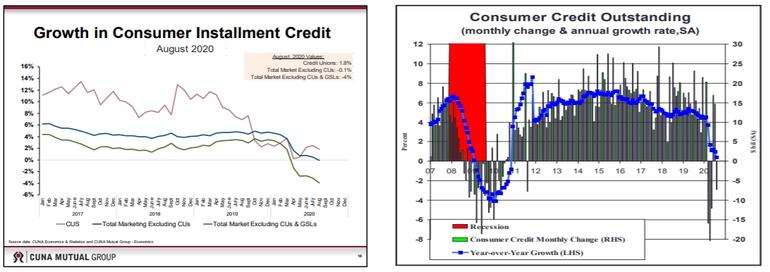
Credit union consumer installment credit loan balances (auto, credit card and other unsecured loans) rose 0.3% in August, a deceleration from the 0.9% pace set in August 2019, according to the Trends Report.
During the last 12 months, credit union consumer installment credit grew 1.8%, greater than the total market excluding credit unions and government student loans. CUNA Mutual cited Federal Reserve showing consumer credit outstanding for all lenders fell $7.2 billion in August; non-revolving credit rose $2.2 billion while revolving credit (credit cards and home equity lines of credit) fell $9.4 billion.
“Going forward, expect credit growth to remain slow due to supply-side constraints. In recent years, lenders have been quick to tighten lending standards at the first sign of deterioration in credit quality. If the unemployment rate remains elevated or even rises due to a third COVID-19 wave, then expect loan delinquencies and charge-offs to rise also,” the company forecast.
Vehicle Loans
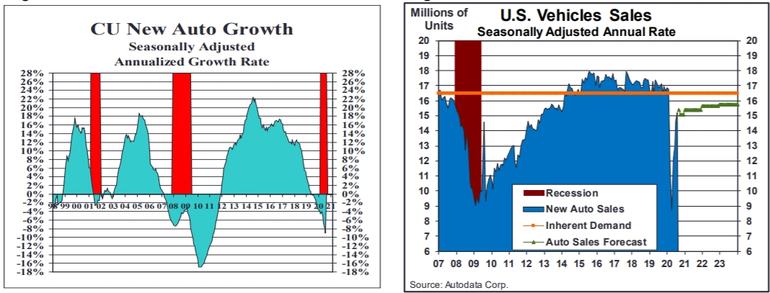
Credit union new auto loan balances fell 0.2% in August, below the 0.3% pace set in August 2019.
“Currently new-auto loan balances are falling at a -8% seasonally-adjusted annualized growth rate, a much slower pace compared to what we have seen over the past few years,” the Trends Report states. “The weak credit union new auto loan growth rates are due high economic uncertainty, low consumer confidence and cash-out refinances paying off new auto loan balances.”
Vehicle sales rose to a 14.9 million unit seasonally-adjusted, annualized sales rate in August, down from 15 million in July and below the 17 million sales pace set in August 2019.
CUNA Mutual is forecasting, “Labor market insecurity is likely holding some buyers back. Car sales will continue to rise for the next few months as people who are no longer flying, taking the train or ride sharing are in the market for a new vehicle. The demand for private mobility is increasing the demand for what can be called COVID cars. Vehicles sales, however, are expected to remain below 16.5 million units in 2020, which is considered by economists to be the ‘inherent demand’ for the U.S. auto sector.”
Real Estate Secured Lending First Mortgages and Other Real Estate
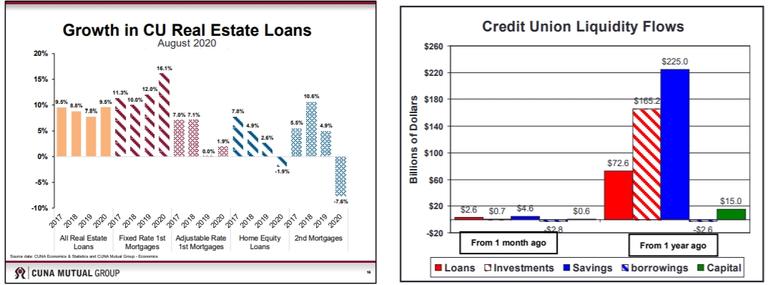
Credit union fixed-rate first mortgage loan balances grew 0.8% in August, slower than the 1.3% pace reported in August 2019.
CUNA Mutual noted that when comparing year-over-year growth, fixed-rate first mortgage balances rose 16.1%, which is above the 9.8% reported in the year ending in August 2019. Adjustable-rate first mortgage loan balances grew slower than fixed-rate loans over the last year, rising 1.9% during the last year and slower than the 2.7% pace reported in the year ending August 2019.
According to the Trends Report, credit unions now hold $509 billion of first mortgages on their books, 76% of which are fixed-rate. Home equity lending posted another weak month in August, decreasing -0.5%, below the -0.1% pace reported in August 2019.
“The recent drop in 30-year mortgage interest rates has encouraged some members to refinance their first mortgage loan and cash out some home equity to pay down home equity loan balances. With home prices expected to rise another 5-7% during the next year, we expect home equity loan balances to begin growing soon after the end of the refinance boom next summer,” the Trends Report states. “The contract interest rate on a 30-year, fixed-rate conventional home mortgage fell to 2.94% in August, from 3.02% in July, and significantly below the 3.62% reported in August 2019. This is the first time the 30-year mortgage rate has fallen below 3%. We expect the 30-year mortgage interest rate to remain below 3.25% during the next year, due to long-term interest rates remaining low worldwide. We expect the low interest rates to have a positive impact on new and existing housing demand during the next year.”
Surplus Funds (Cash + Investments)
Credit union surplus funds rose $0.7 billion, or 0.1%, in August due to a slowdown in savings deposits growth. The $4.6 billion increase in deposits helped to fund loan demand ($2.6 billion) and reduce borrowings by $2.8 billion, according to the Report.
Credit union capital grew by a small $0.6 billion as credit unions increased their provision for loan losses, CUNA Mutual noted. Credit union surplus funds as a percent of assets rose to 30.8% in August, up from 25% in August 2019.
The report notes the obverse of the rising surplus funds ratio is the falling loan-to-asset ratio, which reached 65.2% in August, down from 70.6% last August, as asset growth outpaced loan growth.
“Over the last few years, the shift in the mix of credit union assets toward lower-yielding investments and away from higher-yielding loans has pushed down credit union asset yields. Over the last year, credit union yield-on-asset ratios fell to 3.59% during mid-year 2020 from 4.08% during mid-year 2019 as the asset portfolio shifted toward investments earning an average return of 1.48% and away from loans earning an average return of 4.79%,” the report states.
CUNA Mutual added that with credit union cost of funds only falling 14 basis points during the last year to 0.73%, net interest margins decreased 35 basis points in the second quarter to 2.86%, compared to 3.21% a year earlier.
“Expect net interest margins to fall to 2.7% next year, the lowest in credit union history,” the report said.
Savings and Assets
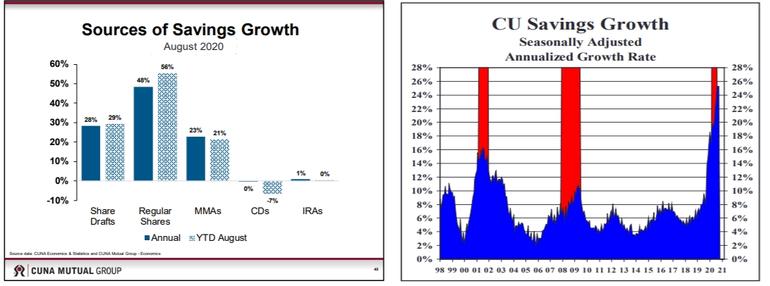
Credit union savings balances rose 0.3% in August, below the 1.6% rise in balances reported in August 2019 when that month ended on a Saturday after a payroll Friday.
The report notes August is normally one of the weakest months of the year for savings growth due to seasonal factors, such as vacation spending and auto loan down payments. Credit union deposit growth is becoming more unbalanced. During the first eight months of the year, credit union deposits rose $202 billion.
“We expect savings balances to grow 18.6% in 2020 and 8% in 2021, above the long run average of 7%, due to high levels of economic uncertainty,” CUNA Mutual said.
Capital and Other Key Measures
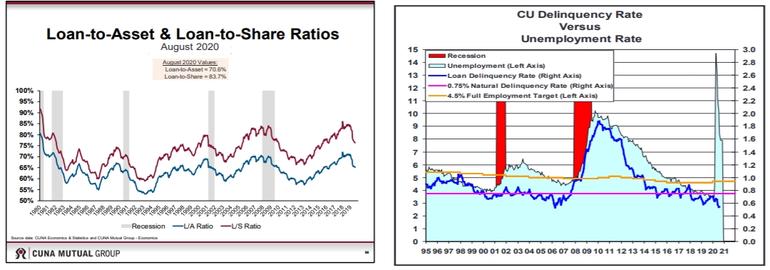
The credit union movement’s weighted average loan-to-share ratio fell to 76.3% in August, down from the 83.9% reported in August 2019, due to savings balance growth (17%) outpacing loan balance growth (6.6%), the Trends Report states.
“Falling loan-to-share ratios occur during recessions as consumer borrowing and spending slows relative to saving. Less loans lead to lower earnings and capital ratios, holding all else equal. Moreover, credit unions with lower capital ratios tend to lend less, which leads to even lower earnings and capital ratios in the future and creates self-reinforcing spiral,” the company said.
The loan delinquency rate (loans two or more months delinquent as a percent of total loans outstanding) fell to 0.54% in August, down from 0.66% in August 2019. This decline in the delinquency ratio was caused by the loan balances’ denominator growing faster (6.6%) than the delinquent loans’ numerator (-12.6%).
The dollar amount of delinquent loans is down due to the loan forbearance programs implemented over the last 6 months of the pandemic, the report adds.
Number of Credit Unions
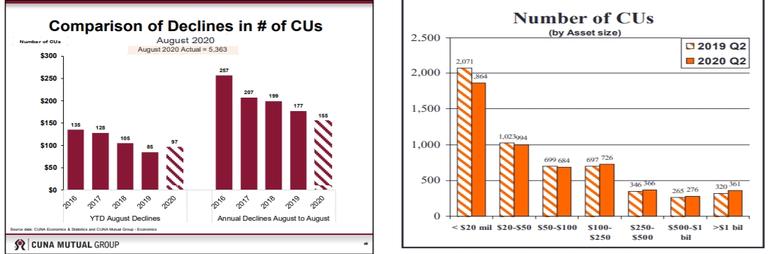
As of August 2019, CUNA estimates 5,363 credit unions were in operation, down 155 from August 2019. Year-to-date the number of credit unions fell by 97, which is above the 85 credit union decline reported in the first eight months of 2019. The credit union movement contracted at a 2.8% pace over the last year, which is below the long-run average decline of 3.5% set over the last 40 years, according to the Trends Report.
“We expect slower than normal merger activity during 2020-2021 due to credit union managers having less bandwidth to deal with the time-consuming business of a merger. But we expect a surge in merger activity in 2022-2024 after the COVID-19 pandemic runs its course,” the report explained.
Credit Unions by Assets
CUNA Mutual reported the number of credit unions with assets over $1 billion rose to 361 in June 2020, 41 more than one year earlier. All asset categories greater than $100 million in assets reported more credit unions, while asset categories less than $100 million reported fewer credit unions.
The number of credit unions with assets less than $20 million declined by 71 institutions to 1,864, which is still by far the asset size category with the most credit unions. The median asset sized credit union rose to $40.3 million in June, up from $35.7 million in June 2019.
Credit Union Membership
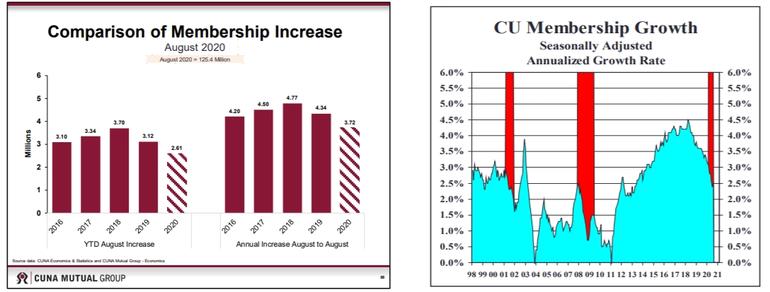
Credit union memberships rose 318,000 in August, or 0.3%, below the 514,000 new members, or 0.4%, added in August 2019. During the last year, credit unions added 3.72 million new members – below the 4.2 million growth pace set through August 2019 – which translates into a 2.4% seasonally-adjusted, annualized growth rate.
“Membership growth has slowed dramatically recently when compared to the last six years. Membership growth is being supported by an unintended consequence of the Durbin Amendment of the Dodd-Frank Act, which capped the fees large banks can charge merchants to process debit card transactions (21 cents plus 0.05% of the total charged),” the Trends Report states. “To make-up for this lost revenue, banks increased their monthly fees for having a debit card or a checking account. The higher charges are driving many bank customers to their local low-or-no-fee, not-for-profit credit union.”