

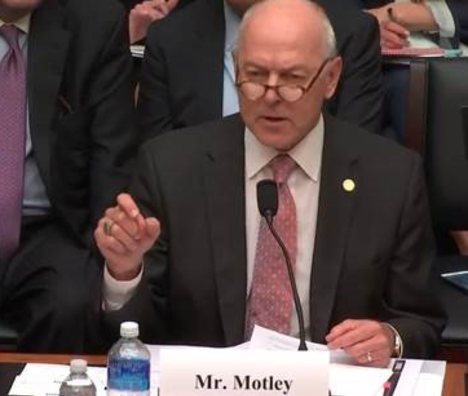
David Motley
WASHINGTON–David Motley, CEO of CU Members Mortgage and the chairman-elect of the Mortgage Bankers Association, testified before Congress that regulatory impediments have imposed unnecessary burdens on mortgage banks and restricted credit to vulnerable consumers.
Motely told the House Financial Services subcommittee on Financial Institutions and Consumer Credit that the result has been the constricted availability of credit in recent years and a lessened ability to provide financial products and services to consumers and smaller lenders.
"MBA has consistently supported reasonable requirements that will prevent a reemergence of housing and market disruptions" Motley testified. “We believe some aspects of the Dodd-Frank Wall Street Reform and Consumer Protection Act and other statutes have made the mortgage market safer; however, in many other respects the Dodd-Frank rules have reduced the availability and affordability of mortgage credit for many American families. Regulatory uncertainty, combined with heightened enforcement risk have forced many responsible lenders to reconsider their ability to lend to the full extent of the credit box. These decisions ultimately impact the consumer, and often disproportionately impact low-to-moderate income borrowers, minorities and first-time homebuyers."
Motley urged that particular attention be given to simplifying rules, providing greater clarity and certainty, and mitigating supervisory burdens. He noted that while measures of mortgage credit, such as the MBA Mortgage Credit Availability Index, have shown improvements in mortgage credit availability, the index remains half of its 2004 level. At the same time, the MBA Quarterly Mortgage Performance Report notes both production and servicing expenses have substantially increased over the past 10 years, he said.
He further told Congress that while the Consumer Financial Protection Bureau is empowered with significant rulemaking authority, its approach to redirecting behavior in the marketplace has relied heavily on enforcement actions.
The MBA offered several recommendations to remove or diminish many of the regulatory impediments it said are too restrictive or complex, including:
* Ability to Repay and Qualified Mortgages. “MBA believes the ATR rule and QM standards must be improved and we continue to work with policymakers, including the CFPB, to responsibly widen the credit box, including expanding the Safe Harbor, increasing the small loan definition; establish alternatives to Appendix Q; broaden right to cure for DTI and other technical errors; revise the Points and Fees Definition; and replace the patch and the default QM,” Motley said.
* Servicing Market Regulations. “MBA believes mortgage servicing market regulations would benefit from review under President Trump's recent Executive Order's direction to ‘make regulation efficient, effective, and appropriately tailored.’ Coordination among federal agencies and streamlining of existing regulations would go a long way toward lowering costs and increasing the availability of credit,” Motley said.
* Additional Authoritative Guidance and Clarity Needed in Key Areas. “MBA supports congressional action to require the CFPB to develop an appropriate framework with public comment for its issuance of rules, policies, and supervisory guidance. "This would include criteria for issuing rules, commentary, supervisory memoranda or compliance bulletins to put the industry on notice regarding supervisory expectations on what the CFPB regards as illegal practices," Motley said.
* Home Mortgage Disclosure Act. "While we appreciate that the CFPB has recognized the problem of potential harm to privacy by virtue of the public disclosure of HMDA data and has committed to engaging in a public discussion about these issues, MBA believes nonbank mortgage lenders play a key role in the mortgage marketplace," Motley said.
* FHA. Reforms to FHA servicing are necessary to add cost certainty and reduce operational inefficiencies. Such reforms should include: 1. Direct conveyance of foreclosed FHA properties; 2. A unified timeline for FHA servicing process rather than three separate milestones. 3. Streamline FHA loss mitigation processes.
* Government Housing Resources. MBA urged Congress to ensure that the FHA, VA and Ginnie Mae programs operate as 21st century programs.