

MADISON, Wis.—Credit union loan growth dipped in March, but expect growth to pick up as the year progresses and to rise markedly in 2022, according to CUNA Mutual Group in its latest Trends Report.
The report does caution, however, that industry capital ratios could fall to 9.5% by year end as the capital growth rate remains low but asset growth surges 14%. Data also continue to show membership growth remains largely among the big CUs while smaller institutions are losing members.
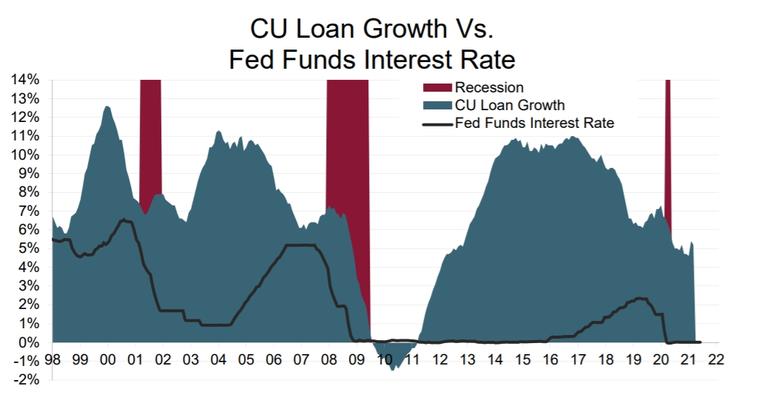
Overall, credit union loan balances rose 0.22% in March, below the 0.33% reported in March 2020 and 4.9% during the last 12 months.
March is historically the third weakest loan growth month of the year, with seasonal factors typically shaving off 0.24 percentage points from the underlying trend growth rate. The lending season for credit unions begins in earnest in April and continues through August, CUNA Mutual noted.
Driving overall loan growth was strong growth in unsecured personal loans (2.6%), used-auto loans (0.7%) and fixed-rate first mortgages (0.6%).
“Periods of low Fed Funds interest rates, (2002-2004 and 2009-2016) have a stimulative effect on overall credit union loan growth. This is, of course, the goal of expansionary monetary policy, which is to raise the rate of credit creation from below trend growth to something closer to normal. Credit union loan growth is currently around 5%, below its long run average of 7%. Expect credit union loan balances to rise 5% in 2021 and 8% in 2021 and 2022 which will be slightly above the long run average,” CUNA Mutual said.
Consumer Installment Credit
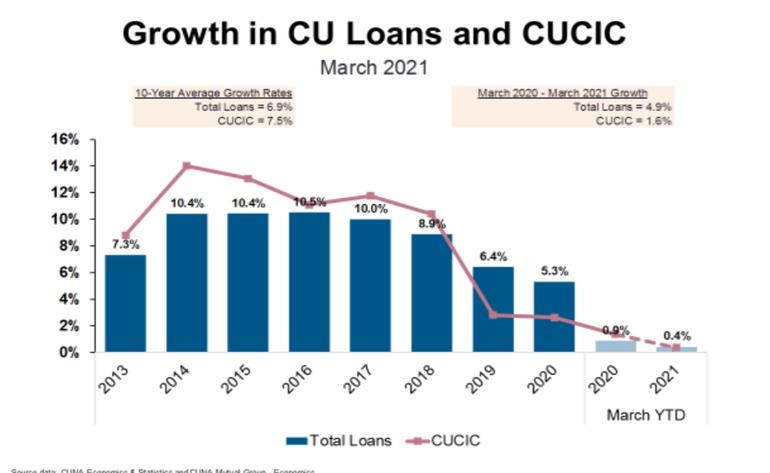
According to the Trends Report, credit union consumer installment credit balances (auto, credit card and other unsecured loans) fell 1% in March, below the 0.8% pace set in March 2020, due to negative growth in new-auto lending (- 3.2%) and credit cards (-2.5%). Credit card balances fell in March due to seasonal factors that typically shave 1.23 percentage points from the underlying trend growth as members use tax refunds and bonuses to pay down outstanding credit card balances, the analysis added.
"But this year many credit union members also received $1,400 stimulus checks in March and used part of these funds to pay off higher rate credit card debt," the Report notes. "Over the last year, credit union credit card loan balances fell 10.3%, the biggest drop in credit union history. Credit union consumer installment credit grew 0.4% year to date, less than half the 0.9% pace set in the first quarter of 2020. Credit union consumer installment credit grew 1.6% during the last year, which is slightly above the 0.9% for the total market excluding credit unions."
Vehicle Loans
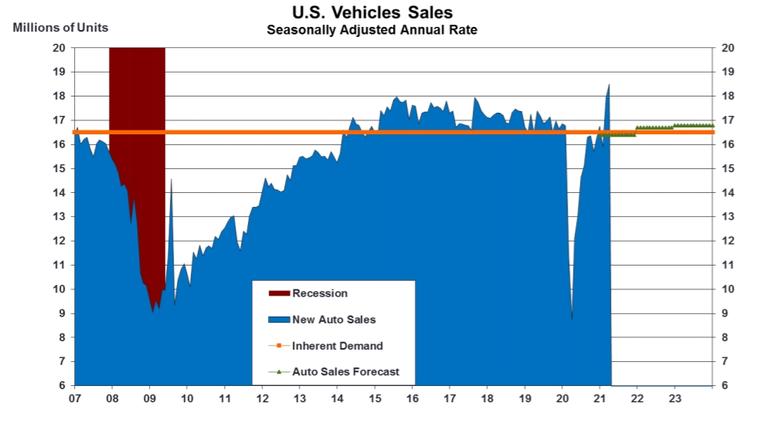
Credit union new-auto loan balances declined 3.2% in March; a bigger decline compared to the 0.8% drop in March 2020. New auto loan balances are down 6.5% from one year ago but used-auto loan balances are up 4.8%, CUNA Mutual reported. The new-auto buying and lending season begins in May and runs through October. On a seasonally-adjusted annualized growth rate basis, new-auto loan balances fell 5.7% in March, as loan payoffs are exceeding loan originations. Vehicle sales were 17.7 million in March and 18.5 million in April at a seasonally-adjusted annualized sales rate. The April sales number is the strongest April in the history of the U.S. auto market and the fastest of any month since July 2005. The April sales number (18.5 million) was 112% above the pandemic-ravaged totals of April 2008 (8.7 million). Sales of both light trucks and SUVs remained strong in April, the report added.
Real Estate
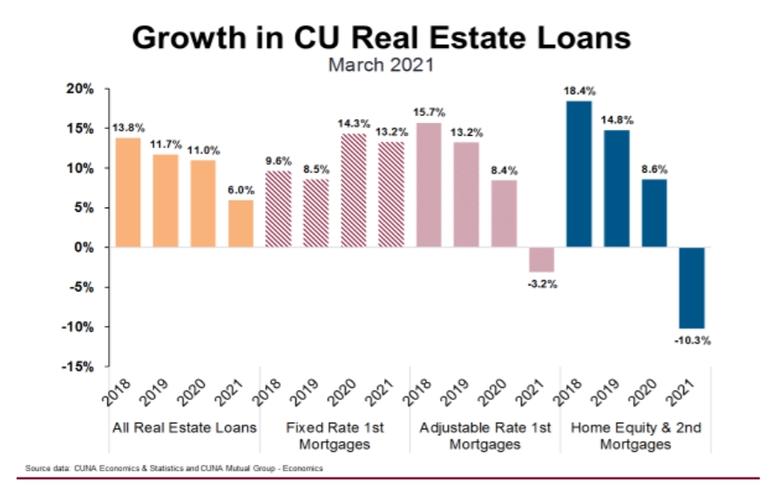
According to the Trends Report, credit union fixed-rate first mortgage loan balances rose 0.6% in March, below the 5.1% increase reported in March 2020, as mortgage interest rates began to rise. Credit union fixed-rate first mortgage loan balances rose 13.2% over the last 12 months, slightly below the 14.3% pace set for the similar time period last year. Home equity loans and second mortgage balances fell by 10.3% over the last year as members rolled these loans into refinanced low-rate first mortgage loans. The contract interest rate on a 30-year fixed-rate conventional home mortgage rose to 3.08% in March, up from the 2.81% in February but lower than the 3.45% reported in March 2020, CUNA Mutual stated.
"The increase in mortgage rates is partly due to the 10-year Treasury interest rate rising from 1.26% in February to 1.56% in March 2021. Interest rates are moving higher due to higher inflation expectations (4 basis points) and higher real interest rates (26 basis points)," the report stes. "Home prices rose 2% in March from February, according to the Core Logic Home Price Index, and 11.3% year-over-year which is the fastest pace since 2006. U.S. home prices are rising faster than incomes due to limited supply of homes colliding with steady demand. The shortage of new homes is due to homebuilders not producing enough new inventories to satisfy demand. With the Federal Reserve not expected to raise interest rates this year, expect mortgage interest rates to remain below 3.5% for the rest of the year."
Surplus Funds
The Trends Report found credit union surplus funds as a percent of assets rose to 35.7% in March from 27% last year, as credit unions placed strong deposit growth into investments as loan growth slowed. During March, a 4.4% surge in savings balances funded a 0.2% increase in loans and an 8.9% increase in surplus funds, CUNA Mutual said.
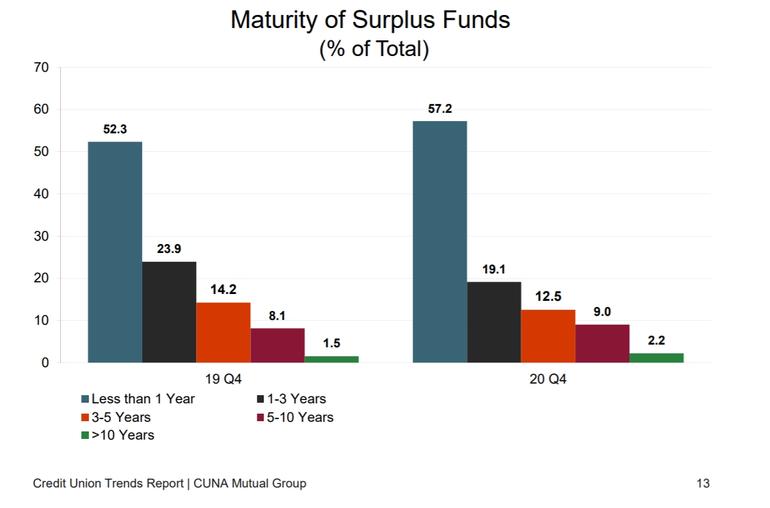
"External borrowings fell a large 22% in March. Surplus funds are expected to rise to 38% of assets by the end of the year, the loosest liquidity position since the second quarter of 2013, as loan balances grow only 5% and savings balances rise at a very strong 14%," the report states. "The COVID-19 pandemic and low market interest rates has shifted credit union surplus funds maturity toward shorter term investments and away from 1–5-year investments. Surplus funds with less than one year maturity rose to 57.2% of total surplus funds in the 4th quarter of 2020, up from 52.3% one year earlier. Investments with a maturity from 1-3 years reported the biggest drop, falling from 23.9% of total to 19.1%. Cash deposits in financial institutions rose from 20.8% of total surplus funds in 2019 to 27.8% in 2020."
Savings and Assets
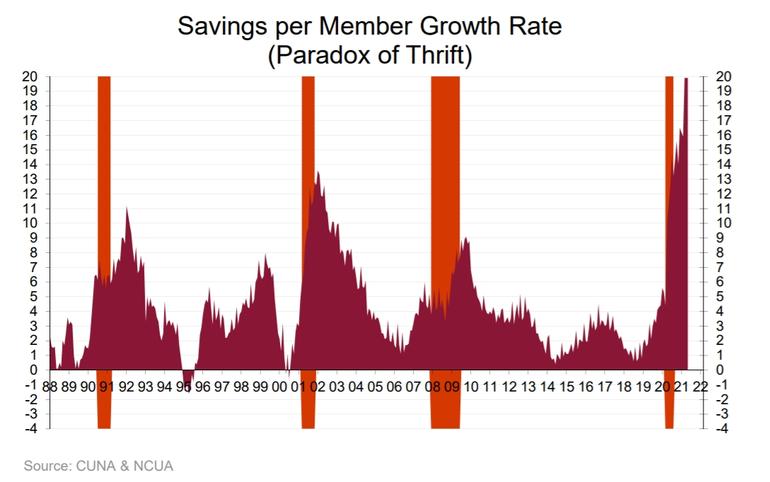
As most CUs know, the Trends Report confirms credit union savings balances surged 4.4% in March, above the 0.9% gain reported in March 2020, due to $1,400 stimulus checks and the seasonal factors of tax refunds and bonuses being deposited in credit union members’ share draft and regular share accounts, which increased 7.1% and 6.9%, respectively. March’s seasonal factors typically add 1.2 percentage points to the underlying savings trend growth, making it the second biggest month of the year for credit union savings growth. The average credit union member had $13,562 in total savings deposits in March 2021, up from $11,307 in March 2020, according to the Trends Report.
"This $2,255 jump in savings balances is the biggest in credit union history and is due to a combination of stimulus checks, enhanced unemployment insurance benefits, less gasoline purchases and increased savings of income due to fear and uncertainty caused by the COVID-19 pandemic," the report states. "In percentage terms, per member savings balances rose almost 20% during the last year, even higher than the 13.5% reported during the 2001 stock market crash. The big question going forward is how 'sticky' will be these additional deposits? Will credit union members keep the additional two thousand dollars as a savings cushion or will they spend those funds once the economy reaches herd immunity sometime in the second half the 2021?"
Capital and Other Key Measures
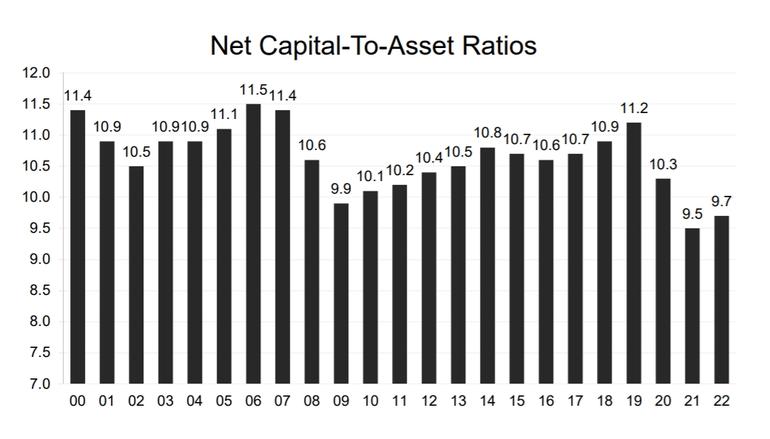
The credit union average capital-to asset ratio fell to 9.8% in March 2021, down from 11% in March of 2020, according to the Trends Report. In the year ending in March, credit union capital rose 6.4% while assets grew 19.4%, which decreased the capital ratio 1.2 percentage points and 11 percent which is the approximate difference between the numerator and denominator growth rates. During the first quarter, credit unions reported strong deposit and asset growth due to $1,400 stimulus checks and many members receiving their tax refund and bonuses, the report added.
"Capital ratios could fall to 9.5% by year end as the capital growth rate remains low but asset growth surges 14%," CUNA Mutual forecast.
Meanwhile, the report further found the industry loan delinquency rate (loans two or more months delinquent as a percent of total loans outstanding) fell to 0.49% in March, down from 0.6% in December 2020, and down from 0.63% in March 2020.
"Credit unions normally report large declines in the delinquency rate in February and March as members use bonuses and tax refunds to catch up on overdue loans," the Report states. "The labor market is now in recovery mode, with the unemployment rate close to 6%, which is slightly above the 4.5% considered to be full employment. With the unemployment rate expected to fall below 4.5% by the end of 2022, we can expect the credit union loan delinquency rate to remain low over the next two years."
Credit Unions and Members
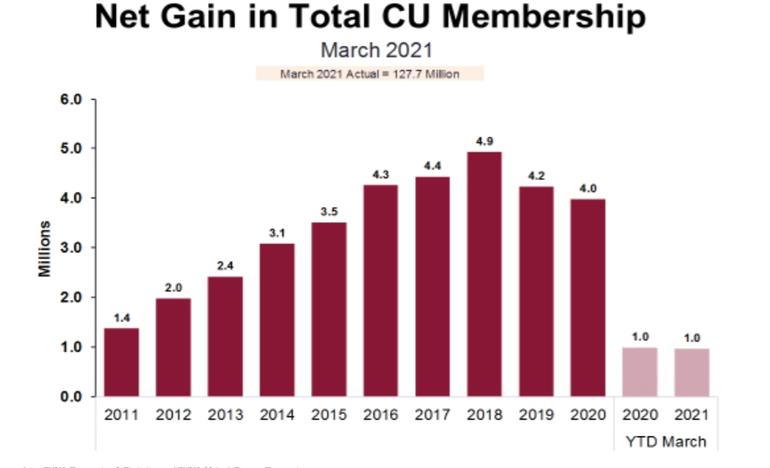
According to the Trends Report, credit union membership growth slowed slightly in the first quarter of 2021, adding 965,000 new memberships, slightly slower than the 993,000 added in the first quarter of 2020.
"On a growth rate basis, memberships are up 3.2% in the year ending in March 2021, below the 3.4% pace set in the year ending in March 2020," CUNA Mutual said. "The membership growth was partially driven by the 1.539 million jobs gained in the first quarter, according to the Bureau of Labor Statistics, which is far above the 1.079 million jobs lost in the first quarter of 2020 when the COVID-19 Pandemic began affecting the economy."
According to CUNA Mutual's analysis, credit unions should expect membership growth around 3% in 2021, before picking up slightly to 3.5% in 2022.
CUNA Mutual noted that once again most of the membership growth is taking place at credit unions with assets greater than $1 billion due to organic growth and mergers, with the large credit unions reported membership growth in the 6% range. Credit union with assets in the range of $250-$999 million reported membership growth of around 2% for the last two years. Credit unions with less than $100 million in assets lost memberships during the last two years, CUNA Mutual said.