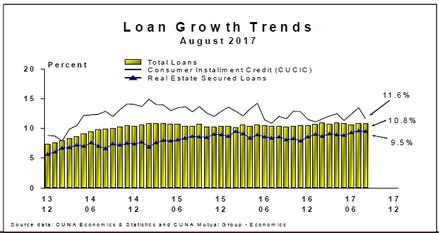
MADISON, Wis.—Credit unions in August continued to post loan growth above 10%, coming in at a 10.1% seasonally adjusted annualized pace, according to CUNA Mutual Group’s latest Trends Report.
CUs, too, continued to take greater share of the mortgage market.
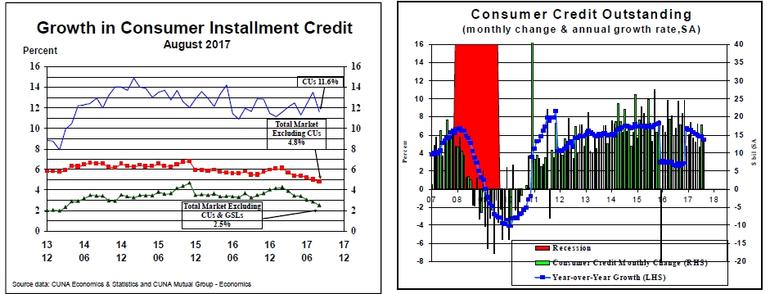
Credit union loan balances rose 1.1% in August, the same pace set in August 2016. During the last 12 months, credit union loan balances increased 10.8%, a similar pace as seen during the last three years. The pace of consumer installment credit growth has decelerated recently to 11.6%; however, this is still more than double the pace of all other lenders bringing the credit union share of the total consumer installment credit market to 11.0%, up from 10.4% one year ago.
“For years, credit unions had been punching below their weight when it came to the first mortgage market. Not anymore. Today credit unions have 8.2% of the first mortgage origination market, up from 7.1% last year and 2.6% a decade ago. Even with credit unions selling off 34.0% of all of their first mortgage originations to the secondary market in the first half of the year, their mortgage balances outstanding rose 10.1% for the year ending in June. Expect mortgage originations to drop 4-5% in 2018 as rising interest rates restrain home demand,” CUNA Mutual said.
Credit Union Consumer Installment Credit (CUCIC)
Credit union consumer installment credit loan balances (auto, credit card and other unsecured loans) rose 0.2% in August, a significant slowdown from the 1.9% pace set in August 2016. During the last 12 months, credit union consumer installment credit grew 11.6%, twice as fast as the total market excluding credit unions. According to the Federal Reserve, consumer credit outstanding rose $13.1 billion for all lenders in August, $5.8 billion in revolving credit and $7.3 billion in non-revolving credit. Going forward, expect credit growth to slow to a more sustainable pace as interest rates begin to move upward and consumers rein in borrowing as it becomes more expensive, CUNA Mutual said.
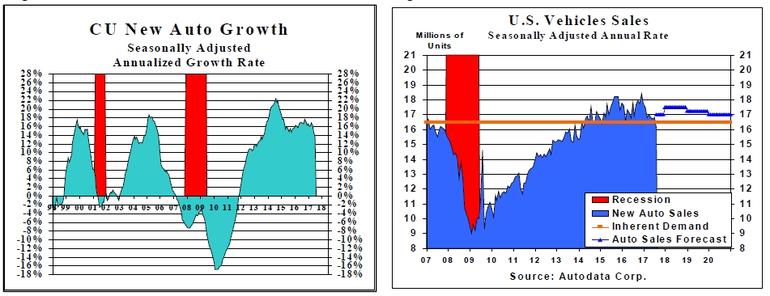
Credit union new-auto loan balances rose 1.1% in August, below the 1.6% pace set in August 2016. Currently new-auto loan balances are rising at a 13.6% seasonally-adjusted annualized growth rate, a pace similar to that seen over the past year. The strong auto sector is being driven by solid household financial fundamentals. These include: robust job creation, better job quality, low interest rates, accessible auto credit, rising wage growth, and improving household balance sheets. The big unknown going forward is how much new-auto loan pent-up demand remains.
Vehicle sales fell to a 16.1 million unit seasonally-adjusted, annualized sales rate in August, down from 16.8 million in July and below the 16.9 million sales pace set in August 2016. Hurricane Harvey reduced 2.0% of the August’s new vehicle sales, so expect a surge in sales in September due to lost sales and replacement purchases of damaged vehicles. Vehicles sales are expected to reach 17.5 million in 2018, above the 16.9 million sales pace expected for 2017 and above the 16.5 million annual sales pace considered by economists to be the “inherent demand” for the U.S. auto sector, CUNA Mutual said.
Real Estate Secured Lending – 1st Mortgages and Other Real Estate
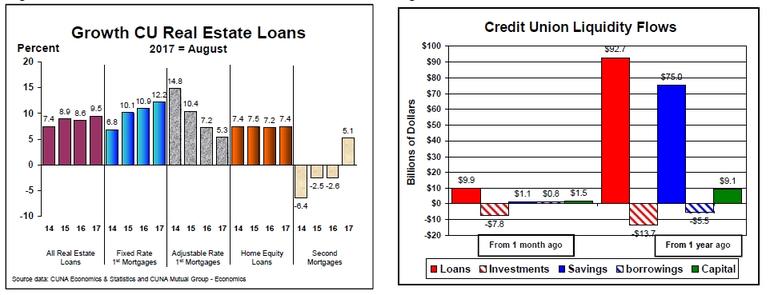
Credit union fixed-rate first mortgage loan balances grew 0.4% in August, slower than the 1.3% pace reported in August 2016. However, when comparing year-over-year growth, fixed-rate first mortgage balances rose 12.2%, which is above the 8.7% reported in the year ending in August 2016. Adjustable-rate first mortgage loan balances grew slower than fixed-rate loans over the last year, rising 5.3% during the last year, and slower, too, than the 11.5% pace reported in the year ending August 2016. Credit unions now hold $382.7 billion of first mortgages on their books, 71% of which are of the fixed-rate variety.
Home equity lending posted another strong month in August, increasing 1.2%, twice as fast as the 0.6% pace reported in August 2016. Rising home prices and improved consumer confidence levels encouraged many credit union members to tap into their home equity to finance the purchase of durable goods. Durable goods spending remained strong as consumers reduced some of their pent-up demand for furniture, appliances and motor vehicles. Moreover, consumers are spending less than they were a year earlier due to retail deflation; this is loosening budget constraints and therefore freeing up cash for other purchases, the report stated.
The contract interest rate on a 30-year, fixed-rate conventional home mortgage fell to 3.9% in August, from nearly 4.0% in July, but above the 3.4% reported in August 2016. “We expect the 30-year mortgage interest rate to increase 15 basis points each quarter during the next year, reaching 4.65% by year-end 2018. However, we don’t expect the interest rate rise to have a significant negative impact on housing demand, due to interest rates remaining at historically low levels,” CUNA Mutual said.
Home prices rose 0.9% in August from July, according to the Core Logic Home Price Index, and 6.9% year-over-year. After more than 11 years, house prices have finally exceeded the previous peak reached during the housing bubble. Home prices are rising due to increasing demand running into a limited supply of homes for sale. Demand for homes is expected to increase in 2017 due to rising household formations and the tightening labor market boosting wage growth.
Surplus Funds (Cash + Investments)
Credit union surplus funds fell $7.8 billion, or -2.1%, in August to help fund strong loan demand ($9.9 billion).
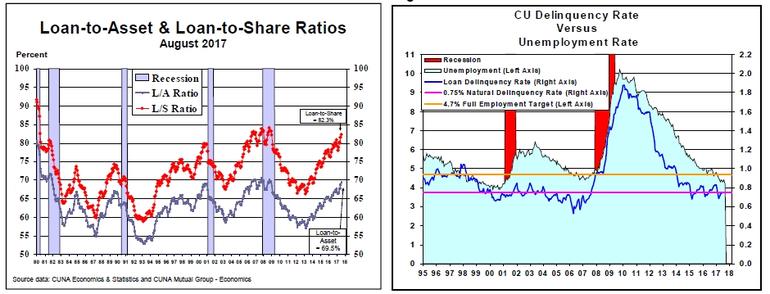
To make up the loan funding shortfall, credit unions reported deposit inflows of $1.1 billion, additional borrowings of $0.8 billion and a capital contribution of $1.5 billion. Credit union surplus funds as a percent of assets fell to 26.5% in August, down from 29.2% in August 2016. “This is the tightest credit union liquidity position since December 2008. The obverse of the falling surplus funds ratio is the rising loan-to-asset ratio, which reached 69.5% in August, from 66.6% last August, as loan growth outpaced asset growth,” the report stated.
This shift in the mix of credit union assets toward higher-yielding loans and away from lower-yielding investments has pushed up credit union asset yields. Over the last year, credit union yield-on-asset ratios rose to 3.44% from 3.38% as the asset portfolio shifted toward loans earning an average return of 4.5% and away from investments earning an average return of 1.5%. The yield-on-loans actually fell from 4.58% in the second quarter of 2016 to 4.580 in the second quarter of 2017 as amortizing loans re-priced to today’s lower interest rates, and with credit union cost of funds only rising 2 basis points during the last year to 0.53%, net interest margins increased 4 basis points in the second quarter to 2.91%, compared to 2.87% a year earlier.
Savings and Assets
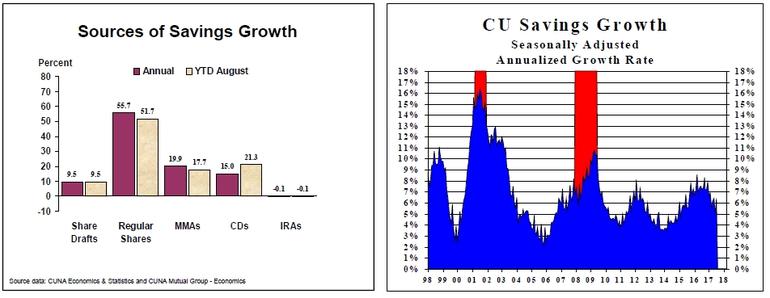
Credit union savings balances rose 0.1% in August, above the 0.1% decline in balances reported in August 2016. “August is normally one of the weakest months of the year for savings growth due to seasonal factors, such as vacation spending and auto loan down payments. Credit union deposit growth is becoming more balanced. During the first 8 months of the year, credit union deposits rose $44.3 billion. Contributing to this growth was a $9.4 billion increase in certificate deposits; thus, making-up 21.3% of total deposit growth,” CUNA Mutual said.
Savings balances grew at a 6.4% seasonally-adjusted, annualized growth rate in August, continuing the downward trend in growth reported over the last year as members spend more of their windfall from low gas prices. CUNA Mutual expects savings balances to grow 7.0% in 2017 and 6.0% in 2018 as the Federal Reserve raises interest rates 0.75 percentage points and some deposits leave credit unions and move to money market mutual funds.
Capital and Other Key Measures
The credit union movement’s weighted average loan-to-share ratio reached 82.3% in August, up from the 79.4% reported in August 2016, due to loan balance growth (10.8%) outpacing savings balance growth (6.9%). “Previous peaks in loan-to-share ratios occur right before recessions, such as the 79.8% in 2000 and 84.1% in 2007. More loans lead to higher earnings and capital ratios, holding all else equal. However, credit unions with higher capital ratios tend to lend more, which leads to even higher earnings and capital ratios in the future and creates a virtuous feedback loop,” the report stated.
The loan delinquency rate (loans two or more months delinquent as a percent of total loans outstanding) fell to 0.75% in August, down from 0.77% in August 2016. This small decline in the delinquency ratio was caused by the loan balances’ denominator growing faster (10.8%) than the delinquent loans’ numerator (7.9%).
Credit Unions and Members
As of August 2017, CUNA estimates 5,870 credit unions were in operation, down 231 from August 2016. Year-to-date the number of credit unions fell by 152, which is above the 135 decline reported in the first eight months of 2015.
NCUA’s Insurance Report of Activity showed 25 mergers were approved in August with an average asset size of $23.6 million, up from the 20 mergers reported in August 2016 with an average asset size of $21.0 million. These small credit unions continue to struggle with earnings. During the first half of 2017, credit unions with assets less than $20.0 million reported an average return-on-asset ratio of only 14 basis points, down from last year’s 20 basis points ratio.
Large credit unions reported falling return-on-asset ratios in the first half of 2017 compared to the first half of 2016 due to rising provision for loan loss expenses and falling fee and other incomes. However, net interest margins did improve 4-7 basis points during the last year as strong loan growth pushed up yield-on-asset ratios.
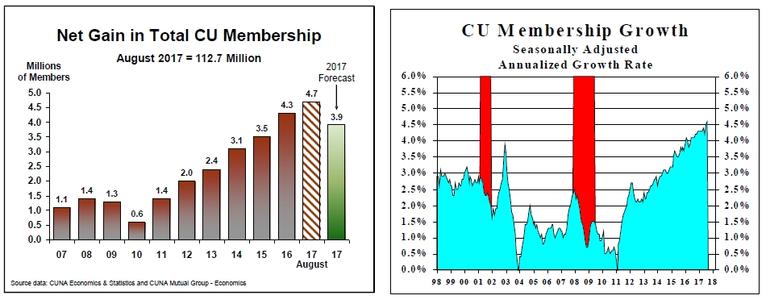
Credit union memberships rose a record 543,000 in August, or 0.50%, much better than the 483,000 new members, or 0.45%, added in August 2016. During the last year, credit unions added 4.7 million new members – the fastest in credit union history – which translates into a 4.6% seasonally-adjusted, annualized growth rate. Membership growth is being driven by strong job gains and Americans’ demand for credit. Membership growth is also being supported by an unintended consequence of the Durbin Amendment of the Dodd-Frank Act. The amendment capped the fees large banks can charge merchants to process debit card transactions (21 cents plus 0.05% of the total charged). To make-up for this lost revenue, banks increased their monthly fees for having a debit card or a checking account. The higher charges are driving many bank customers to their local low-or-no-fee, not-for-profit credit union, the report stated.