MADISON, Wis.—Credit union loan balances rose over the $1-trillion milestone in March, doubling the $500 billion milestone set back in August 2006, while membership growth continued its torrid pace, according to CUNA Mutual Group’s latest Trends Report.
Credit union memberships grew at a record pace in the first quarter of 2017, adding 1.3 million new memberships. CUNA Mutual Group predicts that CU membership growth will exceed 3.5% in 2018 and 2.5% in 2019.
“March is historically the third weakest loan growth month of the year, with seasonal factors typically shaving 0.24 percentage points from the underlying trend growth rate. The lending season is now in full swing, with strong loan growth expected from April through September,” the report stated.
CU loan balances rose 1.1% in the March, faster than the 0.9% pace reported in March 2017.
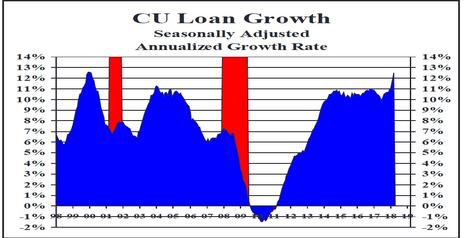
Credit union seasonally-adjusted annualized loan growth reached 12.5% in March, the fastest pace since the first quarter of 2000 when the stock market boom was reaching its apex and the accompanying wealth effect encouraged borrowing.
“The stock market boom soon turned to a bust by the third quarter of 2000, causing consumers to pull back and credit union lending to decline as well. This time around, the credit boom is being driven by strong job growth and rising household formations,” CUNA Mutual Group said.
Credit Union Consumer Installment Credit (CUCIC)
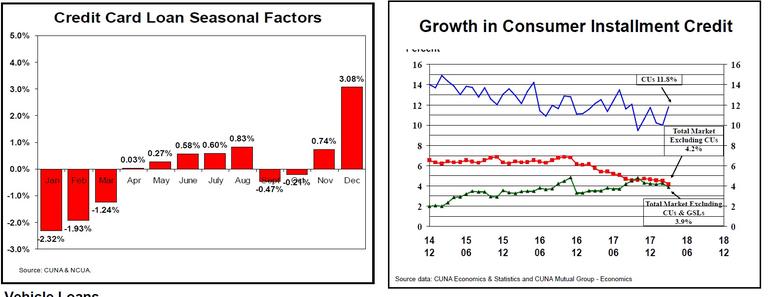
Credit union consumer installment credit balances (auto, credit card and other unsecured loans) rose 1.4% in March, better than the -0.2% pace set in March 2017, due to strong auto lending and banks tightening their credit standards. Credit card balances fell 0.5% in March due to seasonal factors that typically shave 1.24 percentage points from the underlying trend growth as members use tax refunds and bonuses to pay down outstanding credit card balances. Credit union consumer installment credit grew 11.8% during the last year, which is better than the 4.2% for the total market excluding credit unions.
Vehicle Loans
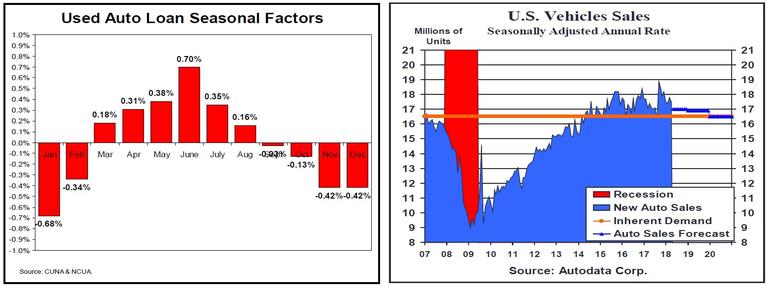
Credit union used-auto loan balances grew 1.6% in March, above the 1.3% reported in March 2017. March’s used-auto loan seasonal factors usually add 0.18 percentage points to the underlying trend growth rate, the report noted. The used auto buying and lending season begins in March and runs through August. On a seasonally-adjusted annualized growth rate basis, used-auto loan balances rose 14.3% in March – the fastest pace since 1999.
“The last time used-auto loan balances grew this fast was during the dotcom stock market boom of 1999. Improving consumer fundamentals are driving strong auto loan growth: an improving labor market, low oil prices, faster wage growth, low interest rates, an expanding driving-age population, improving construction activity and better household balance sheets,” CUNA Mutual Group explained.
Vehicle sales in March rose to a 17.5 million seasonally-adjusted annualized sales rate, up from a 17.1 million sales pace in February and above the 17.1 million set in March 2017, due to one additional selling day compared to one year earlier. Expect sales to slow to 17 million for the rest of the year, but still above the 16.5 million units consistent with inherent auto demand, due to rising interest rates and tightening access to credit attributable to weakening credit conditions in subprime groups.
Real Estate Secured Lending – First Mortgages and Other Real Estate
Credit union fixed-rate first mortgage loan balances jumped 1.3% in March, slower than the 2.5% increase reported in March 2017. This slower March mortgage volume was due to a drop in loan applications during January and February when mortgage interest rates rose 38 basis points. During the last 12 months, fixed-rate first mortgage balances rose 10.2%, faster than the 6.9% increase in adjustable-rate mortgage balances. Improving household balance sheets, rising consumer incomes and a rising capacity to service debt has decreased mortgage credit risk and therefore encouraged credit union lenders to loosen lending standards, the report stated.
The contract interest rate on a 30-year fixed-rate conventional home mortgage rose to 4.47% in March, up from 4.44% in February and higher than the 4.20% reported in March 2017. The 3 basis point increase in mortgage interest rates in March coincided with a 2 basis point decrease in the 10-year Treasury interest rate, which fell to 2.84%. The 2 basis point decrease in long-term interest rates was caused by a 1 basis point decrease in real interest rates (due to investors rotating out of stocks and into bonds) and a 1 basis point decrease in expected inflation.
According to the Core Logic Home Price Index, single family home prices rose 1.4% in March from February, the fastest pace in five years. During the last 12 months home prices rose 7%. Supply-side constraints continue to be the most significant driver of higher home prices; during March there was only 3.6 months’ supply of existing homes on the market at the current sales rate. Improving economic fundamentals bode well for home sales and house price appreciation. Wage growth will help first-time buyers accumulate sufficient savings for down payments. This will increase the demand for housing, boosting home sales and house prices.
Home equity loan balances fell 0.5% in March as members used bonuses and tax refunds to pay down some of their lines of credit, the report explained.
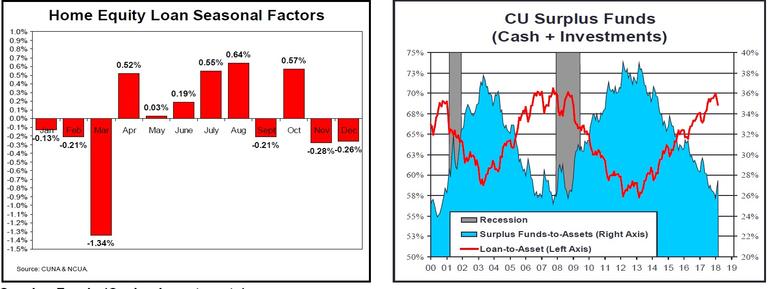
“Because of these seasonal factors, March is typically the weakest month of the year for home equity loan growth, with balances falling 1.34 percentage points below the underlying trend growth rate. However, credit union home equity loan balances grew at a 10.3% seasonally-adjusted annualized growth rate in March, due to rising home prices, the strong job market, rising consumer confidence and consumers releasing pent-up demand for durable goods,” the report said.
Surplus Funds (Cash + Investments)
Credit union surplus funds as a percent of assets fell to 27.5% in March from 29.7% last year, as credit unions partly funded new loan growth with cash and investments. During March, a 2.5% surge in savings balances funded a 1.1% increase in loans, a 5.4% increase in surplus funds and a 5.72% reduction in external borrowings. Surplus funds are expected to fall to 26% of assets by this time next year, the tightest liquidity position since the fourth quarter of 2007, as loan balances grow 9% and savings balances rise only 7%.
Loans as a percent of assets are expected to rise from 68.5% today to 70.5% by March 2018. Since the average return on loans is approximately 4.6% today, and the average return on investments is 1.6%, the 2 percentage point shift in assets from surplus funds to loans will boost asset yields by 6 basis points [(4.6 - 1.6) x 0.02], the report explained.
During March, three-year Treasury notes had yields only 91 basis points above the Fed Funds interest rate (2.42% versus 1.51%) slightly more than the 80 basis point difference reported during March 2017. The percentage of credit union surplus funds with a maturity greater than 1 year fell to 49% in March from 50% last year.
Savings and Assets
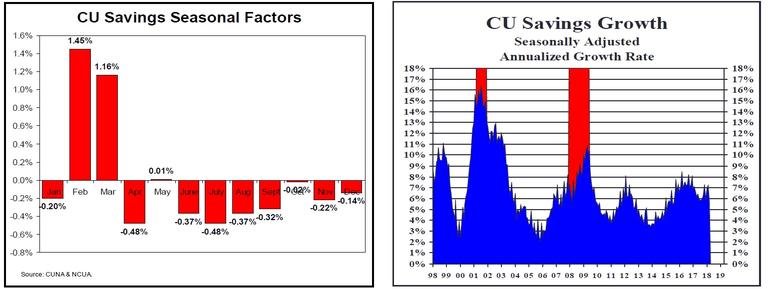
Credit union savings balances surged 2.5% in March, the same 2.5% gain reported in March 2017, due to March ending on a payroll Friday and the seasonal factors of tax refunds and bonuses being deposited in credit union members’ share draft and regular share accounts, which increased 6.4% and 3.1%, respectively. March’s seasonal factors typically add 1.16 percentage points to the underlying savings trend growth, making it the second biggest month of the year for credit union savings growth, according to CUNA Mutual Group.
Credit union savings balances grew only 5.7% at a seasonally-adjusted annualized growth rate in March, due to a falling national savings rate (savings as a percent of disposable personal income) and consumers more willing to spend rather than save. The savings-per-member growth rate fell to 1.7% during the last year, down from 4% in March 2017.
“We forecast credit union savings balances to grow 6.0% in 2018,” CUNA Mutual Group said.
Capital and Other Key Measures
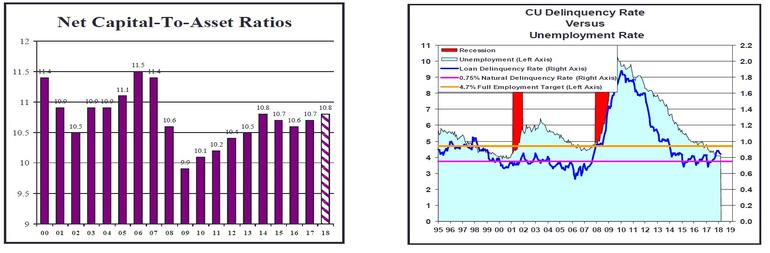
The credit union average capital-to asset ratio fell to 10.4% in March 2018, down from 10.7% at the end of 2017 but the same as was reported one year earlier. In the year ending in March, credit union capital rose 7.1% while assets grew 7.1%, which maintained the capital ratio at 10.7%. During the first quarter credit unions reported strong asset growth due to March ending on a payroll Friday and many members see higher after-tax income and bonuses. Capital ratios should climb to 10.8% by the end of 2018, as the capital growth rate exceeds asset growth rate this year, the report stated.
The credit union loan delinquency rate (loans two or more months delinquent as a percent of total loans outstanding) fell to 0.84% in March, down from 0.88% in December 2017, but up from 0.68% in March 2017. Credit unions reported large declines in the delinquency rate in February and March as members used bonuses and tax refunds to catch up on overdue loans. The labor market is very tight, with the April unemployment rate of 3.9% falling below the 4.7% considered to be full employment.
“With the unemployment rate expected to fall to 3.6% by 2019, this heralds continued strong loan performance over the next seven quarters,” CUNA Mutual Group said.
Credit Unions and Members
As of March 2018, CUNA estimates 5,727 credit unions were in operation, 30 fewer than February. During the last 12 months, the number of credit unions fell by 246, slightly above the 222 annual decline set one year ago. During the first quarter of 2018, the number of credit unions fell by 73, the fastest pace since the first quarter of 2012. Greater regulatory compliance burdens from the BCFP will put additional downward pressure on CU non-interest fee income and will therefore accelerate the number of mergers over the next few years, the report forecast.
At the end of 2017, 290 credit unions reported assets greater than $1 billion – 15 more than the year before. These large credit unions control more than 65% of all credit union loans, but make up less than 5.1% of all credit unions. The number of credit unions with assets less than $20 million fell by 177 to reach 2,302, as these credit unions either grew into the larger asset class or merged with a larger credit union.
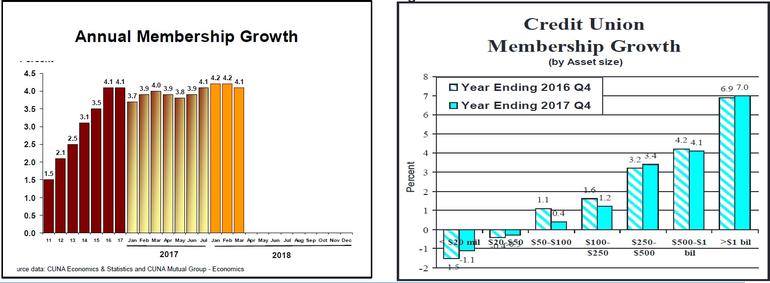
Credit union memberships grew at a record pace in the first quarter of 2017, adding 1.3 million new memberships, significantly better than the 1.1 million added in the first quarter of 2017. On a growth rate basis, memberships are up 4.1% in the year ending in March 2018, the same pace set in the year ending in March 2017. The memberships gain was partially driven by the 635,000 new jobs created in the first quarter, according to the Bureau of Labor Statistics, which is better than the 532,000 jobs added in the first quarter of 2017.
“Members are also joining credit unions in droves to get auto loans and other forms of credit. Credit unions should expect membership growth to exceed 3.5% in 2018 and 2.5% in 2019. Most of the membership growth is taking place at credit unions with assets greater than $500 million due to organic growth and mergers. Credit unions with less than $50 million in assets lost memberships during the last 2 years,” the report stated.