

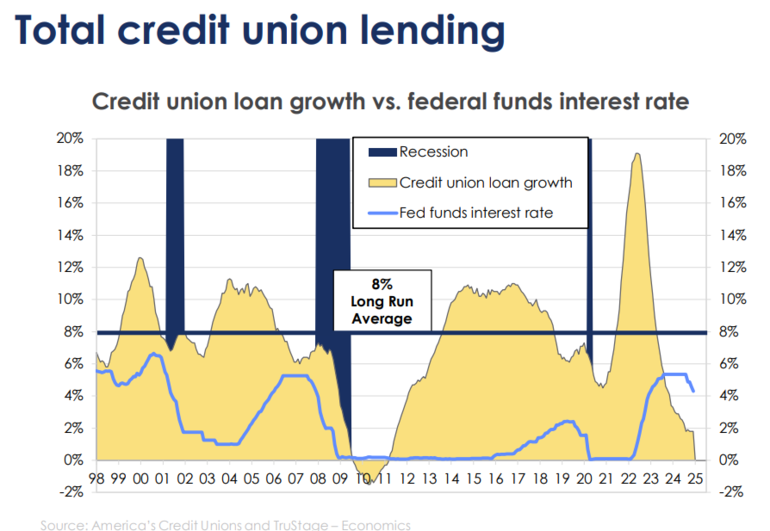
MADISON, Wis.—Credit union loan balances typically grow on average 8% per year over the long run. However, based on the latest data, CU loan balances are only rising at a 1.8% seasonally-adjusted annual rate, the slowest pace since 2011, TruStage shared in its latest Trends Report.
Overall, credit union loan balances rose 0.4% in October, the exact same pace reported in October 2023, the Trends Report states. The December report is based on data through October.
Here’s a look at how credit unions performed by category, with analysis by TruStage Chief Economist Steve Rick.
Total Lending
Loan categories that increased the fastest were home equity (3.3%), fixed-rate first mortgage (3.0%) and credit card (0.6%). New-auto loan balances declined 0.1% and adjustable-rate first mortgages fell 1%.
“Federal Reserve chairman Jerome Powel likes to mention the ‘long and variable lags’ of monetary policy during his press conferences. Economists recognize there are at least 10 channels through which lower interest rates impact the real economy. One of the them is the growth rate of consumer credit. Short-term interest rates (specifically the fed funds interest rate) have already decreased one percentage point over the last 4 months. So how do falling short-term interest rates affect credit union loan growth?” Rick asked.
“Periods of falling Fed Funds interest rates, (2000-2004, 2007-2009 and 2019-2020) have a stimulative effect on overall credit union loan growth. A 5-percentage point decrease in the Fed Funds rate historically boosts credit union loan growth by 3.5 percentage points, albeit with a 2–year lag. This is, of course, the goal of today’s less restrictive monetary policy, which is to accelerate the rate of credit creation from below–trend growth to something closer to normal in an attempt to engineer a soft landing; reducing inflation to 2% without causing a recession,” Rick noted. “Credit union loan balances grow on average 8.0% per year over the long run, but today credit union loan balances are only rising at a 1.8% seasonally-adjusted annual rate (see chart above), the slowest pace since 2011. However as short-term interest rates fall another 50 basis points in 2025, we are forecasting credit union loan growth to rise to 6%.”
Consumer Installment Credit
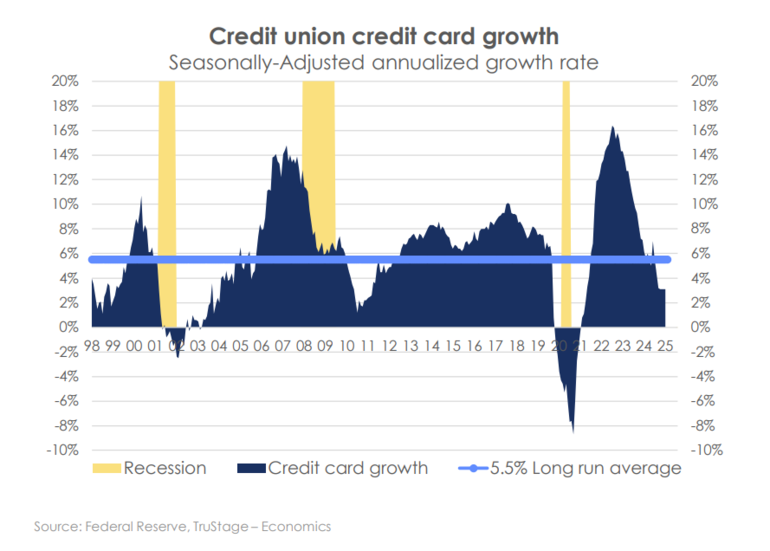
Credit union consumer installment credit balances (auto, credit card and other unsecured loans) reported a 0.3% rise in October, the exact 0.3% increase set in October 2023. Credit card balances rose 0.6% in October, below the 1.2% growth reported in October 2023. On a seasonally-adjusted annualized rate, credit cards grew only 3.1% in October, below the 5.5% long run average as higher interest rates discourage borrowers from carrying a balance.
The slowdown in the rise of consumer credit outstanding demonstrates one of the channels of restrictive monetary policy, i.e., higher interest rates reducing credit creation. Year–to–date, credit union consumer installment credit fell 1.1%, significantly below the 4.2% gain reported through October in 2023. This has pulled down overall credit union loan growth to 2.3% so far this year, from 5.9% year-to-date growth in 2003. For all lenders, outstanding consumer credit rose by $17.3 billion in October, according to the Federal Reserve, which is much higher than the $3 billion reported in September, and above the average monthly pace of $15 billion growth reported during the years 2015 – 2019. This data series is known, however, for its significant volatility. Expect growth in consumer credit to rise modestly in 2025 due to a strong job market and falling interest rates, the report states.
Vehicle Loans
Credit union new-auto loan balances fell 0.1% in October, similar to the decline set in October 2023, and decreased 5.6% during the last year. On a seasonally-adjusted annualized basis, new-auto loan balances fell 8.3% in October, the biggest drop since May of 2011. October seasonal factors typically add 0.3 percentage points to the underlying annualized growth trend.
“Multiple factors are driving the slowdown in credit union new-auto loan growth: First, credit union liquidity pressures have pushed loan-to-savings ratios to 84%, which cause some credit unions to pull back in lending. Second, manufactures have increased vehicle incentives and offer low-rate captive financing to entice auto buyers. Third, rising auto loan delinquency and charge off rates have prompted some lenders to tighten credit standards. The effect of this lending slowdown is the number of new-auto loans as a percent of members in offering credit unions – the penetration rate – fell to 7.1% in the third quarter, down from 7.5% last year. But on the bright side, the penetration rate is up from the 6.3% in pre–COVID 2019,” Rick stated.
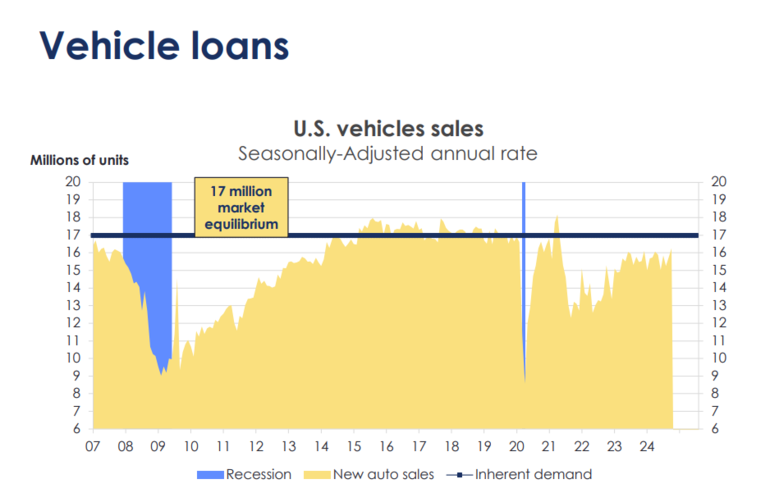
“New vehicle sales rose 1.7% in October to 16.1 million units on a seasonally-adjusted annualized sales rate, up from the 15.8 million reported in September (see figure above). October sales were 4.5% above the October 2023 rate but still 5% below the 17 million considered the market equilibrium. Expect new vehicle sales to rise 7% in 2025 compared to 2024, due to rising auto inventories, a healthy labor market, rising stock prices, falling vehicle prices and lower interest rates. And with 80% of all retail new vehicle sales being financed, this should boost credit union new-auto loan originations in 2025.
Real Estate Information
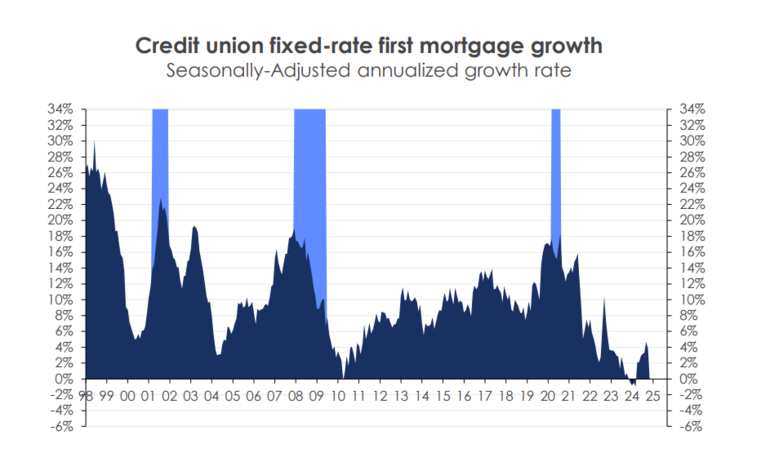
Credit union fixed–rate mortgage loan balances rose at a 3.8% seasonally-adjusted annual rate in October, above the 0.8% reported one year ago, due to significantly lower mortgage interest rates. Total first mortgage loan balances are up 4% during the last year because adjustable-rate mortgages rose a strong 13.2% as members opted for lower rate adjustable-rate mortgage products. The contract interest rate on a 30–year fixed–rate conventional home mortgage rose to 6.43% in October, from 6.18% in September, but below the 7.62% reported in October 2023.
The 119 – basis point decline in mortgage interest rates during the last year was due to a 70 – basis point drop in the 10 – year Treasury interest rate and a 49 – basis point drop in the credit risk spread. Home prices rose 0.3% in October from September, according to the S&P Core Logic Case-Shiller Home Price Index despite the lowest housing affordability in four decades. Home prices are up 3.6% year – over – year, which is slightly below the 4% long run U.S. annual price appreciation rate due to the growth in the number of homes for sale.
“With the Federal Reserve expected to cut the Federal Funds interest rates 50 basis points in 2025, this should put downward pressure on mortgage rates over the next few quarters and increase home sales and mortgage originations. Expect mortgage originations to increase 10% in 2025 due to mortgage interest rates falling, rising supply of homes for sale and a strong labor market,” the report states.
Savings And Assets
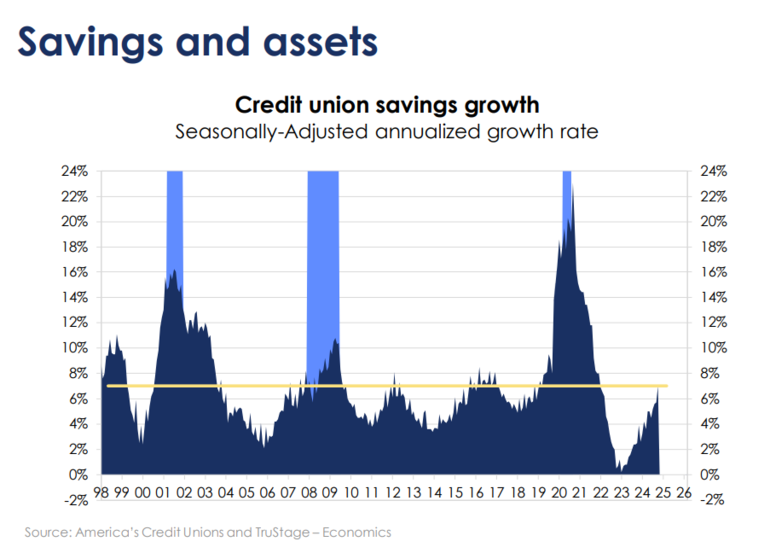
Credit union savings balances rose in October by 0.7%, better than the 0.7% decline in October 2023. Historically, October’s seasonal factors reduce the underlying savings trend growth by 0.10 percentage points. So, this year members were rebuilding their savings deposits to maintain their current pace of consumption spending in this era of high and rising prices.
For many consumers, their real disposable income rose during the last year thus allowing for the buildup in precautionary savings balances. Savings balances grew at a 7.0% seasonally–adjusted annualized growth rate in October, above the 2.5% reported one year earlier and equal to the 7% long–run average. Credit unions are experiencing rising deposit growth due to some members moving funds back from money market mutual funds, strong new membership growth, and rising real incomes.
The personal savings rate (personal savings as a percent of disposable personal income) rose to 4.5% in October from 4.1% in September, and above the 3.8% in October 2023. The rising personal savings rate is a tailwind for credit union deposit growth rates. Moreover, a tight labor market will keep wage growth strong. And as inflation falls, real personal income will rise going into 2025, along with the personal savings rate.
“We expect credit union deposit growth to rise 8% in 2025, above the 7% long–run average. Much of the deposit growth in 2025 will be self funded by the credit union itself as they pay high deposit interest rates on these accounts,” Rick said.
Credit Unions And Members
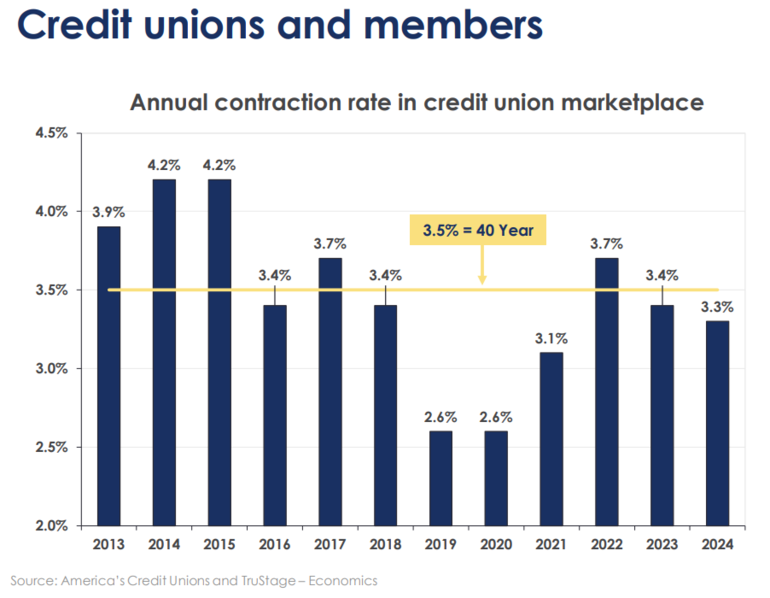
“As of October 2024, we estimate 4,665 credit unions were in operation, down 160 from October 2023. Year–to–date the number of credit unions fell by 131, less than the 138–decline reported in the first ten months of 2023. We expect around 160 to 165 credit union mergers in the 2025 and 2026 years as smaller credit unions look to offer more financial services to their members through mergers. Credit union consolidation and concentration are expected to fall below their long – run pace over the next few years due to a recovery in deposit growth and credit union earnings,” Rick said.
Since 1980, the number of credit unions has declined by roughly 3.5% each year, but this year they were contracting at only 3.3% pace.
“If we apply the historical 3.5% exponential ‘decay’ rate to the current number of credit unions, 4,665, we should expect another 163 credit unions to exit the financial system in 2025. If we forecast out a little further, according to the laws of exponential decay, there will only be 2,288 credit unions in 20 years, half as many as there are today. Fortunately, credit union assets follow an average annual exponential growth rate of 7%. This means the time that it takes for credit union assets to double (currently $2.363 trillion) is only 10 years. So, 20 years from now in the year 2044 credit union assets could be 3.9 times bigger than today, or $9.1 trillion.” Rick said.