

MADISON, Wis.–Credit union loan balances fell in March—a traditionally slow month—and credit unions have also lost loan share due to “very competitive” loan pricing from competitors, according to a new analysis from TruStage.
In addition, according to the analysis, CU membership growth slowed in the first quarter of 2024, and was significantly slower than the first quarter of 2023. Credit unions with less than $100 million in assets reported little to no membership growth during the last two years, according to the TruStage Trends Report for May, which is based on data from March.
Here’s a look at how credit unions performed by category.
Total Credit Union Lending
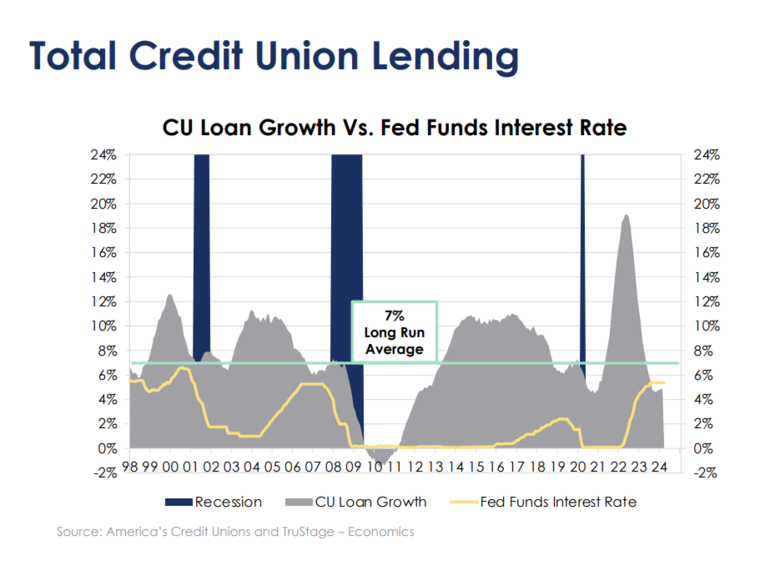
Credit union loan balances fell 0.02% in March, below the 0.7% rise reported in March 2023, and rose 4.8% during the last 12 months, according to the TruStage analysis by its chief economist, Steve Rick.
“March is historically the third weakest loan growth month of the year, with seasonal factors typically shaving off 0.24 percentage points from the underlying trend growth rate,” the report states. “The lending season for credit unions begins in earnest in April and continues through August. “
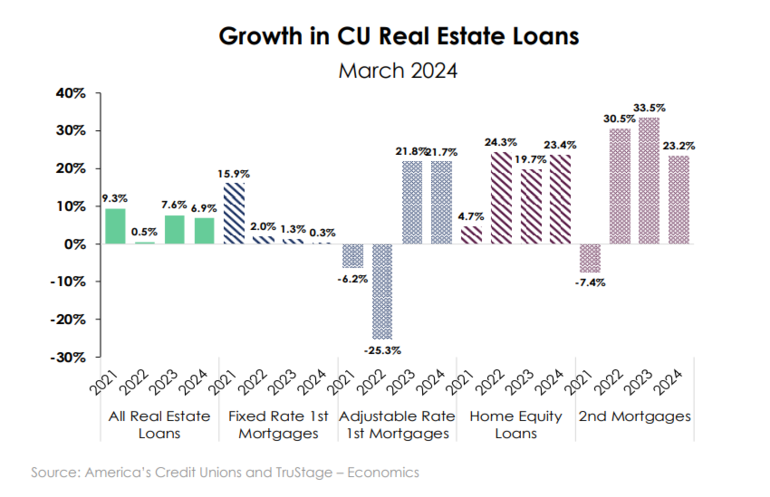
According to the Trends Report, driving overall loan growth in March was growth in second mortgages (2.4%), home equity loans (0.7%) and fixed-rate first mortgages (0.3%). Home equity loan balances have increased 23.4% during the last year, the fastest growing loan category.
Question Posed
“With the Federal Funds interest rate stuck at 5.33% since July 2023, what impact is this having on credit union loan growth?” the Trends Report asks. “The (figure shown) shows the relationship between credit union annualized loan growth numbers and the Fed Funds interest rate for the past 26 years. Periods of rising Fed Funds interest rates, (1999-2000, 2004-2006, 2017-2019 and 2022-2024) have a restraining effect on overall credit union loan growth. For every one percentage point increase in the fed funds rate, credit union loan growth typically slows by 1.75 percentage points.
“This is, of course, the goal of restrictive monetary policy, which is to lower the rate of credit creation from above trend growth to something closer to normal, which then reduces spending and therefore inflationary pressure,” the analysis continued. “Credit union annualized and seasonally-adjusted loan growth is currently running at 4.8%, significantly below its long run average of 7%. Expect credit union loan balances to rise 5% in 2024, and then rise 5.5% in 2025, as the Fed Funds interest rate falls slightly in the fourth quarter of 2024, and throughout 2025.”
Consumer Installment Credit
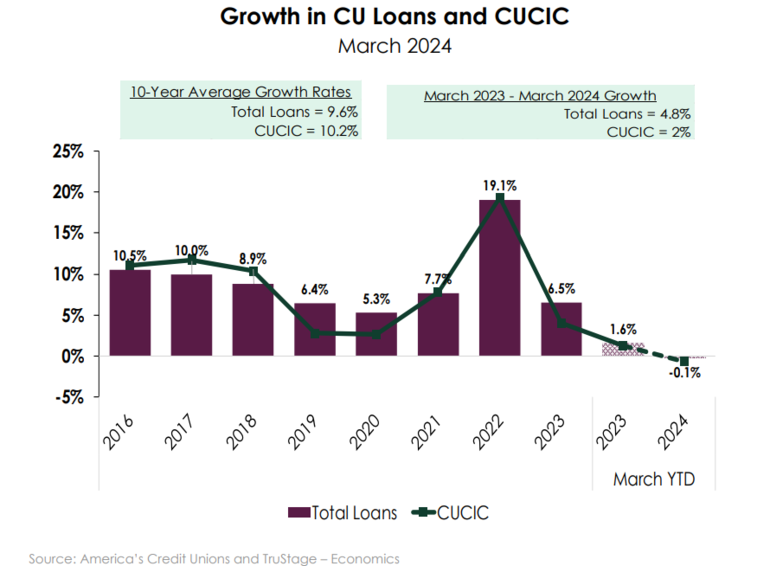
According to the Trends Report, credit union consumer installment credit balances (auto, credit card and other unsecured loans) rose only 0.2% in March, below the 0.6% pace set in March 2023, as higher interest rates reduce the demand for new loans and tight liquidity reduce its supply.
“Over the last year, credit union credit card loan balances rose a strong 8.9%, above the 30-year long run pace of 7%, due to higher inflation reducing some members purchasing power of their income and other members spending more on travel and leisure,” the report states. “Credit union consumer installment credit fell 0.7% year to date, significantly below the 1.3% increase set in the first quarter of 2023, and weaker than the 0.1% decline for total loans.”
Driving the ‘Disparity’
The report further notes credit union consumer installment credit grew 2% during the last year, which is significantly below the 8.5% for the total market, excluding credit unions and government student loans.
“This disparity in credit union and other lenders loan growth rates has led to credit unions now holding 13.1% of the total consumer loan market, down from the record high 13.5% set in March 2023,” the analysis states. “Very competitive loan pricing by other lenders and tight liquidity at larger credit unions is driving this loan growth disparity and loss of market share.”
Vehicle Loans
Credit union new-auto loan balances fell 1.1% in March, a big drop compared to the 0.6% jump in March 2023, the report states.
“Finance companies have seen a dramatic increase in auto loan market share at the expense of credit unions during the last year,” Rick wrote. “Credit union new-auto loan balances are down 2.8% from one year ago and used-auto loan balances are up only 1%.
The new-auto buying and lending season begins in May and runs through October. On a seasonally- adjusted annualized growth rate basis, new-auto loan balances fell 3.6% in March, as loan originations fell below loan payoffs.”
Vehicle Sales
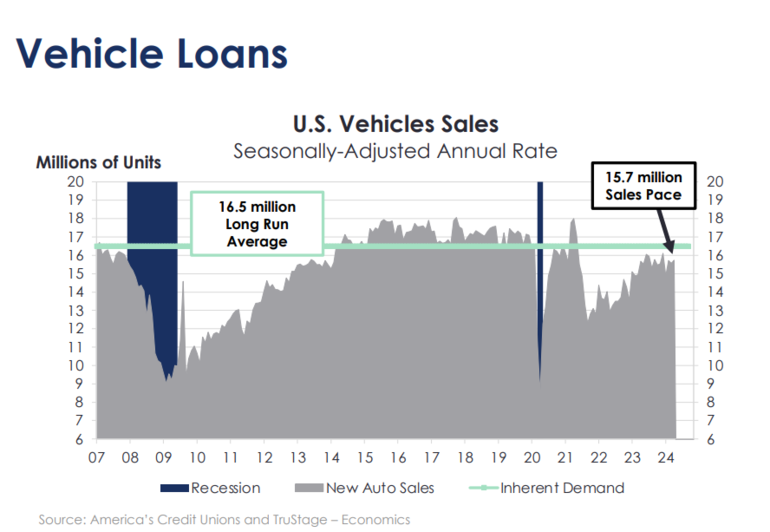
The report further notes that vehicle sales fell to 15.6 million in March but then rebounded to 15.7 million in April at a seasonally-adjusted annualized sales rate, but still below the 16.5 million long run average.
“Vehicle sales only rose 0.4% on a year-ago basis due to restrictive lending rates. But the demand for new vehicles is being supported by ongoing strength of the labor market,” the Trends Report states. “The unemployment rates has remained below 4% for more than two years, the longest period of such low joblessness since the 1960s. This has led to robust wage growth, which is playing a significant role in supporting new-vehicles sales as it helps consumers partly offset the effects of higher lending interest rates.”
Rick said a rise in the inventory-to-sales ratio indicates that new supply is greater than demand as automakers normalize inventory levels.
Real Estate Information
According to the analysis, credit union fixed-rate first mortgage loan balances rose only 0.3% in March, below the 1.6% increase reported in March 2023, due to higher mortgage interest rates.
The report found credit union fixed-rate first mortgage loan balances rose 0.3% over the last 12 months, below the 10.4% pace set for the similar time period last year.
Home equity loan balances rose 23.4% due to strong home price appreciation over the last few years, while second mortgage balances rose by 23.2% over the last year as members decided to lock in interest rates before they rose further, according to the Trends Report.
Other Real Estate Data Points
Other real estate data points included in the report include:
- The contract interest rate on a 30-year fixed-rate conventional home mortgage rose to 6.82% in March, up from the 6.78% in February and above the 6.54% reported in March 2023 due to an increase the credit spread.
- Mortgage rates rose despite no change in the 10-year Treasury interest rate which averaged 4.21% in both February and March.
- Home prices rose 0.4% in February from January, according to the S&P Core Logic Case Shiller Home Price Index, and 6.1% year-over-year due to a limited number of homes for sale.
- At 3.2 months’ supply of existing homes for sale, inventories are about half of the level, “representing a healthy housing market. Most homeowners are locked into ultra-low mortgage interest rates and have little incentive to sell.”
Looking forward, Rick forecast that inventories should rise over the year as mortgage interest rates slowly decline and those households wishing to move list their properties for sale.
“Expect real home prices to fall over the next few years, as home prices rise slower than the rate of inflation, due to the imbalance between median home prices and median incomes,” the report predicts.
CU Savings Balances
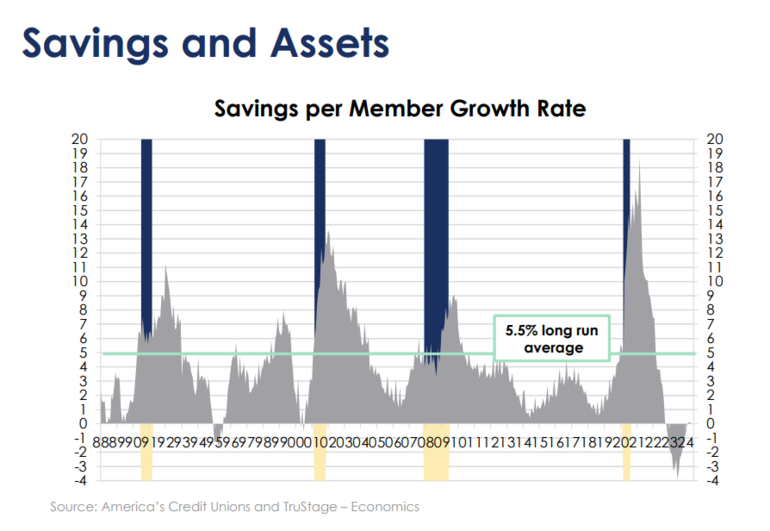
Credit union savings balances rose 1.6% in March, below the 1.7% gain reported in March 2023. Seasonal factors like tax refunds and bonuses typically get deposited in credit union members’ share draft accounts in March, which increased 2.7%, the Trends Report states.
“March’s seasonal factors typically add 1.2 percentage points to the underlying savings trend growth, making it the second biggest month of the year for credit union savings growth,” according to the analysis. “After declining for 16 months, the year-over-year growth rate in savings-per-member has finally turned positive again in March 2024. The average credit union member had $13,809 in total savings deposits at their credit union in March 2024, up 0.1% from the $13,795 in March 2023. This small growth rate figure, however, is still significantly below its long run average of 5.5%.”
Significant Disintermediation
According to the Trends Report, credit unions experienced significant disintermediation in 2023 due to three factors.
- First, low-income members withdrew savings balances as inflation outpaced wage growth reducing the purchasing power of their income.
- Second, middle-income members withdrew savings to spend on services like hotels, airfares and restaurants as the COVID-19 pandemic came to an end.
- Third, some high- income members withdraw some of their large balance deposits in search of higher yielding alternative investments.
“This disintermediation of deposits was a big concern for credit unions, banks and the economy in general as falling deposits could have led to a significant credit contraction and possibly a recession,” the Trends Report observes. “But a recession never materialized in 2023, due to the massive increase in the money supply, deposits and credit union investment portfolios in 2021, which allowed loan growth to continue in the face of falling liquidity. With the Federal Reserve expected to lower short-term market interest rates in September, savings-per-members growth will accelerate and approach its 5.5% average in 2025.”
Equity and Other Key Measures
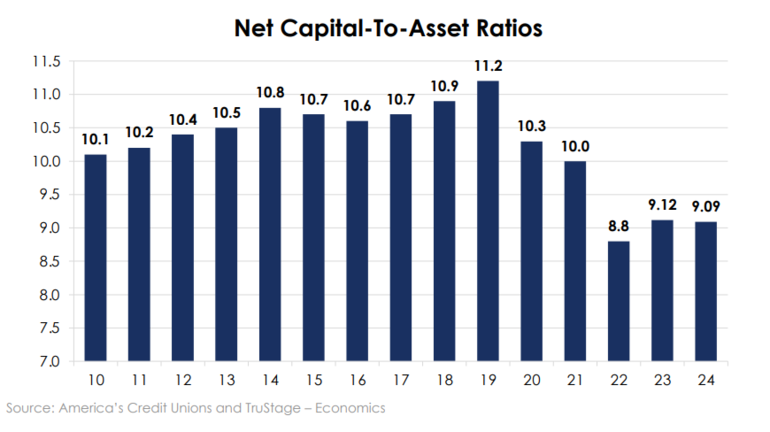
The credit union average equity-to-asset ratio came in at 9.09% in March 2024, slightly below the 9.12% reported at the end of 2023.
The report notes that in the first quarter of this year, the dollar amount of credit union capital rose 1.82%, while assets increased 2.14%, which decreased the capital ratio 0.03 percentage points and -0.33 percent which is the approximate difference between the numerator and denominator growth rates.
“Credit union equity (a.k.a. net capital) is defined as the sum of Reserves + Undivided Earnings + Gains/Losses on Available for Sale Securities,” the Trends Report states. “By the end of the first quarter, market interest rates rose slightly from their December 2023 levels, which decreased the market value of available-for-sale securities. Earning were enough however to offset the small losses on AFS investments.
“So, during the first quarter of 2024, the dollar amount of credit union equity rose $3.8 billion, from $208.9 billion in December 2023, to $212.7 billion in March 2024,” the analysis continues. “During the last 12 months, credit unions have reduced their interest rate risk exposure by decreasing their percent of investments in maturities greater than one year from 57.4% to 46.6% today.”
Delinquencies
Meanwhile, the Trends Report said the credit union loan delinquency rate (loans two or more months delinquent as a percent of total loans outstanding) fell to 0.803% in March, down from 0.826% in December 2023, due to seasonal factors like tax refunds and bonus allowing some borrowers to become current on their loans.
The delinquency rate is, however, up from the 0.523% reported in March 2023, the report added.
“The labor market remains beyond “full employment”, with the unemployment rate at 3.9%, which is below the 4.5% considered to be the natural unemployment rate,” the Report states. “The tight labor market and rising wages should be keeping the loan delinquency rate below the long run natural delinquency rate of 0.75%, but high inflation and interest rates are leading to larger loan payments which is causing financial stress among low income and young households.”
Credit Union Numbers & Members
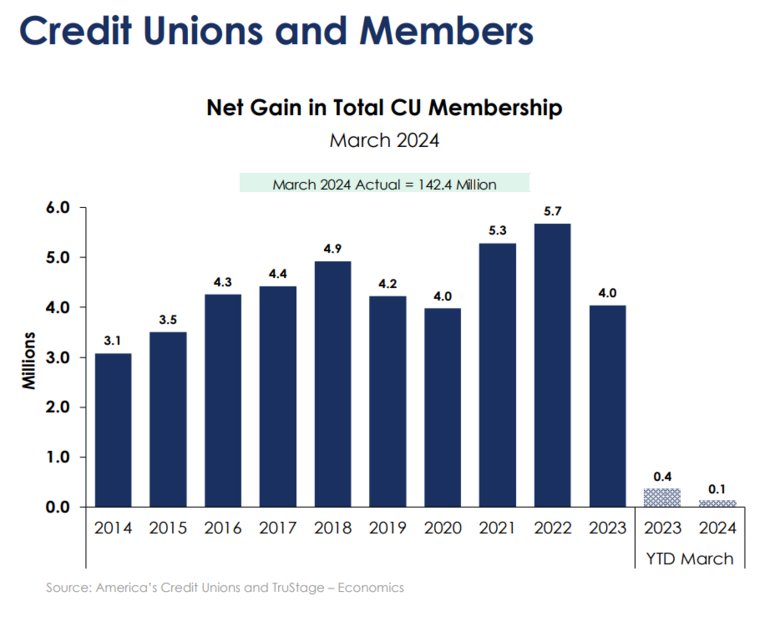
According to the TruStage analysis, credit union membership growth slowed in the first quarter of 2024, adding 0.1 million new memberships, significantly slower than the 0.4 million added in the first quarter of 2023.
“On a growth rate basis, memberships are up 2.4% in the year ending in March 2024, below the 4.3% pace set in the year ending in March 2023,” the report states. “The membership growth slowdown was partially driven by the 0.807 million jobs gained in the first quarter, according to the Bureau of Labor Statistics, which is below the 0.915 million jobs gained in the first quarter of 2023.”
The second factor driving the slowdown in membership growth was due to the significant reduction in auto loan originations, the report found.
Membership Projection
“Credit unions should expect membership growth around 2.5% in 2024, and a slightly better 2.8% membership growth is forecasted for 2025,” the analysis found. “Most of the membership growth is taking place at credit unions with assets greater than $1 billion due to organic growth and mergers. These large credit unions reported membership growth in the 4.4% range. Credit union with assets in the range of $250-999 million reported membership growth of around 1.5% for the last 2 years. Credit unions with less than $100 million in assets reported little to no membership growth during the last two years.”