MADISON, Wis.–Credit union liquidity has dropped precipitously over the last year, according to CUNA Mutual’s newest Trends Report, which further urges CUs to prepare for lower mortgage volumes and notes CU membership growth, while slower, continues to reflect growing marketshare by credit unions.
The October Trends Report is based on credit union data through August.
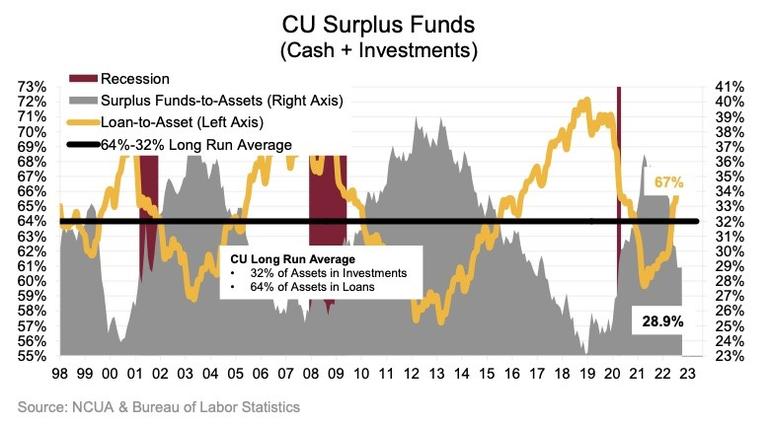
“Cash plus investments as a percent of assets fell from 35.2% in August 2021 to 28.9% in August 2022,” the Trends Report notes. “This 6.3 percentage point drop in liquidity was the biggest year-over-year decline since July 2000 when, coincidentally, the S&P 500 stock index reached its apex during the stock market bubble of 1998- 2000 and credit union members were buying stocks with their excess funds instead of placing them in insured deposits at their local credit union.
“Today members are drawing down some of their excess savings built up during the COVID-19 pandemic to spend on goods and services,” the report adds.
Here's a look at how credit unions performed by category:
Total CU Lending
Credit union loan balances rose 1.9% in August, above the 1.0% pace set in August 2021, according to the Trends Report.
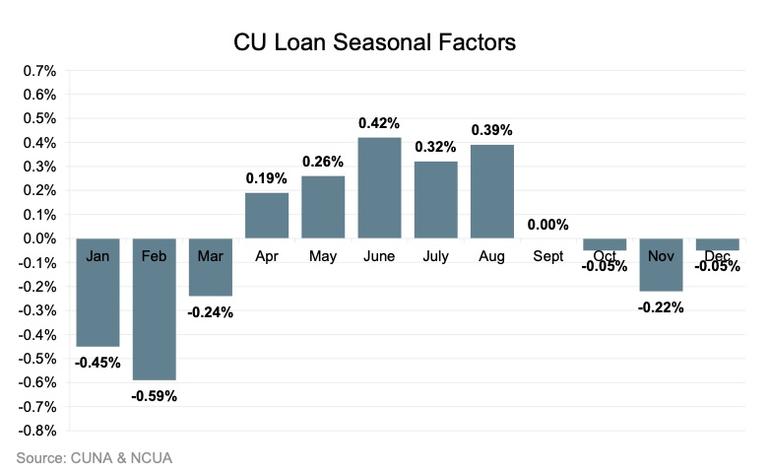
“Much of this growth was due to new-auto lending increasing 2.6%, used-auto lending increasing 1.6% and unsecured personal loans increasing 3.3%,” the analysis states. “The strong credit union lending season of April through August is now over as loan seasonal factors turn negative for the rest of the year. During the last 12 months, credit union loan balances increased a remarkable 17.8%, more than three times the 5.4% pace set in the year ending August 2021 and above the 7% long-run credit union average loan growth. The 17.8% figure is the fastest credit union loan growth since July 1985 when loans grew 18.4% and the inflation rate was 3.5%. If we factor out the ‘price effect’ of today’s abnormally high 8.3% year-over-year inflation, credit union loan growth would be around 11%.”
The report adds that credit union loan balances grew at a 22.6% seasonally-adjusted, annualized growth rate in August, significantly better than the 9.4% pace set in August 2021.
“We are forecasting above-trend credit union loan growth for the next two years (10% in 2023 and 8% in 2024) due to inflation remaining above its long-run trend and the labor market remaining tight,” CUNA Mutual’s Steve Rick wrote.
Consumer Installment Credit
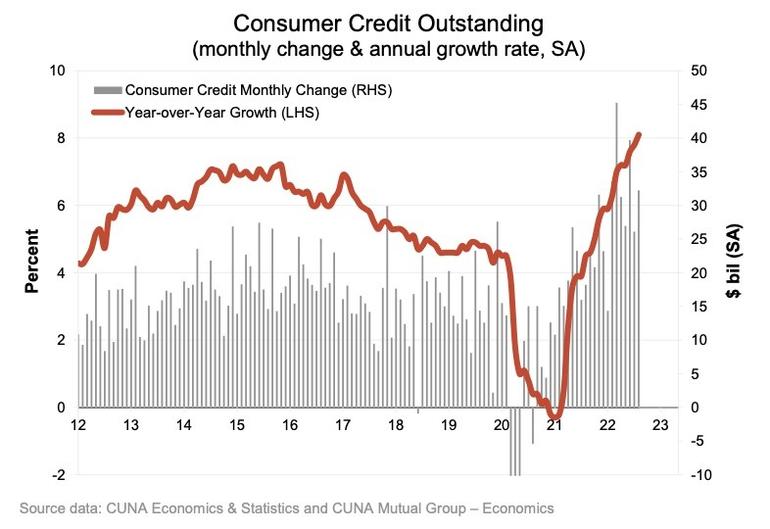
Credit union consumer installment credit loan balances (auto, credit card and other unsecured loans) rose 1.3% in August, an acceleration from the 1.1% pace set in August 2021, according to the Trends Report.
The report noted that during the last 12 months, credit union consumer installment credit grew 15.6%, greater than the total market excluding credit unions and government student loans at 14.1%.
“Credit union consumer installment credit is growing at the fastest pace since the summer of 1995 when inflation was only 2.8% while today it’s running over 8%,” the Trends report states. “Going forward, expect credit growth to decelerate into 2023 as consumer demand becomes satiated, higher interest rates make debt less attractive and economic uncertainty increases.”
Vehicle Loans
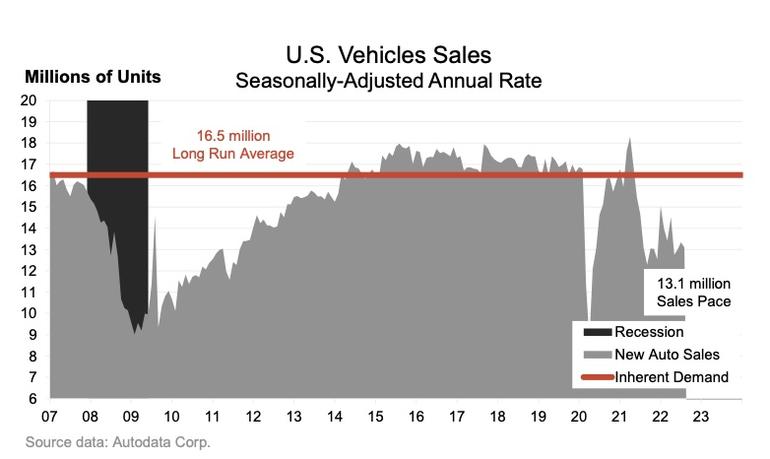
Vehicle sales fell in August to a 13.1 million unit seasonally-adjusted, annualized sales rate, which is down 2% from July, but up 0.1% from August 2021 when slightly more than 13.1 million units were also sold, the Trends Report states.
“Rising interest rates and transaction prices are crushing affordability, which will depress demand over the next year, so sales will remain below the 16.5-million-unit level considered a normal auto market well into 2023,” the report forecasts. “New vehicle inventories stood at 1.09 million in July, down slightly from the 1.12 million in June but up 2% from the year before. This put the day’s supply of cars (inventory-to-sales ratio) at 37 days. To put that inventory number in context, inventories stood at 3.7 million vehicles in July 2019 with the inventory-to-sale ratio at 88 days.”
The report goes on to note, “Despite slow auto sales, credit union new-auto lending is booming. Credit union new-auto loan balances are up 19.6% during the last year due to competitive interest rates, aggressive indirect auto lending and the higher prices of vehicles.”
Real Estate Information
According to the analysis, credit union fixed-rate, first mortgage loan balances grew 0.9% in August, slower than the 1.5% pace reported in August 2021.
The Trends Report states that when comparing year-over-year growth, fixed-rate first mortgage balances rose 6.5%, below the 14.1% reported in the year ending in August 2021.
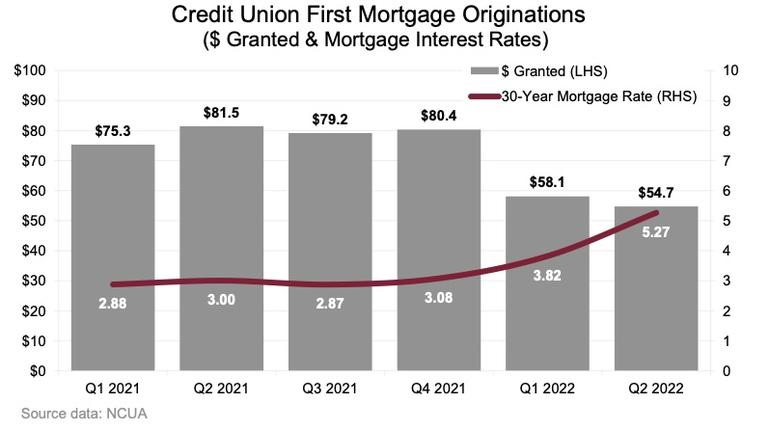
“Credit union first mortgage originations slowed 33% in the second quarter of 2022 compared to the second quarter of 2021,” the Trends Report states. “Credit unions then sold 22.3% of the $54.7 billion into the secondary market, down from the 37.6% sold of the $81.5 billion in the second quarter of 2021. The 33% drop in mortgage originations will reduce credit union fee income and gains on sales of mortgage income this year. Expect mortgage originations to drop 40% in 2022 from 2021 levels and another 5% drop in 2023.”
Savings & Assets
Credit union savings balances fell 0.2% in August, below the 0.1% rise in balances reported in August 2021.
“August is normally one of the weakest months of the year for savings growth due to seasonal factors, such as vacation spending and auto loan down payments,” the Trends Report states. “Credit union deposit growth is becoming more balanced in 2022. During the first eight months of the year, credit union deposits rose $63 billion. “Contributing to this growth was a 3.8% increase in regular shares, a 4.0% increase in money market deposits and a 4.9% rise in share drafts, the report adds.
“With credit union members expecting short-term market interest rates to continue rising for the next six months, their demand for share certificates is still rather weak,” the Trends Report observes. “During the first 8 months of this year, share certificate balances fell 1.8%, continuing the trend that began in the spring of 2020.”
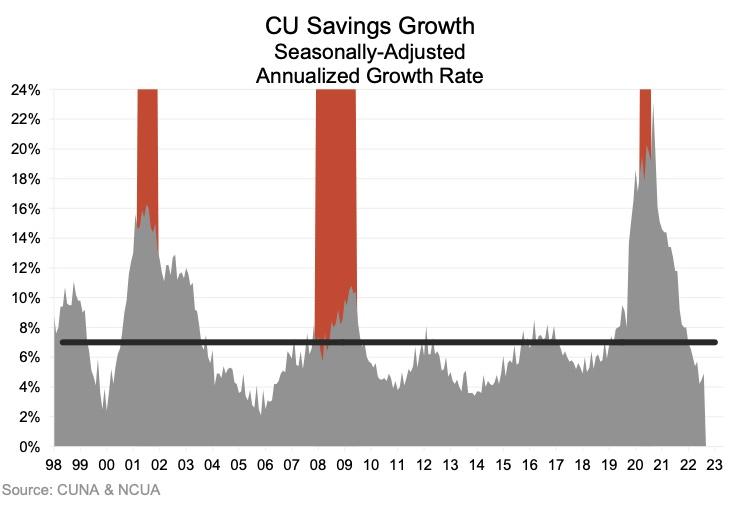
The Report added that savings balances grew at a below-trend 4.9% seasonally-adjusted, annualized growth rate in August, due to a jump in consumer spending on services.
“We expect savings balances to grow only 5% in 2022 and 6% in 2023, below the long-run average of 7%, due to excess savings built up over the last 2 1⁄2 years,” the Report predicts.
Capital & Other Key Measures
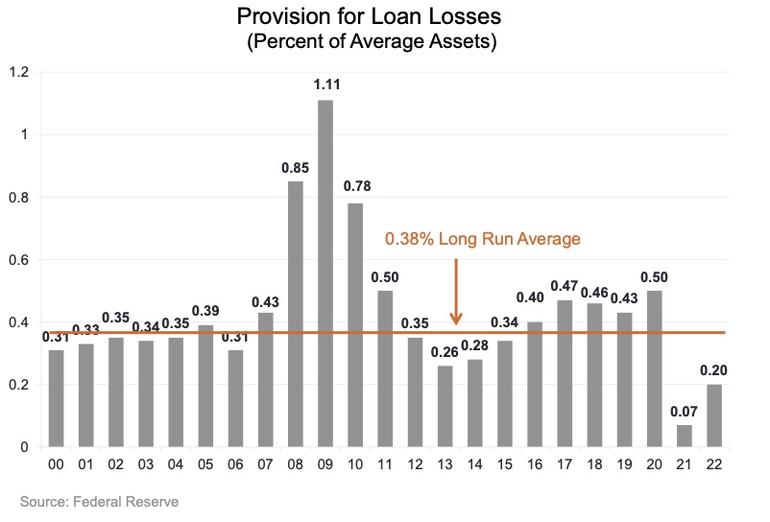
Credit union provisions for loan losses, as a percent of assets, rose to 0.20% in the first half of 2022 from the record low 0.7% set in 2021. Historically, credit unions set aside 38 cents for every $100 in assets to account for loan losses, the Trends Report states.
“Last year, many credit unions determined their allowance for loan losses had excess qualitative reserves and pulled funds out of the allowance account or made smaller contributions. That boosted the credit union return-on-assets ratio to 1.07% in 2021, the highest level since 2004,” the Trends Report notes. “Provisions are low this year due to record-low loan delinquency rates. During 2022 loan delinquency rates have averaged 0.45%, below the natural loan delinquency rate of 0.75%.”
The Report goes on to point out credit union loan delinquency rates are at record lows due to the unemployment rate also being at the lowest level in over 40 years.
“Eventually, the unemployment rate will rise from 3.5% today to its natural long-run rate of 4.5% over the next two years,” the report states. “Then we will see the provision for loan loss ratio return to its long-run average of 0.38%.”
Credit Unions & Members
Credit union memberships rose by 443,000 in August, or 0.3%, below the 466,000 new members, or 0.4%, added in August 2021. This has pushed credit union memberships to over 134.6 million, according to the Trends Report.
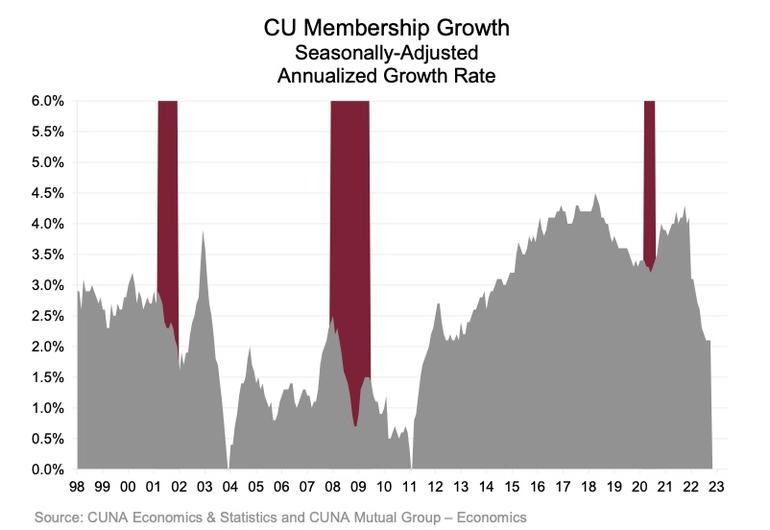
During the last year, credit unions added 4.0 million new members, below the 4.8 million growth pace set through August 2021, which translates into a 2.1% seasonally-adjusted, annualized growth rate (see figure above). Membership growth has decelerated from the 4% pace reported in 2021, the Report adds.
“The slowdown in credit union membership growth to 2.1% was to be expected as the average growth rate during the last 20 years was about 2.3%,” the Report explains. “The recent pace of 2.1% is still five times faster than the overall U.S. population growth rate of 0.4%. Therefore, credit unions are still picking up market share from banks and other depository institutions.”