

MADISON, Wis.–While lending was up by double-digits at all credit unions through February, once again it was the largest credit unions leading the way, according to CUNA Mutual’s newest Trends Report.
In addition, the new Report is forecasting credit union savings balances will grow by only 4% in 2023, in part because credit union membership growth slowed significantly during the first two months of 2023, adding 352,000 new memberships versus the 759,000 reported in the first two months of 2022.
However, as indirect auto lending picks up pace, so, too, will membership growth, the Trends Report stated.
Here is a look at how credit unions performed by category according to the May Trends Report, which is based on data through February of this year.
Total Credit Union Lending
Credit union loan balances rose 0.5% in February, slower than the 1% reported in February 2022, and 18.4% during the last 12 months.
Driving this growth was home equity loan balances (1.5%) adjustable-rate mortgages (1.1%) and unsecured personal loans (0.8%).
“February is historically the weakest loan growth month of the year, with seasonal factors typically shaving off 0.6 percentage points from the underlying trend growth rate,” the CUNA Mutual analysis noted. “Credit union members have been on a borrowing and spending binge for the last year in order to get ahead of rising future interest rates. Therefore, we are forecasting credit union loan growth to slow to around 8% this year, down from the record setting pace of 19% set last year.”
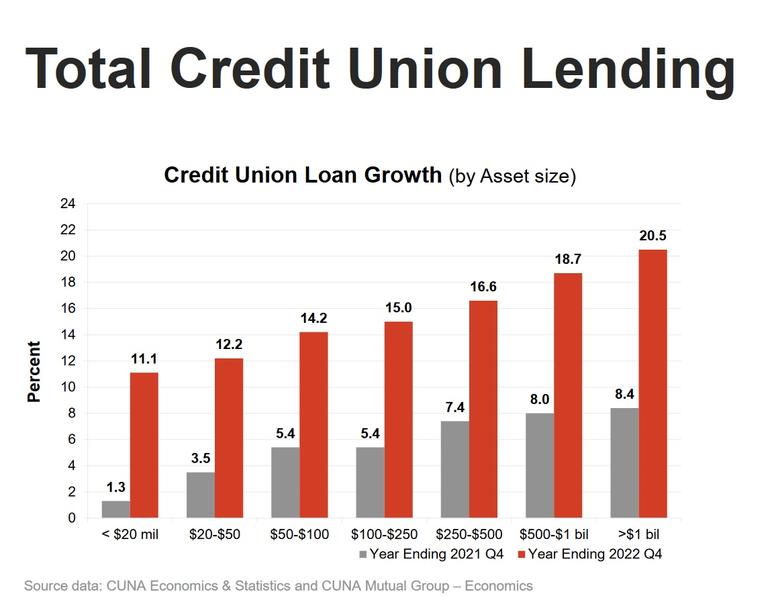
As continues to be the case, the Trends Report said once again large credit unions reported significantly faster loan growth in 2022 as compared to smaller credit unions.
“Credit unions with assets greater than $1 billion reported loan growth of 20.5% compared to credit unions with assets less than $20 million, reporting loan growth of 11.1%,” the Trends Report stated. “All asset size categories reported faster loan growth in 2022 compared to 2021, with all asset size categories jumping about 10 percentage points.”
Consumer Installment Credit
Credit union consumer installment credit balances (auto, credit card and other unsecured loans) rose 0.2% in February, significantly below the 1.0% reported in February 2022, according to the new data.
“Nevertheless, consumer installment credit year-over-year growth rates have been rising over the last year due mainly to a surge in auto loans and credit card lending,” the CUNA Mutual analysis stated. “February’s loan seasonal factors typically shave off 0.59 percentage points from the underlying trend growth as members use tax refunds and bonuses to pay down outstanding credit card and home equity loan balances.”
The Trends Report noted that during the last year, nominal wage growth has been slower than the rate of inflation, reducing the real incomes of many credit union members.
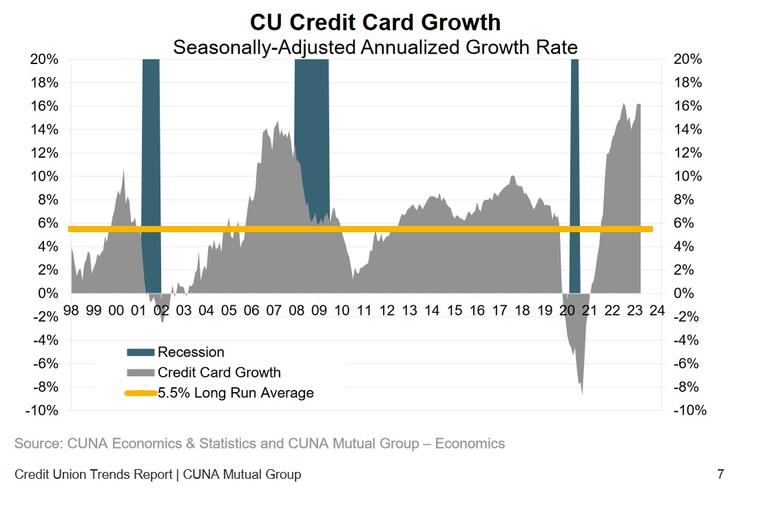
“In order to maintain their level of real spending, credit union members have either spent some of their excess savings accumulated during the pandemic or have increased their debt levels,” the Report stated. “Credit union credit card loan balances rose at a 16.1% seasonally- adjusted annualized rate in February, the fastest pace in over 25 years.”
The Report further noted credit union consumer installment credit grew 19% during the last year, faster than the total market, excluding credit unions which rose only 6.1%, “indicating credit unions have increased their market share.”
The total consumer installment credit market, excluding credit union and government student loans, rose 7.4% during the last year.
Auto Lending
The new Trends Report shows credit union new-auto loan balances rose 0.2% in February, weaker than the 0.7% rise set in February 2022, but rose 21.9% during the last 12 months. On a seasonally-adjusted annualized basis, new-auto loan balances rose at a 11% pace in February, more than twice the 5% long-run average growth rate, the Report explained.
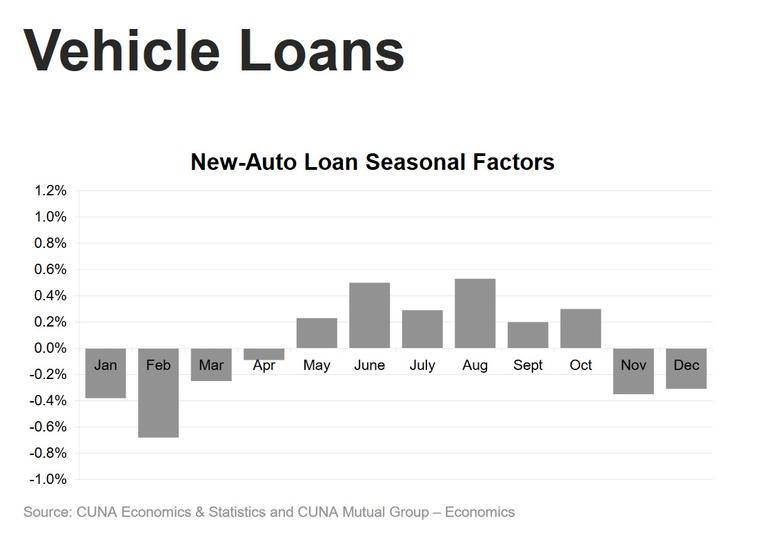
“The first quarter is typically the weakest quarter for credit union new-auto loan growth due to various seasonal factors. February is historically the weakest new-auto loan growth month of the year, with seasonal factors typically adjusting -0.68 percentage points from the underlying trend growth rate,” stated the analysis by CUNA Mutual’s chief economist, Steve Rick.
As the Trend Report notes, vehicle sales were 15 million in February, which at a seasonally-adjusted annualized sales rate is 9.4% above the 13.7 million pace set one year earlier but 6% below January sales.
“The production of vehicles rose by 11% in the first quarter compared to a year earlier as supply chain problems eased while inventory levels were up 69%. This should help reduce auto prices soon,” the Trends Report states. “Consumer demand for new vehicles may fall during the second half of 2023 due to high transaction prices, high inflation reducing real incomes, higher auto loan interest rates, slowing job creation, and worries about a possible recession later in the year. We expect new vehicle sales to only reach 15.9 million in 2023, well below the 17.1 million pre pandemic average. So, expect credit union auto lending to slow for the remainder of 2023.”
Real Estate Information
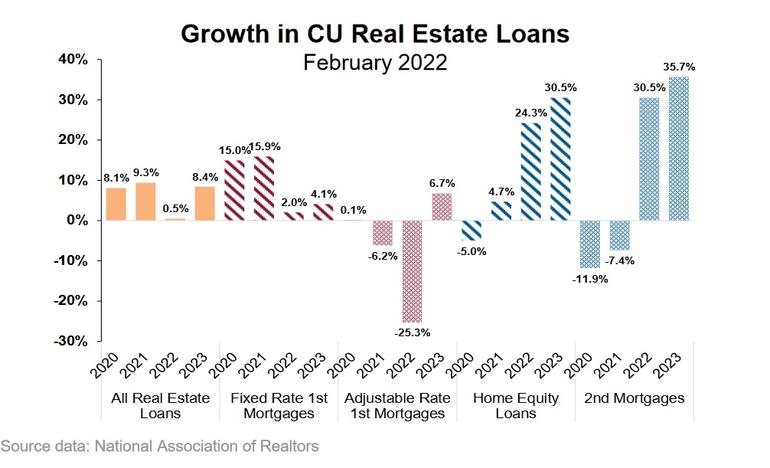
According to the Trends Report, credit union fixed-rate first mortgage loan balances rose 0.3% in February, above the -2.4% decrease reported in February 2022, due to credit unions holding more mortgages rather than selling them off into the secondary market. Nevertheless, credit union fixed-rate first mortgage loan balances rose only 4.1% during the last 12 months, half the 8.9% pace set in the year ending in February 2022, the Report added.
“Home prices fell 0.5% in February from January, according to the Core Logic Case-Shiller Home Price Index but are still up 3.8% year-over-year,” the Report states. “This is the eighth consecutive month of decline since reaching the peak in June 2022 due to the housing market being mired in recession. Nevertheless, the worst of the home sales may be over as existing home sales have started to rise after 12 months of declines, mortgage applications have bottomed out and are starting to rise again, and home builder sentiment is trending upward.”
Savings & Assets
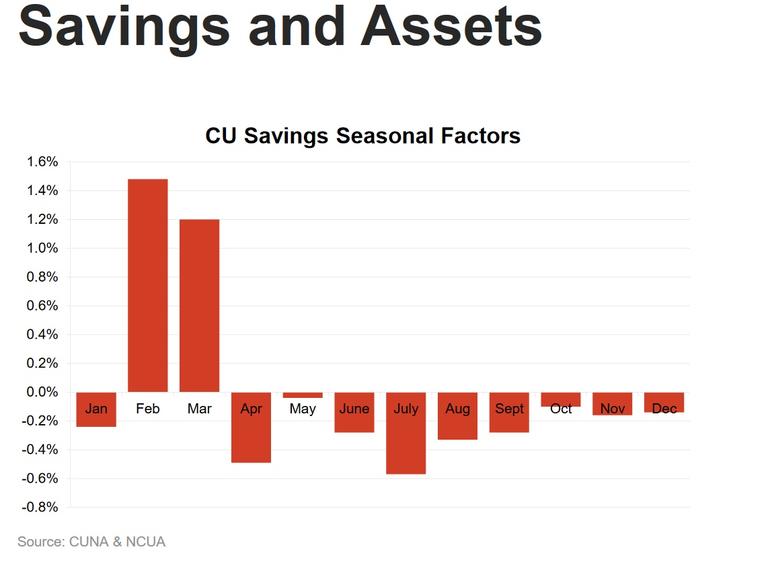
Credit union savings balances rose 1.1% in February, below the 1.6% gain reported in February 2021, due to the seasonal factors of tax refunds and bonuses being deposited in credit union members’ share draft accounts, which increased 2.4%, according to the Trends Report.
February’s seasonal factors typically add 1.48 percentage points to the underlying savings trend growth, the biggest of the year, the Report explained, adding that credit union savings balances fell at a -0.7% seasonally-adjusted annualized growth rate in February, below the 6.5% rate set in February 2022.
“We forecast credit union savings balances to grow only 4% in 2023, below the 7% long-run 30-year average, as members spend some of the excess savings accumulated during the
COVID-19 pandemic,” the Report predicts. “Moreover, some credit union members holding high-balance non-maturity shares and deposits (particularly money market accounts) might find yields on money market mutual funds attractive as the year progresses and the Federal Reserve continues to raise short-term interest rates.”
Capital & Other Key Measures
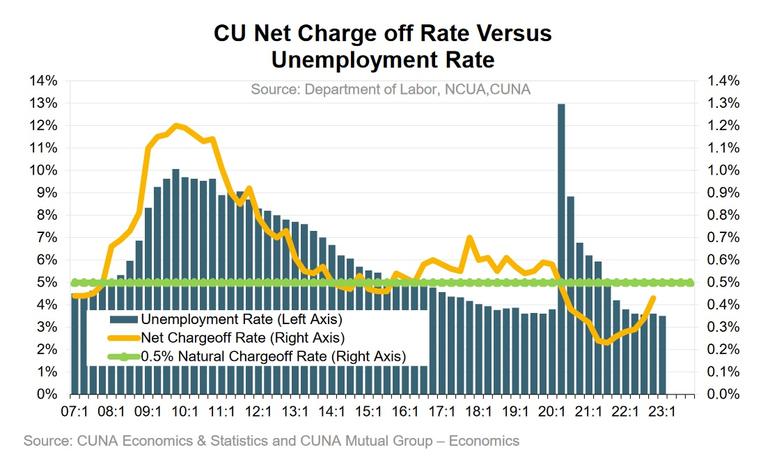
The credit union industry’s average loan net charge-off rate rose to 0.43% in the fourth quarter, from 0.26% one year earlier, the new analysis reveals.
“The loan charge off rate has been rising for the last five quarters after reaching the lowest in over a generation of 0.23% in the third quarter of 2021,” the Report reads. “The charge off rate remains below its ‘natural’ long-run rate of 0.5%. In other words, 50 cents of every $100 of credit union loans are normally charged off each year.
“The charge-off rate is below its natural rate due
to credit union members’ excess savings from stimulus checks and the incredibly strong job market,” the Report continues. “The charge-off rate typically exhibits a quarterly seasonal pattern whereby the loan charge-off rate rises by 0.05% in the fourth quarter and then declines over the next three quarters.”
Delinquencies
According to the Trends Report, credit union loan delinquency rate (loans two or more months delinquent as a percent of total loans outstanding) rose to 0.67% in February from the 0.46% reported one year earlier.
“A delinquency rate around 0.75% is considered the ‘natural delinquency rate,’ or the rate due to idiosyncratic life events (divorce, large medical expense, job loss), not due to the business cycle,” the Report states. “The loan delinquency rate exhibits an annual seasonal pattern whereby the rate drops on average 0.04-0.06 percentage points in February and again in March as members use tax refunds and bonuses to catch up on late loan payments. Delinquency rates therefore typically reach their nadir in the first quarter and then slowly rise as the year progresses, reaching their apex late in the fourth quarter.”
Credit Unions & Members
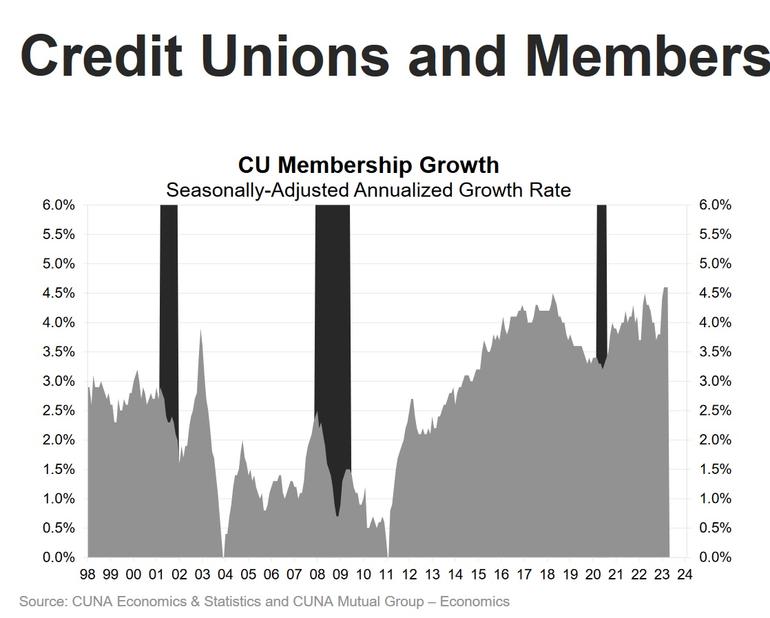
The new data show credit union membership growth slowed significantly during the first two months of 2023, adding 352,000 new memberships versus the 759,000 reported in the first two months of 2022. In percentage terms, credit union memberships rose 0.14% in February, 0.26% year-to-date, and 5.3% during the last 12 months, according to the Trends Report.
Memberships grew at a 4.6% seasonally-adjusted annual rate in February, up from 3.7% in February 2022.
“Americans typically join credit unions to obtain credit. With loan growth expected to be 8% this year and 7% in 2024, membership growth is expected to remain around its long-run average of 3.5% in 2023 and 2024,” the Report states. “Americans also join credit unions when they obtain a job at a business with an associated credit union. With job growth expected to slow this year, this avenue of membership growth will be weaker than last year. And finally, the decline in membership growth in 2020 was due to a decline in indirect auto lending.
“New indirect auto lending is expected to rise again in 2023 due to credit unions aggressive auto loan pricing compared to other lenders,” the Report added.