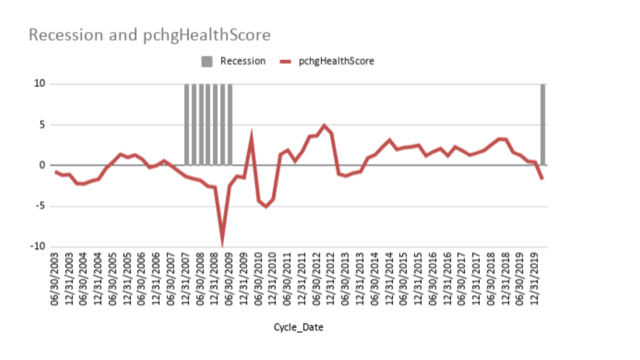
WILMINGTON, N.C.–New data released as part of one company’s “HealthScore” measure of credit unions indicates declines not seen since the lead-up to the Great Recession of more than a decade ago.
According to Glatt Consulting, its HealthScore for credit unions as of March 30 is 5.939, which represents a 1.7% year-over-year decline, the first such decline since the fourth quarter of 2013.
“Driving the score decline were major drops in loan growth, membership growth, return on assets, and efficiency scores – four of the seventeen component scores making up the overall HealthScore,” the company said. “The quarter’s results end a historic streak of 24 straight quarters of year-over-year HealthScore improvement.”
Component Score Details
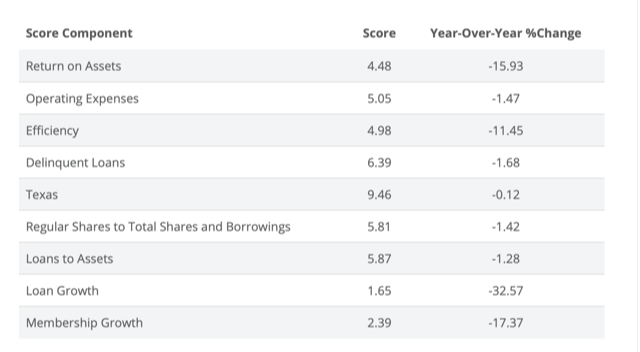
According to Glatt Consulting, credit unions saw year-over-year declines in nine of the company’s 17 HealthScore components, most notably in loan growth which declined 32.57% year-over-year. The loan growth score itself now sits at 1.65, the fourth lowest in 18 years of HealthScore reporting, the company said. “It is also the largest year-over-year decline since the third quarter of 2010.”
Glatt Consulting said the nine scores with year-over-year declines are as follows:
- Return on Assets: -15.93
- Operating Expenses: -1.47
- Efficiency: -11.45
- Delinquent Loans: -1.68
- Texas: -0.12
- Regular Shares to Total Shares and Borrowings: -1.42
- Loans to Assets: -1.28
- Loan Growth: -32.57
- Membership Growth: -17.37
Some Improvements
“While there were eight scores with positive year-over-year improvement, the level of improvement was generally small – with two exceptions: cash and short term investments, and asset growth,” the company said. “Year-over-year score changes for these two metrics were 8.97% and 5.79% respectively. Both trends make sense when factoring in the low loan growth rates noted earlier, and consumers hedging personal risk by migrating funds to insured credit union accounts.”
The eight scores with year-over-year improvement are as follows:
- Net Worth: 0.48
- Solvency: 1.00
- Charge Offs: 0.51
- Cash and Short Term Investments: 8.97
- Deposits per Member: 3.8
- Loans per Member: 2.09
- Borrowers per Membership: 0.51
- Asset Growth: 5.79
‘Might Seem Confusing’
“It might seem confusing that the loans per member score would be positive given the stark declines in loan growth scores, however, when considering credit unions’ more determined effort to become leaders in mortgage loan origination it makes sense,” the company said in its analysis. “In the first quarter mortgage loan applications jumped as did the volume of approved loans (which, incidentally, led some credit unions to throttle applications). This would account for an increase in loan balances per member even while overall loan growth declined.”
Other Observations
Other observations on the data as shared by Glatt Consulting:
- Delinquency and Charge Offs. “Forbearance and paycheck protection strategies did not come to life until the second quarter. It is possible that as the year goes on, what currently is 'above average' performance in these two score components will change dramatically if/when the time runs out on these legislative efforts.”
- Income and Expenses. “Income has outpaced expenses for some time which has allowed for strong scores for ROAA and consequently efficiency, but the tide is turning. The challenge in the near future is with expenses. Credit unions that are slow to act to trim expenses to better align them with today's income realities face an especially troublesome future.”
The Road Ahead. “Regardless of how the COVID recession resolves itself over the coming months, it clearly looks like challenging times for credit unions. Consider that the percentage of credit unions scoring below five, our benchmark average, increased by 2.06% (an additional 89 credit unions) from the first quarter in 2019. It should be noted that generally a score of '5' is considered average or baseline for each of our 17 metrics. This is due to the fact that we based our score distribution on 'average credit union performance over 20 years for each of our HealthScore components.”