

CHICAGO– There’s an issue on which credit unions need to take the lead if they expect to prosper and grow moving forward, according to one person.

Brenton Peck
“The thesis in a nutshell: credit unions need to be on the forefront of financial health in order to compete,” according to Brenton Peck.
Peck, director with the Chicago-based Financial Health Network, which has conducted research on member and employee financial wellness with several credit unions, shared his insights during the CU FInHealth 21 Conference, which is sponsored by the National Credit Union Foundation, the Cornerstone Foundation and the California and Nevada leagues.
Peck’s comments came during a virtual presentation on “Improving the Financial Health of Members & Employees.”
Peck acknowledged that over the past few years there have been some “positives” in Americans’ financial states, hourly wages increasing and, until the pandemic, unemployment declining.
“But despite the broader stroke financial gains we still witness persistent inequalities across various groups,” said Peck. “The financial health of all Americans does not necessarily follow that macro trend line.”
Peck cited data from research sponsored by PSCU and Members Development Co. that probed the financial well-being of participating credit unions’ members and employees. The research provided a “holistic look” at the state of both constituencies, he said.
Broader Strategies Needed
“Credit unions need to address the financial health of their employees, members and communities,” he said. “Credit unions need to broaden their financial health strategies.”
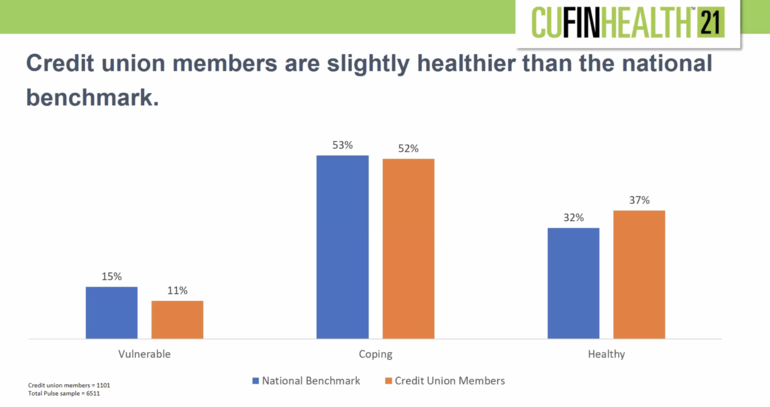
That research led to the development of Financial Health Scores that examined how members and employees spend, save, borrower and plan. Members and employees were then rated as either financially healthy, financially coping, or financially vulnerable.
“Credit unions have a great opportunity to differentiate by improving members’ financial health,” observed Peck.
The survey found 60% of CU members are struggling financially, But what may have surprised many is that the survey also found more than 60% of CU employees are also struggling, as CUToday.info reported at more length here.
“It may mean credit unions need to rethink how they invest in these solutions,” said Peck. “The healthier members are, the healthier the credit union.”
‘Future of Membership’
Peck noted that income is obviously correlated with financial health, but it does not determine one’s financial health. Forty-two percent of households earning more than $100,000 per year, for example, were found to be struggling with many showing signs of increased vulnerability.
In particular, said Peck, the research shows a big opportunity for credit unions with members 50 years of age and younger who are “financially coping.”
“This group at large is the future of membership, and these are the members seeking your help on their financial journey,” he said.