

WASHINGTON–Credit unions were offered some insights into the troubled state of many Americans’ finances, what the “she-cession” means, and why DEI initiatives are not just good for members but for the credit union’s bottom line, as well.

Samira Salem
Addressing those issues during the CU FInHealth 21 Conference, which is sponsored by the National Credit Union Foundation, the Cornerstone Foundation and the California and Nevada leagues, was Samira Salem, VP-diversity, equity and inclusion with CUNA.
The virtual session was moderated by NCUF Executive Director Gigi Hyland.
In response to a question from Hyland on where Americans stand in terms of financial wellness and how to ensure that everyone has the opportunity to advance their own financial well-being, Salem provided both data and insights around how credit unions cannot just help their own members, but the CU itself in the process.
“When we talk about financial well-being, we have been really kind of thinking about what does financial well-being for all mean,” said Salem. “It’s the idea of how financial well-being connects to credit union efforts around diversity, equity and inclusion. It’s a natural fit. It is want credit unions are about. It is our credit union difference. Making this connection is more urgent now than ever.”
Salem said the data are clear that low-income households and especially women of color have been hit hardest, “not just financially, but physically and mentally.”
“The pandemic has really exacerbated existing disparities for low income groups,” she said.
Wealth Inequality
Looking to household wealth and wealth inequality, Salem pointed to data indicating the top 10% own 76% of the wealth in the United States, while the bottom 50% own 1% of the wealth.
“It’s a tremendous disparity. We know of the bottom 60%, 14 million people, had negative wealth,” said Salem. “And we also know in 2020 that household wealth in the United States increased $12 trillion to an all-time high, which primarily benefitted those at the top. Those at the bottom experienced economic distress.”
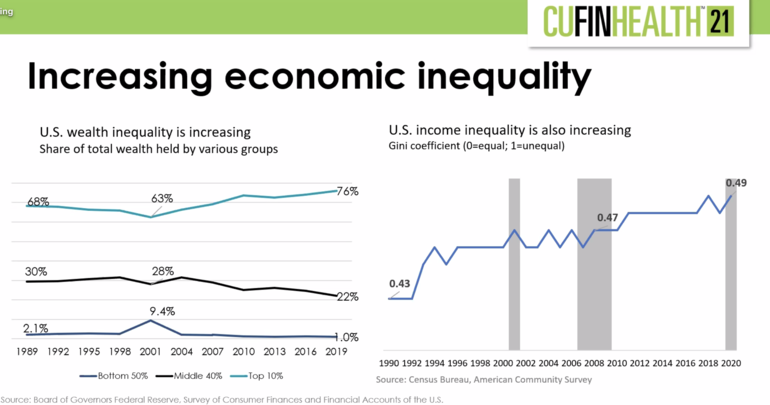
“The gap between those who have and those who don’t has grown,” Salem said. “We can expect people in lower income levels are really struggling to make ends meet. Census data show 81 million Americans are having trouble paying household expenses.”
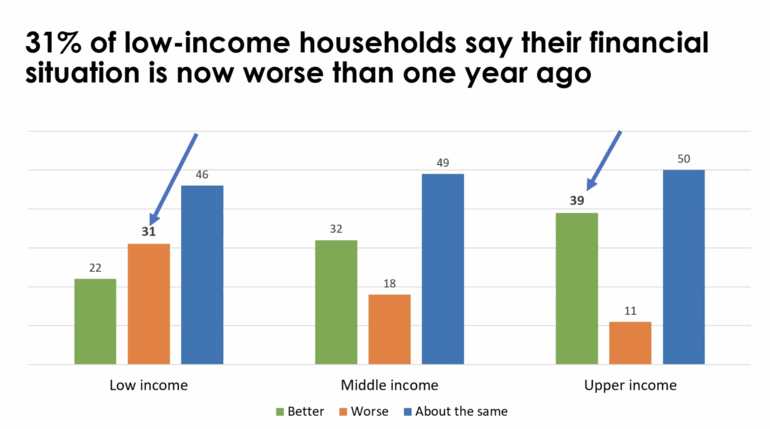
Salem also cited data showing the racial wealth gap remains “wide and persistent,” with white household wealth eight times that of Black household wealth as of 2019. She said Black and Latinx workers have been most vulnerable, as they comprise a large share of those in the service and hospitality industries hit hard by the pandemic.
“Plus, recovering from job loss tends to be harder,” said Salem. “The jobs they find tend to pay less.”
The She-Cession
Salem said women have been especially hit hard by the pandemic, dubbed by some the “she-cession,” with more than two-million women falling out of the workforce for a variety of reasons, including “carrying the bulk” of family responsibilities.
“This story is really about Black and Hispanic women who have really experienced the greatest job losses,” said Salem. “They have a double whammy going on, as they face racial and gender (hurdles).”
In The ‘Wheelhouse’
DEI, said Salem, “is our wheelhouse,” adding it’s a “business imperative” and is “vital” to credit union advocacy.
Salem said DEI is one of the most effective tools credit unions can leverage in driving growth, pointing to statistics showing a majority of the U.S. population, 61%, will be “multi-cultural” within 20 years. She cited a McKinsey analysis that found companies with the most gender diversity are 21% more profitable than other companies. CUNA research shows similar results, she said.
“It’s good for the bottom line,” said Salem.