

WASHINGTON–Two credit union CEOs were among those testifying before two hearings in Washington on Thursday.
Karen Madry, who leads Marion, Ind.-based Afena FCU, told a Senate Banking, Housing, and Urban Affairs Committee hearing on “Consumer Protection: Examining Fees in Financial Services and Rental Housing,” that the types of fees proposals the Consumer Financial Protection Bureau is putting forward will ultimately hurt many members if enacted.
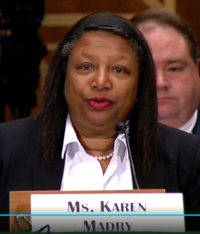
But at least one senator pushed back, arguing the fees add up for consumers and can become a significant expense.
Madry is the chair of America’s Credit Unions’ Small Credit Union Committee and a member of the Indiana CU League board.
In her comments to the committee, Madry said credit unions like hers would have to “rethink everything” from staffing to offering free checking accounts if the proposed junk fee rules being proposed by the CFPB end up applying to credit unions.
A ‘Made Up Word’
“I'd like to address the term junk fees. It’s a made-up word and it is not in statute,” Madry told the committee. “We heard a lot of comments about junk fees and various industries. I would argue that in the financial services market that those fees differ. Credit union fee programs are regulated by federal and state government and the reduction of fee income would ultimately result in the reduction of services to our members.”
Madry told the committee that data show credit union fee income is at a 32-year low.
“The CFPB's actions really want to impact overdraft protection,” she said. “They would make it seem that this is a predatory way that we serve our members. My members would argue that they are paying for a service that is valuable to them. Overdraft protection provides a lifeline for my members. It gives them peace of mind to know that when their paycheck cannot stretch and meet their needs that we will cover a charge to help them to buy gas or put food on their table.”
Consumers Opt In
As many proponents of overdraft services have stated, Madry also pointed out consumers opt in to OD programs.
“It is a choice they make,” she emphasized to the committee. “It is a choice they make, understanding what (the overdraft program) is and how it works. At our credit union make sure that we educate our members on overdraft protection and teach them how to use it responsibly. We disclose everything to our members up front.”
Not Really Exempt
Madry noted she understands that as a $100-million CU, her organization is exempt from the CFPB OD rule, but added that Afena FCU is not really exempt.
“There will be a trickle-down effect,” she said. “If larger institutions are forced to lower or cut their fees, my members will expect me to do the same. And a reduction in fees would mean a reduction in the services that I am able to provide.”
About the CFPB Rule
In turning to the CFPB’s credit card late feel rule,
Madry turned to the CFPB’s credit card late fee rule, stating that similar to courtesy pay rule, it will have a negative impact on her institution, again recognizing that competition will force her CU to price according to the new rule.
“Regardless of the fact that I'm exempt, the $8 fee is not enough to cover the cost of collecting on a credit card once that credit card becomes delinquent,” she said. “Again, those fees are fully disclosed to our members prior to them receiving their credit card and at the time of application.”
Madry also argued that a small, $8 fee is not high enough to encourage consumers to behave responsibly with their cards and pay their bills on time.
Safety & Soundness Issue
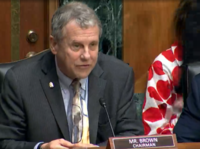
“For us, this is also a safety and soundness issue,” she said. “As Sen. (Sherrod) Brown (D-OH) pointed out, if our members become late as reported on their credit bureau, it will damage their credit score and damage their ability to get credit in the future. It will also cause financial institutions to tighten up on their credit standards. In conclusion I'd like to say that I hope you understand that these regulations pose a substantial risk to small credit unions like mine, as well as to my members and the communities that we serve. I am asking Congress and regulators to take action and do something to stop this before it's too late.”
Senator Pushes Back
Sen. Brown, however, contended during the hearing that financial education does little to help consumers battle “hidden” fees.
“No amount of financial education is going to protect someone from a tactic that's meant to purposely hide the real purpose of a product or service,” Brown said. “They hide the price—that's the whole point. Junk fees make a mockery of free and fair markets, so, $32 here, $45 there, sprinkle in a $10 service fee…Before you know it a product you thought was the most affordable option is actually the most expensive. Without junk fees consumers would keep more of their hard-earned money. They'd be able to better find the lowest price, which is how you really should promote competition to bring costs down. That's why the CFPB is taking long-overdue steps to reduce costs and fees and make them more transparent.”
Senator Criticizes Administration
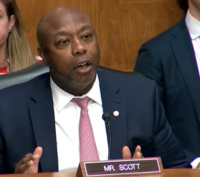
In a sign of the partisan divide in Congress, Republican Tim Scott (SC) fired back at Brown, stating the Biden administration “would rather throw a towel over the mirror and say it might be easy, or even politically expedient, to slap a label of junk, or excessive, fees on additional costs for legitimate products and services in an effort to villainize business in America. So, they, themselves, do not have to face the reality.
“But ‘Bidenomics’ is causing devastation after devastation upon the shoulders of the American people,” Brown continued. “It is long past time that Democrats stop playing political games with price controls and trying to micromanage the business operations—especially when the real outcome of these feel-good games is reducing access to credit and limiting economic opportunity for those who need it most.”
ABA CEO Testifies
In one of those rare instances where credit unions and banks agree, ABA President and CEO Rob Nichols was critical during the hearing toward what he called a political campaign to “denigrate legitimate, transparent and well-disclosed fees for banking services.”
“Today’s Senate hearing clearly seeks to perpetuate the myth that there are junk fees in financial services,” said Nichols. “There may be junk fees in the economy, but they are not in banking. National surveys have consistently shown that consumers value the wide range of banking services available to them today and acknowledge that banks are transparent about the cost of those services, most of which must be disclosed under existing federal law. The irony is that this misguided political campaign will ultimately harm, rather than help, the very consumers supporters claim to want to protect.”
In an earlier statement to the committee, the ABA had written, “Banks, credit unions, credit card companies, mortgage lenders, fintechs, and other providers of consumer financial products and services compete aggressively on all aspects of their offerings—including fees. This ultra-competitive environment benefits consumers, who are free to choose from a wide variety of high-quality, convenient, innovative, and competitively priced products and services.”
Testimony During CFPB Hearing
Separately, Apple FCU President/CEO Andrew Grimm was part of a panel discussion at a hearing conducted by the CFPB and the Department of Transportation on airline and credit card rewards.
Grimm shared the opposition of credit unions to the Fed’s debit interchange proposal.
The deadline for comment on the Fed proposal is May 12.
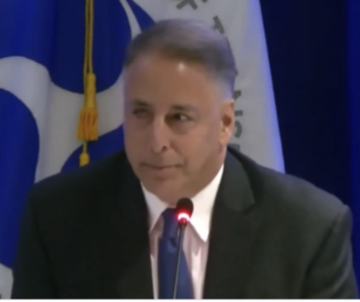
Andrew Grimm during hearing.
In Grimm’s opening remarks, he shared some reasons as to why Apple – and other credit unions -- has struggled to compete among credit card rewards programs. He cited:
- Scale: “Larger institutions can produce more efficiently and in a less costly manner.”
- Budget: “Larger institutions have the financial capacity to execute credit card advertisements and to invest in technology.”
- Relationships: “Larger institutions develop and retain relationships with both airlines and large retailers.”
The Q&A
Asked by CFPB Director Rohit Chopra about assurances and proper notices to consumers on terms, Grimm told the hearing the use of different terminologies and changes to rewards when conditions change that make it difficult to compare products and compete.
“We know that conditions are going to change. I'm not going offer rewards that I know, when the interest rates go up, we can't sustain,” he said. “So, we don't change what we promise. I mean, that is a core value, we will not change we promise and nobody should do that."
DoT Secretary Pete Buttigieg asked about the affects of airline rewards programs on newer or smaller players’ ability to compete, and steps that might help mitigate any negative competitive impact that could come from the way these programs are managed, run, and regulated.
“Eighty-eight percent of our rewards card members revolve,” Grimm said. “Now that may be an anomaly. I don't know what the industry stats are for that. But that tells you that rate has to be part of the competitive process. We're so focused on 'this reward' and that ‘bonus’ and all that, but ultimately, it's the rate that will save the consumer money."