

JACKSON, Miss.–In remarks to the Senate Banking Committee, Bill Bynum, CEO of Hope Credit Union, pointed to his own credit union’s experiences in building wealth in rural, poor communities.
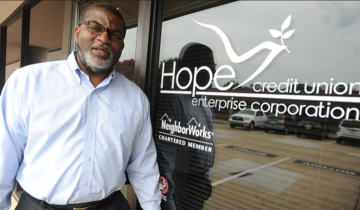
Bill Bynum
Addressing a hearing on “An Economy that Works For Everyone: Investing in Rural Communities,” Bynum offered recommendations on strategies to increase economic opportunity by expanding access to financial services, drawing on HOPE’s experience in the Delta and Black Belt and other rural communities in the Deep South.
“People, when afforded opportunity and access to the right tools, will climb the economic ladder,” Bynum told the committee. “Yet many of our members live in communities entrenched in poverty. They lack critical infrastructure such as quality schools, grocery stores, broadband, and affordable housing, and the financial tools necessary to obtain these economic mobility-enhancing assets. These needs have been neglected for generations, as reflected by the region’s acute and persistent poverty.”
Bynum noted that prior to COVID-19, Deep South communities were already dealing with the pre-existing crises of racial and economic inequality. He said there is a current “triple threat” of the health, economic and social justice crises that is the convergence of centuries of policies and practices that have extracted, discriminated and under invested in Deep South people and communities.
“As the nation seeks to recover from COVID-19, Deep South communities, especially communities of color, are now even more precariously situated on the brink of economic and social devastation,” Bynum said. “Policy decisions made today have the opportunity to break, rather than repeat this cycle of inequity.”
Solutions That Will Work
Bynum told the Senate HOPE’s testimony provides important context on existing disparities and under-investment in the Deep South, and he highlighted solutions he said he knows will work, including:
- Increase investments into CDFIs with a track record of reaching underserved communities and those hit hardest by COVID-19
- Close opportunity gaps in bank lending, service, and investment in underserved communities
- Deploy funds in ways that account for existing racial and economic disparities
- Build and preserve wealth in rural communities, particularly communities of color, through homeownership and small business ownership
- Strengthen consumer protections that prevent wealth stripping and build assets
‘Possible to Ensure Prosperity’
“People in rural areas know what solutions work best for their communities, and have consistently demonstrated their capability of doing it, most often with significantly fewer resources than other communities,” said Bynum. “CDFIs with track records of reaching and working in partnership with communities of color and rural communities model solutions that work. With adequate resources supporting these institutions, and increased commitment by others to do the same, it is possible to ensure prosperity and mobility in the most economically distressed communities in rural America.”
Bynum’s full testimony can be found here.