

WASHINGTON–A credit union CEO testifying before a House subcommittee repeatedly emphasized members understand and want overdraft programs, and that efforts by the CFPB and other regulators to limit fees will ultimately be harmful to everyone involved.
Testifying before the Financial Services Committee, Karen Harbin, CEO of Commonwealth Credit Union in Kentucky, was asked numerous questions following her testimony during the hearing titled, “Politicized Financial Regulation and Its Impact on Consumer Credit and Community Development.”
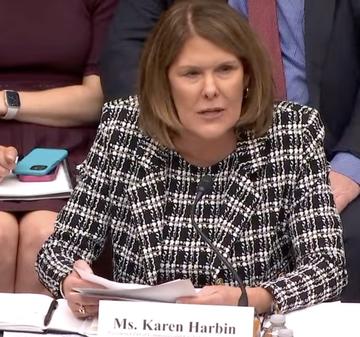
Karen Harbin testifies before House subcommitte.
As the hearing title suggests, it was aimed at illustrating the differences between Republicans and Democrats on regulation, a point made clear as members of the committee from each party made their statements (see related story).
In her statement to the committee, Harbin said financial regulations and some of the proposals being made hamper the ability of Commonwealth Credit Union and other CUs to serve members.
Unfortunately, she said, credit unions that are already struggling will only find increasing pressure with fees and card interchange under attack.
What Regulators Need to Know
“Credit unions want regulators such as the CFPB to know that they embody pro-consumer relationship banking. They feel the Bureau is uninterested in hearing how difficult this is,” Harbin said. “A major concern is the CFPB's recent initiative against junk fees. All fees are not the same. This initiative has been mislabeled with the CFPB calling several lawful payment incentives junk fees. These fees bear no resemblance to the type of surprise hotel ticket and airline fees referenced by others as junk fees, and in contrast are all subject to comprehensive laws and regulations that include clear and conspicuous consumer disclosures.
“Mislabeling payment incentives for regulated financial products and services will cause credit unions to no longer be able to offer these products and services to vulnerable communities.”
Harbin said credit unions also have serious concerns about the CFPB’s new proposal around overdraft fees, saying it may “inadvertently undermine the ability of smaller financial institutions, like ours, to offer services that are critical to our members’ financial well-being.
What Members Say
“Like numerous other credit unions, Commonwealth Credit Union offers an overdraft protection program to our members,” she continued. “Our members tell us they want and appreciate this service and they don't object to paying a fee. In fact, we work with members and refund fees when we can. Even with the proposed exemption in the rule, market pressures will necessitate that smaller credit unions alter their overdraft programs in response, without the ability to benefit from the same economies of scale that allow larger institutions to weather a reduction in fee income.
“These changes could make it unsustainable for smaller institutions to offer overdraft protection, disproportionately affecting those who rely on it the most,” Harbin told the subcommittee. “Uncertainty surrounding the abusiveness prong of UDAAP and how the CFPB interprets it continues to be a source of concern for credit unions…Knowing whether or not an act or practice is abusive would allow the entities that are governed by the CFPB to better understand their obligations.”
Other concerns credit unions have include the Fed’s recent proposed changes to the debit interchange rule, which she said as proposed would “cause serious harm to consumers.”
‘Harming Our Ability to Help’
In concluding her prepared remarks, Harbin told the committee, “The regulatory burden on credit unions, whether from the CFPB, Federal Reserve or the NCUA, continues to increase. Credit unions, including mine, do not boast the massive earnings of big banks, but our impact lies and our genuine commitment to serving communities. We’re not here to merely facilitate financial transactions. Our goal is to empower, educate and uplift our members, ensuring their financial well-being. Regulatory overreach is harming our ability to do this.”
The Q&A
Harbin was asked several questions by committee members during the Q&A:
Barr: How do you help your members in central Kentucky?
Harbin: We use AI-powered technology to serve more vulnerable communities. We make loans to those with moderate incomes, and that's a very costly thing. We also provide free checking accounts, HELOC loans with no closing costs. We have no annual fee on credit cards.
So, there's lots of services we provide to our members that are very costly that we absorb.
We also bear all the fraud and the merchant bears none when a fraudulent transaction takes place. Compliance costs are very expensive. In 2023 alone, we spent over $1.3 million on compliance costs, cybersecurity tools and fraud related to transactions that our members.
Rep. Bill Posey (R-FL): Is there an issue you would prioritize?
Harbin: This is not one size fits all. It’s death by a thousand cuts. Fees (don’t exist) in a vacuum. As a credit union president, I have to deal with all these fees that come in one at a time, but they add up. Even with the exemption (on credit card late fees), there is a trickle--down effect, because our members will go to other financial institutions that do not charge the fees or have lower fees and we will have to lower our fees just to stay competitive.
Posey: What about overdraft programs?
Harbin: Overdraft programs need to be looked at in their entirety. We see most people who overdraft their accounts are intentional. They want overdraft and have threatened to leave and will go down the road to another provider that is less desirable, such as a payday lender.
Rep. Barry Loudermilk (R-GA): If members of your credit union repeatedly overdrafted and paid the fee, do you think the member doesn’t understand the product or the fee, or are they using it as intended?
Harbin: They are using the product as intended. We track whether it’s a first time user or a (habitual) user. When they sign up they receive a letter that reiterates how the program works. The first time they use the program they get a letter that educates them. (If using often) they get an excessive use letter, and we spend a lot of time of members on the phone and say why not take one withdrawal and pay one fee, rather than multiple fees?
We feel it is our responsibility to educate our members and not dictate how they manage their finances. Members want this service. They will go elsewhere to get it if we don’t provide. We can see that in the transaction history. If we take a member out of our overdraft program, they will go to a payday lender.
In most cases (the overdraft is) accidental. We empower staff to give back up to two fees. Last year, we refunded about $600,000 in fees to our members. We listen to them. We are here to make their lives better.
Loudermilk: How does the Bureau perceive overdrafts?
Harbin: I think the CFPB misunderstanding why consumers use the service and that consumers don’t understand the service, when in fact they do understand.
Loudermilk: How do you perceive your customer would respond if educated on what the Bureau is trying to do.
Harbin: They would be very unhappy. They want the service.
Loudermilk: If the service were taken away, what are the If alternatives?
Harbin: They would go to a payday lender or some other less-desirable option. That’s not something we want, not something Congress wants, and it shouldn’t be what the Bureau wants.
Loudermilk: The Bureau not sure what they want.
Now With Free Shipping! The CUToday.info Daily News Email Keeps Getting Better!
The biggest, best and freshest news reporting in credit unions remains free, and now has an added bonus---free shipping to your email address! That’s right. Each morning CUToday.info delivers its daily Fresh Today news update offering the latest headlines and breaking news right to your email, with the easy-to-read headlines format allowing you to click on the stories that interest you most in order to learn more. So stop paying those bank-fee-like subscription prices from other so-called “news” publications!
If you haven’t yet signed up for the new email solution on which CUToday.info has partnered with ResponseGenius, you can do so here. Signing up requires less than one minute of your time—and it’s free!
Please note that after signing up you may need to go to your Spam/Junk folder and mark the morning headlines email as safe. CUToday.info does not provide its list of readers and emails to outside parties, and we will not be contacting you to sell you an extended warranty or sending you any links so you may cash in on an inheritance you didn’t know was coming.
And did we mention it’s free?