

MADISON, Wis.—Credit unions will soon see their auto loan portfolios begin to grow again, CUNA Mutual Group’s latest Trends Report indicates.
The new report points out credit union new auto loan balances have been declining since the second half of 2019, but calls for growth in the second quarter of the year.
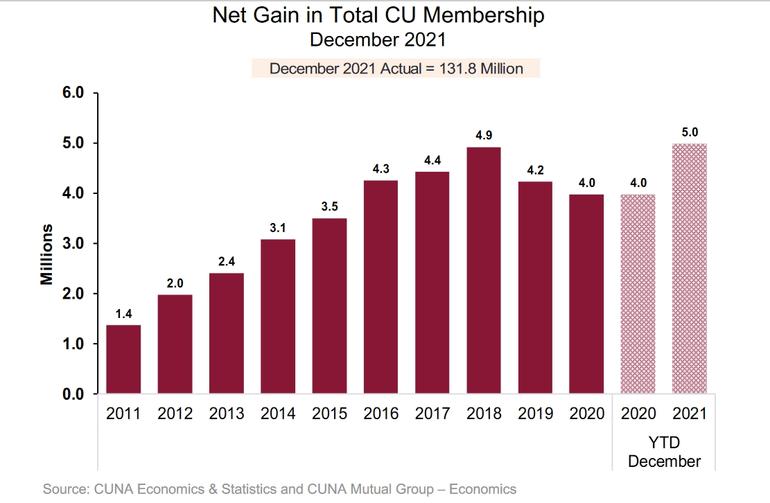
The February Trends Report also shows credit unions added five million memberships in all of 2021, the fastest growth in credit union history.
Despite the good news, CUs will likely not have an easy year in 2022, as capital growth will be subdued due to return-on-asset ratios falling to 0.7% this year as net interest margins fall to the lowest in history, CUNA Mutual Group said.
Total Credit Union Lending
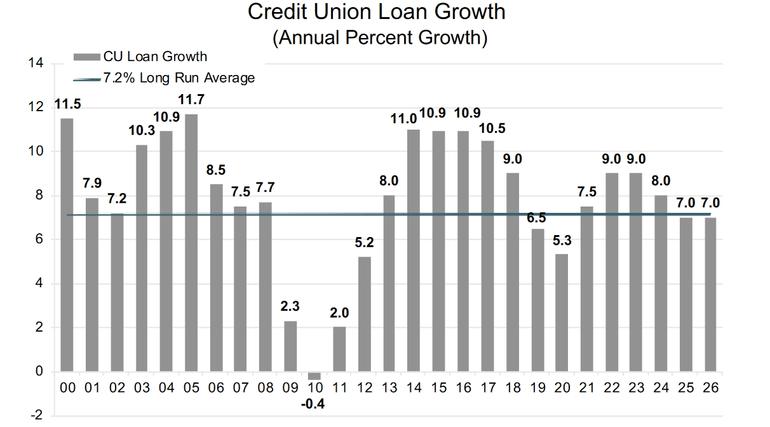
Credit union loan balances rose 1% in December, above the 0.2% pace reported in December 2020. Driving overall loan growth was strong growth in credit card loans (2.3%), fixed-rate mortgages (2%) and home equity loans (1.2%). December credit card seasonal factors – such as holiday shopping – typically add 3.1 percentage points to the underlying credit card trend loan growth. The muted December credit card growth was caused by the continuing effects of cautious consumers deleveraging their balance sheets. Credit union loan balances rose 7.5% in 2020, up from the 5.3% reported in 2020 and above the 7.2% long-run average for two reasons. First, fixed-rate mortgage loan balances rose 15.8% as credit unions held more loan originations on their balance sheets instead of selling the loans in the secondary market. Second, used auto lending grew 10.2% as consumers substituted used car purchases for new car purchases.
Expect loan growth to surge to 9% in 2022 and 2023 as consumers release pent-up demand for new cars and appliances and credit card balances surge as spending on leisure and hospitality increases, CUNA Mutual Group said.
Consumer Installment Credit
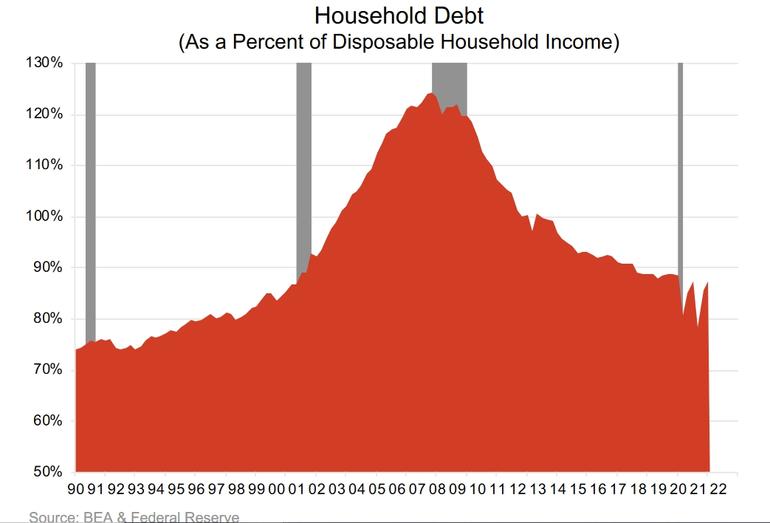
The great deleveraging of the U.S. consumer balance sheet continued in 2021. Household debt burdens, as measured by residential mortgages and consumer credit as a percentage of disposable personal income, fell to 87.1% in the third quarter of 2021, down from 87.4% in the third quarter of 2020, according to the Federal Reserve’s Flow of Funds report.
“Debt-to-income ratios haven’t been this low since 2001, before the housing boom of 2003 to 2007. Falling debt burdens during the last 12 years have improved household balance sheets,” the report noted.
Household net worth has also surged since 2009 due to rapidly rising stock and home prices. The big drop in the debt-to-income ratio during the first quarter of 2021, when the ratio fell to 78%, was due to the $1,400 stimulus check sent out in March, which boosted disposable income, the denominator of the ratio. Expect household debt-to-income ratios to rise for the next few years as debt growth exceeds income growth, CUNA Mutual said.
Vehicle Loans
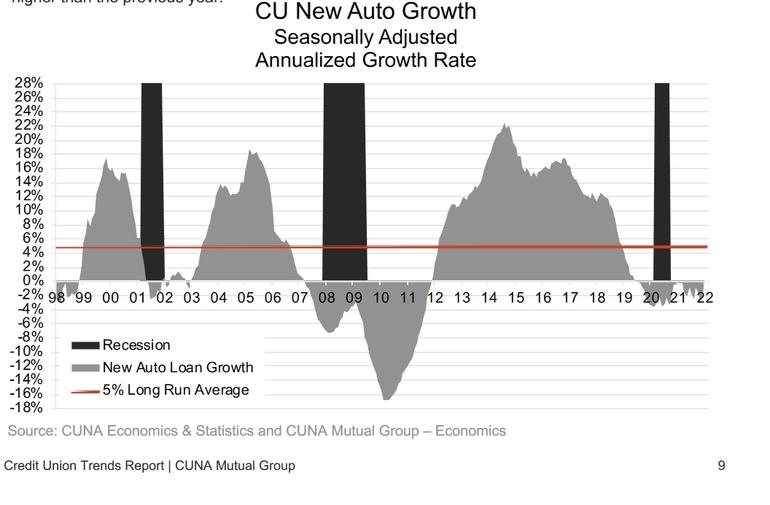
Credit union new auto loan balances rose 0.3% in December, significantly above the -1.0% pace set in December 2020, but overall balances fell 1.0% for the full year. On a seasonally-adjusted annualized basis, new auto loan balances fell 1.8% in December. Credit union new auto loan balances have been declining since the second half of 2019.
“We expect new auto loan growth to return to positive territory in the second quarter of 2022,” CUNA Mutual Group said, noting five factors drove this 2.5-year decline.
“The pandemic raised job and income insecurity among potential new auto buyers, rapid loan originations two to three years ago precipitated larger loan balance amortization today, new auto sales declined 23% over the last year, members used ‘cash-out’ funds from mortgage refinances to pay off auto loans and the rapid growth of indirect auto lending has leveled off,” CUNA Mutual explained.
New vehicle sales were at 12.5 million in December, which, at a seasonally-adjusted annualized sales rate, is 23% below the 16.2 million pace set one year earlier. Supply-chain disruptions, headlined by a shortage of electronic semiconductor chips, kept 2021 new-vehicle sales below 15 million for the second straight year. The lack of available substitute goods for new vehicles continues to put significant pressure on used-vehicle prices. Wholesale used-vehicle prices ended the year 56% higher than the previous year.
Real Estate Information
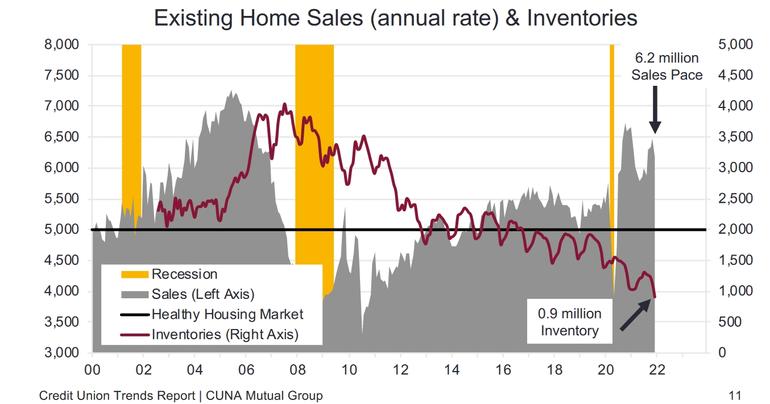
The housing market closed 2021 on a weaker note, as existing home sales fell 5% in December from November and fell 7% from December 2020. Rising mortgage interest rates appeared to weigh on sales along with limited homes available for sale. Currently, the monthly supply of homes on the market has plummeted to 1.8 months, the lowest in modern history. Six months supply is considered a balanced housing market. Meanwhile, price appreciation remains strong amid a tight housing market. Median single-family home prices rose 16% over the last year, up from the 5-6% pace recorded over the last few years. Housing demand is expected to remain above its long-term trend of five million home sales per year during the next few years due to the Millennial generation (83 million strong) reaching the prime home-buying ages of 25 to 35.
“This will help support credit union purchase mortgage originations,” the company said.
The contract interest rate on a 30-year, fixed-rate conventional home mortgage rose to 3.10% in December, up from 3.07% in November and up from the record low 2.68% reported in December 2020. The 10-year Treasury interest rate fell to 1.47% in December from 1.56% in November due to the drop in inflation expectations (16 basis points), exceeding the rise in real interest rates (7 basis points). Home prices rose 1.3% in December from November, according to the Core Logic Home Price Index, and 18.5% year-over-year. House price appreciation accelerated in December, driven partly by home sellers taking advantage of the lack of inventory and hiking prices.
Savings and Assets
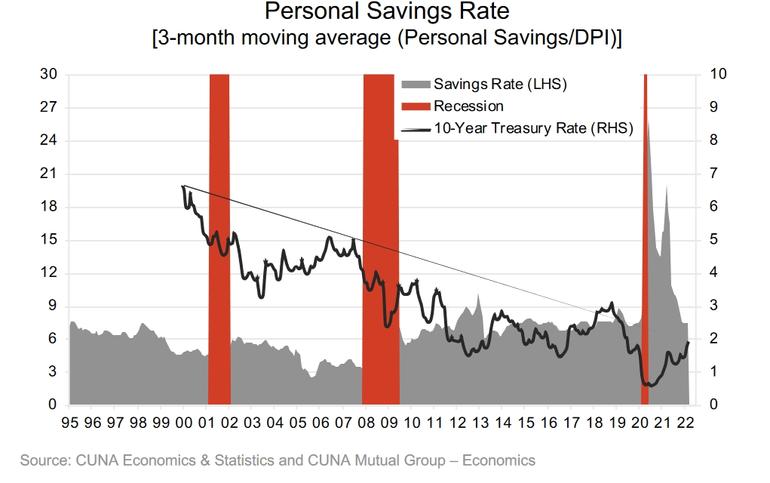
The personal savings rate has returned to pre-pandemic rates in the fourth quarter of 2021. During the last three months of 2021, consumers saved 7.4% of their disposable income, down from the 16.1% reported in the first half of the year.
“The high savings rates over the last two years were caused by consumers spending less on leisure and hospitality, in addition to three rounds of government stimulus checks. Consumers typically used 80% of their stimulus payments to either pay down debt or to build up their precautionary savings balances. Expect the savings rate to remain around 7.5% in 2022, which was the 10-year average savings rate prior to the arrival of the COVID-19 pandemic in 2020,” CUNA Mutual Group explained.
The drop in the personal savings rate is one factor pushing up long-term interest rates recently. The jump in the savings rate over the last few years helped to lower the 10-year Treasury note interest rate. Financial institutions used the surge in savings deposits to purchase additional government debt. This increased the price of bonds and reduced the interest rates on those bonds. The recent drop in the savings rate will slow the growth in deposits and therefore the funds available to purchase additional government debt, which raises interest rates, CUNA Mutual said.
Capital and Other Key Measures
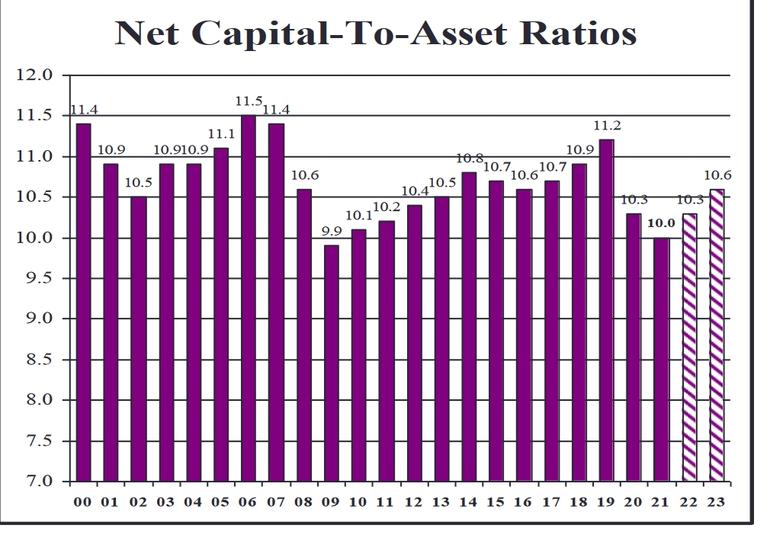
The credit union movement’s net capital-to-asset ratio ended 2021 at 10.0%, down from the 10.3% reported at year-end 2020, as asset growth outpaced capital growth. Credit union earnings as measured by return-on-asset ratios came in at 1.10% in 2021, resulting in credit union capital growing 7.7%, below the 11.8% growth in assets.
“The credit union capital ratio is expected to rise to 10.3% in 2022, as the pace of capital growth (7%) is expected to rise above the anticipated pace of asset growth (4.5%). The growth rate of capital, also known as the return on equity ratio, is an important measure of credit union financial performance and is considered the speed limit for asset growth in the long run. Capital growth will be subdued in 2022 due to return-on-asset ratios falling to 0.7% this year as net interest margins fall to the lowest in history. Expect loan loss provision expense to return to normal levels and operating expenses to dramatically increase due to a tight labor market and high inflation,” the company said.
Credit Unions and Members
Credit unions added 278,000 memberships in December, more than the 220,000 reported during December 2020. Credit unions added 5.0 million memberships in all of 2021, the fastest growth in credit union history.
“This membership surge is due, in large part, to the mortgage refinance boom recorded in 2021. Membership growth is also driven by job growth. In 2021, the economy gained 6.7 million jobs, according to the Bureau of Labor Statistics, a big turnaround from the 9.3 million job loss reported in 2020. For 2022, expect a strong labor market with an expected 3.5 million additional jobs being added to the workplace,” CUNA Mutual Group said.
Credit union membership growth is expected to be 4% in 2022 and 2023, above the recent five-year average of 3.7%, due to an increase in the demand for credit by the American consumer.