

RANCHO CUCAMONGA, Calif.–Just offering a traditional menu of products and services increasingly doesn’t cut it with consumers, according to one person, and the coronavirus pandemic is only accelerating consumer preferences away from that model.
There has been a “definitive movement beyond products and services and sales” over the last two years toward a new strategy that bundles products and services in a “much more personal way” and creates the kinds of emotional connection the resea
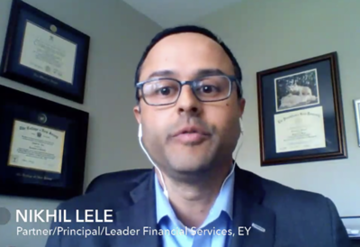
rch clearly shows is much more profitable to the financial institution, according to Nickhil Lele, partner, principal and leader of financial services with EY.
The coronavirus pandemic is only accelerating the trend, Lele told CO-OP’s THINK 20 virtual event.
“Prescription-based services are the big pivot in consumer service as a new value proposition,” Lele said. “From a human perspective, the trends are even more clear now than they were during our original research. Every single aspect of the customer mindset is being impacted. In order to get a consumer in the door, it’s increasingly about transparency and understanding how the data about a consumer can be used to personalize the experience. It’s about how you can help an individual solve for a complex set of needs, instead of a transaction set of needs. It’s about a community of trust and the connectivity people feel that resonates with them.”
A Strong Trend
Another trend has also emerged “prominently” in consumer research, according to Lele, and that is the role of the household structure in making financial decisions.
“There is this home CFO role by a person who either knowingly or by necessity takes on the role of being able to navigate sound financial behavior,” he said. “It’s increasingly complex, and increasingly, now it’s about how to serve the needs of a family unit, and not just the needs of an individual family member. That pivot is beyond moving beyond just digital. It’s more about how your member equates their emotional connections and their intrinsic motivations with the solutions you are providing them.”
The Other End
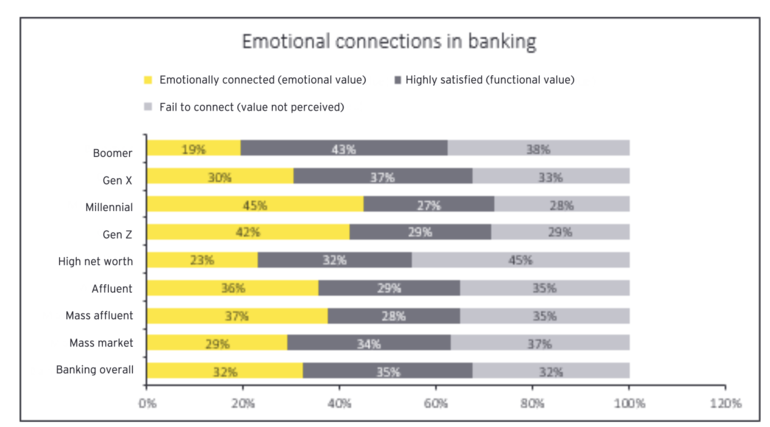
But there is an entirely different tranche of consumers who are at the other end of the spectrum, according to Lele. He said it’s a “significant group.”
“They are not emotionally connected; they fall into the category called Fail to Connect, and when we pivot this into what it means for value creation, there is an absolute correlation and predictive correlation between the level of emotional connection with members and the lifetime value they bring to your institution,” Lele said.
Not surprisingly, people who exhibit better financial behaviors feel more connected to their financial institution, and the opposite also holds true, he said.
The economic shutdown stemming from the coronavirus pandemic is also playing a role, he added.
“Behavioral science predicts people will follow a curve of reaction to the evolving global pandemic This will fundamentally change their relationship with their money and with financial services providers,” Lele said.
A Predictable Path
What the research shows, according to Lele, is that during a crisis people follow a very predictable path. Emotionally connected members view their financial institution as providing more confidence during a crisis and equate their FI to the family’s well-being. As a result, they remain connected.
“During times of crisis members are most vulnerable, and they are also most apt to look elsewhere where they can find an emotional connection,” Lele said. “Now is the time to double down. What are you doing to emotionally connect? It’s not just in the lifecycle, it’s in every interaction the member has with your brand. How does it reinforce the level of connection?
“The industry is in this difficult transition mode,” he continued. “For last 10 years financial institutions spent time, energy and capital on building tools that are for the benefit of the end-member. The pivot we are now seeing is, how does an FI create the capabilities that allow them to become more central to the members’ lifestyle?”
Capturing Share in the New Normal
In the new normal, said Lele, consumers need solutions that integrate financial products, services and experiences organized around their personal needs.
With personal finance, there are six basic needs to which financial institutions seek to respond, he said: Earn money, save money, spend money, invest money, borrow money, and protect money and lives.
“What this really shows is at the intersection of life, needs and financial stability there is no one set of products that get the member all the way there. You need to fulfill a series of purposes the member is trying to fill in their life,” Lele said. “These vertical silos (must) fundamentally shift into something intrinsically more horizontally driven.
“Credit unions are in a unique position to create a partnership ecosystem that is distinctive and helps to reframe the banking value proposition around holistic needs,” he continued. “If you provide them with an easy, platform-based ecosystem, you will capture more of their asset base, but also more mindshare of how they think of you.”